

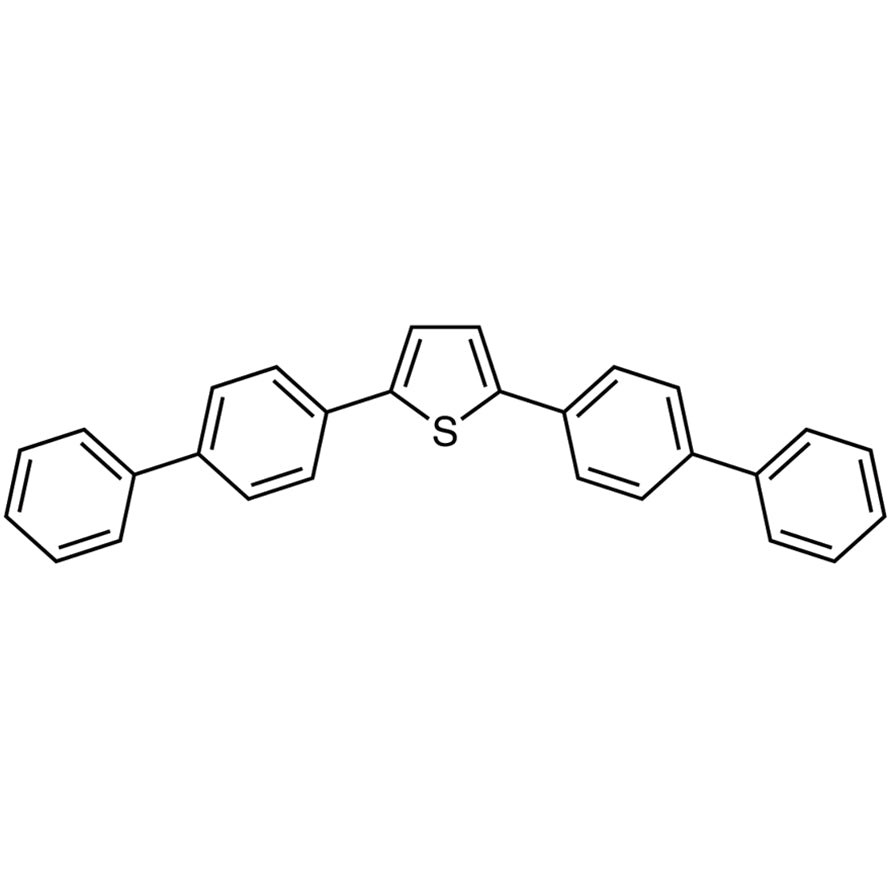
2,5-Bis(4-biphenylyl)thiophene is an organic compound widely used in electronic materials research, particularly in the development of Organic Field-Effect Transistor (OFET) materials. This compound plays a crucial role in laboratories where researchers are exploring advanced semiconductor technologies. Its molecular structure is designed to facilitate efficient electron transport, making it essential for the fabrication of high-performance organic electronic devices. Due to its unique chemical properties, it is frequently utilized in the synthesis of thin films and active layers that are integral to the functioning of organic electronics.
The compound's high electrical conductivity and chemical stability make it a preferred choice for researchers working on next-generation electronic materials. Its molecular architecture, consisting of two biphenyl rings connected via a thiophene group, provides both structural stability and flexibility, enabling it to perform well in various electronic applications. These characteristics ensure that it remains a reliable material for use in both academic and industrial research settings. Additionally, its compatibility with thin-film deposition techniques enhances its utility in the development of flexible and lightweight electronic components.
In Indonesian laboratories, 2,5-Bis(4-biphenylyl)thiophene is commonly used by researchers in higher education institutions and research organizations. It supports the development of organic electronic devices such as sensors and flexible displays. Its application is particularly relevant in the growing field of organic electronics, where it contributes to the advancement of sustainable and innovative technologies. The compound is a key component in the pursuit of next-generation electronic materials that are both efficient and environmentally friendly.
TCI brochures (PDF)
- Organic Transistor (OFET) Materials 2026-05-07 · p. 10
- Thiophenes 2026-06-29 · p. 7
Related TCI products
- TCI O0576 1781261-95-7 2-Octyl-7-phenyl-benzo[d][1]benzothieno[3,2-b]thiophene [for organic electronics]
- TCI B5551 248-70-4 Benzo[b]benzo[4,5]thieno[2,3-d]thiophene
- TCI T3461 6326-64-3 1,3,5-Tris(4-biphenylyl)benzene
- TCI T3337 1092356-36-9 Tris[4'-(2-thienyl)-4-biphenylyl]amine
- TCI T3054 164724-35-0 N,N,N',N'-Tetrakis(4-biphenylyl)benzidine
- TCI B5312 1215228-57-1 9-(2'-Bromo-4-biphenylyl)carbazole
- Organic Field-Effect Transistor (OFET) Development: This compound is ideal for creating high-performance OFETs due to its excellent electron mobility and structural stability, which are essential for efficient electronic transport.
- Thin-Film Deposition Research: Its compatibility with thin-film fabrication techniques makes it suitable for producing uniform and high-quality organic layers used in electronic devices.
- Organic Semiconductor Material Testing: The compound is frequently used in testing the electrical and chemical properties of organic semiconductors, supporting material characterization studies.
- Flexible Electronic Device Fabrication: Its flexibility and conductivity make it a preferred material for developing flexible and lightweight electronic components.
- Sensor Development: The compound's stability and conductivity are beneficial in the creation of organic sensors that require reliable and consistent performance.
| Brand | TCI |
|---|---|
| CAS number | 56316-86-0 |
| Molecular formula | — |
| Purity | — |
| Category | Materials Science > Electronic Materials > Organic Transistor (OFET) Materials |
| Pack sizes | As per supplier specifications |
| Physical form | Solid |
| Storage | Store in a cool, dry place away from light and moisture |
This compound should be stored in a cool, dry environment, away from direct light and moisture to maintain its chemical integrity. It is recommended to use airtight containers made of materials that are chemically inert, such as glass or high-density polyethylene, to prevent contamination and degradation. In laboratory settings, it is important to handle the compound with appropriate personal protective equipment, including gloves and safety goggles, to ensure safe handling. Due to its organic nature, it should be stored separately from incompatible substances to avoid any potential chemical reactions. Regular monitoring of storage conditions is advised to ensure the material remains stable and suitable for use in research applications.
—
Produk Terkait
-
2-Octyl-7-phenyl-benzo[d][1]benzothieno[3,2-b]thiophene[fororganicelectronics] TCI O0576
Regular price From Rp 5.326.650,00Regular priceRp 3.740.100,00Sale price From Rp 5.326.650,00 -
Benzo[b]benzo[4,5]thieno[2,3-d]thiophene TCI B5551
Regular price From Rp 955.500,00Regular priceRp 683.550,00Sale price From Rp 955.500,00 -
1,3,5-Tris(4-biphenylyl)benzene TCI T3461
Regular price Rp 3.658.200,00Regular priceRp 2.557.800,00Sale price Rp 3.658.200,00 -
Tris[4'-(2-thienyl)-4-biphenylyl]amine TCI T3337
Regular price Rp 5.460.000,00Regular priceRp 3.833.550,00Sale price Rp 5.460.000,00 -
N,N,N',N'-Tetrakis(4-biphenylyl)benzidine TCI T3054
Regular price Rp 2.279.550,00Regular priceRp 1.609.650,00Sale price Rp 2.279.550,00 -
9-(2'-Bromo-4-biphenylyl)carbazole TCI B5312
Regular price From Rp 1.008.000,00Regular priceRp 720.300,00Sale price From Rp 1.008.000,00 -
2-(4-Biphenylyl)indole TCI B5250
Regular price From Rp 3.074.400,00Regular priceRp 2.165.100,00Sale price From Rp 3.074.400,00 -
9-(4-Biphenylyl)carbazole TCI B5128
Regular price From Rp 848.400,00Regular priceRp 609.000,00Sale price From Rp 848.400,00


