

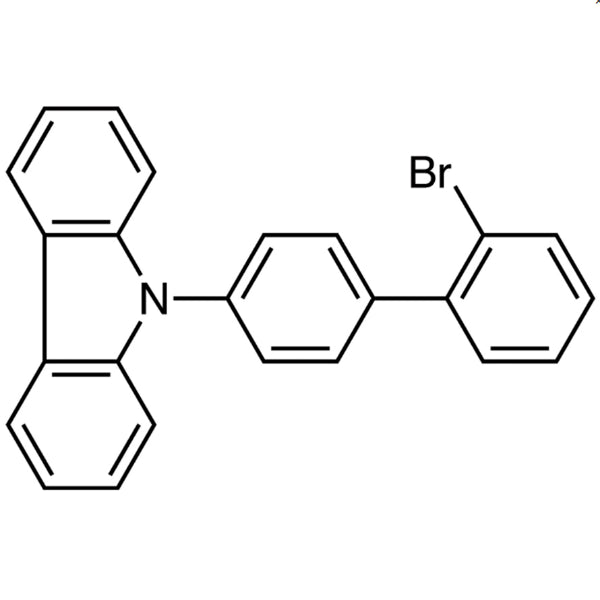
9-(2'-Bromo-4-biphenylyl)carbazole is an organic compound widely used in semiconductor and optoelectronic material research. This compound plays a crucial role in the development of advanced materials with tailored optical and electronic properties. Its complex molecular structure, combining carbazole and biphenyl units, enables unique interactions that are essential for creating high-performance materials. In laboratory settings, it serves as a foundational building block for synthesizing compounds with specific conductivity and light response characteristics.
The compound is favored for its chemical stability and compatibility with various laboratory processing conditions. Its molecular structure allows for functional group modification, making it adaptable for a range of applications. The optical and electronic properties of this material are highly tunable, which makes it a preferred choice for researchers aiming to develop materials with specific performance criteria. Its versatility supports innovation in both academic and industrial research environments.
In Indonesian laboratories, 9-(2'-Bromo-4-biphenylyl)carbazole is commonly used in material science and energy technology research. It is a key component in the development of environmentally friendly and efficient semiconductor materials. Its availability ensures that researchers can conduct experiments requiring specific optical and electronic properties, supporting advancements in optoelectronic devices and solar cell technologies.
TCI brochures (PDF)
- Building Blocks for Organic Semiconductor 2026-03-24 · p. 19
Related TCI products
- TCI B5128 6299-16-7 9-(4-Biphenylyl)carbazole
- TCI B5111 1028648-25-0 9-(4-Biphenylyl)-3-(4-bromophenyl)carbazole
- TCI B5109 212385-73-4 9-(4'-Bromo-4-biphenylyl)carbazole
- TCI B5502 750573-24-1 9,9'-(5-Bromo-1,3-phenylene)bis(9H-carbazole)
- TCI B5471 177775-87-0 9-Benzoyl-3-bromo-9H-carbazole
- TCI B5461 339576-55-5 9-Benzyl-3-bromo-9H-carbazole
- Semiconductor Material Development: This compound is ideal for creating high-conductivity materials used in advanced electronic devices.
- Optoelectronic Device Fabrication: Its optical properties make it suitable for applications in light-emitting and light-detecting components.
- Solar Cell Research: It is used in the development of photovoltaic materials that efficiently convert light into electricity.
- Environmental Material Innovation: Researchers use it to design sustainable and energy-efficient semiconductor materials.
- Academic and Industrial Research: Its versatility supports both fundamental studies and applied research in material science.
| Brand | TCI |
|---|---|
| CAS number | 1215228-57-1 |
| Molecular formula | — |
| Purity | — |
| Category | Materials Science > Material Building Blocks > Small Molecule Semiconductor Building Blocks |
| Pack sizes | As per supplier specifications |
| Physical form | Solid (as per standard product description) |
| Storage | Store in a cool, dry place away from light |
This compound should be stored in a cool, dry environment, away from direct sunlight and sources of heat. It is recommended to use airtight containers to prevent moisture absorption and contamination. Due to its chemical nature, it should be handled with appropriate personal protective equipment, such as gloves and safety goggles. Avoid exposure to incompatible substances to ensure safe storage. Regular inspection of storage conditions is advised to maintain the integrity of the material. Proper labeling and documentation of storage locations are essential for laboratory safety and compliance.
—
Produk Terkait
-
9-(4-Biphenylyl)carbazole TCI B5128
Regular price From Rp 848.400,00Regular priceRp 609.000,00Sale price From Rp 848.400,00 -
9-(4-Biphenylyl)-3-(4-bromophenyl)carbazole TCI B5111
Regular price From Rp 1.192.800,00Regular priceRp 849.450,00Sale price From Rp 1.192.800,00 -
9-(4'-Bromo-4-biphenylyl)carbazole TCI B5109
Regular price From Rp 3.603.600,00Regular priceRp 2.535.750,00Sale price From Rp 3.603.600,00 -
9,9'-(5-Bromo-1,3-phenylene)bis(9H-carbazole) TCI B5502
Regular price From Rp 2.835.000,00Regular priceRp 1.998.150,00Sale price From Rp 2.835.000,00 -
9-Benzoyl-3-bromo-9H-carbazole TCI B5471
Regular price Rp 1.934.100,00Regular priceRp 1.368.150,00Sale price Rp 1.934.100,00 -
9-Benzyl-3-bromo-9H-carbazole TCI B5461
Regular price From Rp 1.563.450,00Regular priceRp 1.108.800,00Sale price From Rp 1.563.450,00 -
9-Benzyl-2-bromo-9H-carbazole TCI B5460
Regular price From Rp 1.856.400,00Regular priceRp 1.313.550,00Sale price From Rp 1.856.400,00 -
3-Bromo-9-(4-bromophenyl)-9H-carbazole TCI B5107
Regular price From Rp 2.623.950,00Regular priceRp 1.850.100,00Sale price From Rp 2.623.950,00


