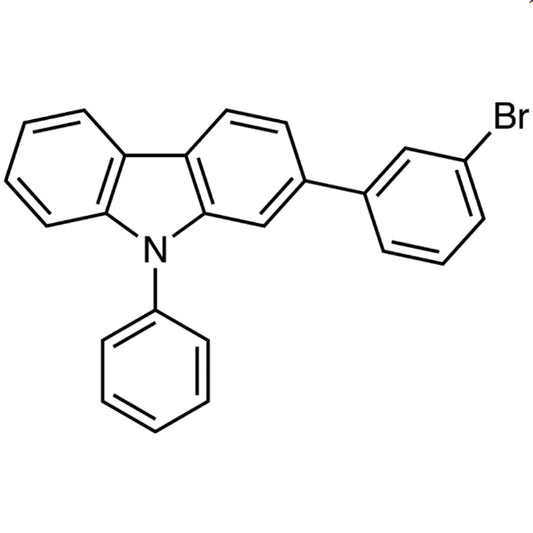
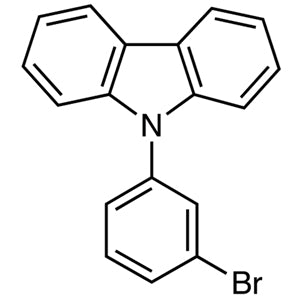
9-(4-Biphenylyl)-3-(4-bromophenyl)carbazole is an organic compound widely used in semiconductor material research. This compound plays a crucial role in the development of carbazole-based materials, which exhibit unique electronic properties. In the laboratory, it serves as a foundational building block for the synthesis of complex molecules used in display technologies and photovoltaic applications. Its chemical stability and controlled reactivity make it a preferred choice for researchers aiming to construct intricate molecular structures.
The compound’s molecular structure consists of a carbazole unit connected to two aromatic rings, providing excellent electronic conductivity and the ability to absorb light within specific spectral ranges. These characteristics make it ideal for optoelectronic applications. Its high chemical stability ensures minimal degradation during storage and use, enhancing its reliability in experimental settings. This stability is particularly important in long-term research projects where consistent performance is essential.
In Indonesian laboratories, this compound is commonly used in semiconductor material development and optoelectronic technology research. It is a key component in studies focused on improving the efficiency of solar cells and organic light-emitting diodes. Its application supports both academic and industrial research initiatives aimed at advancing material science in the region.
TCI brochures (PDF)
- Carbazoles 2025-06-27 · p. 6
- Building Blocks for Organic Semiconductor 2026-03-24 · p. 18
Related TCI products
- TCI B5465 1190100-35-6 3-(2-Bromophenyl)-9-phenyl-9H-carbazole
- TCI B5437 1616607-88-5 2-(2-Bromophenyl)-9-phenyl-9H-carbazole
- TCI B5312 1215228-57-1 9-(2'-Bromo-4-biphenylyl)carbazole
- TCI B5128 6299-16-7 9-(4-Biphenylyl)carbazole
- TCI B5109 212385-73-4 9-(4'-Bromo-4-biphenylyl)carbazole
- TCI B5108 1365118-41-7 2-(3-Bromophenyl)-9-phenyl-9H-carbazole
- Semiconductor material synthesis due to its unique electronic properties and structural versatility.
- Organic light-emitting diode (OLED) development for its light absorption and conductivity characteristics.
- Photovoltaic research as a building block for high-performance solar cell materials.
- Molecular structure analysis in material science for understanding electronic behavior and stability.
- Optoelectronic device prototyping due to its ability to conduct electricity and interact with light.
| Brand | TCI |
|---|---|
| CAS number | 1028648-25-0 |
| Molecular formula | — |
| Purity | — |
| Category | Materials Science > Material Building Blocks > Small Molecule Semiconductor Building Blocks |
| Pack sizes | 25 g |
| Physical form | Solid |
| Storage | Store in a cool, dry place away from light and moisture |
This compound should be stored in a cool, dry environment, away from direct light and moisture to maintain its chemical stability. It is recommended to use airtight containers made of glass or high-density polyethylene to prevent contamination and degradation. Due to its organic nature, it should be handled with appropriate personal protective equipment, including gloves and safety goggles, to ensure laboratory safety. Avoid exposure to heat sources and keep it away from incompatible substances such as strong oxidizing agents. Proper labeling and storage conditions are essential to ensure its integrity and usability in research applications.
—
Produk Terkait
-
3-(2-Bromophenyl)-9-phenyl-9H-carbazole TCI B5465
Regular price From Rp 4.266.150,00Regular priceRp 2.998.800,00Sale price From Rp 4.266.150,00 -
2-(2-Bromophenyl)-9-phenyl-9H-carbazole TCI B5437
Regular price From Rp 1.246.350,00Regular priceRp 887.250,00Sale price From Rp 1.246.350,00 -
9-(2'-Bromo-4-biphenylyl)carbazole TCI B5312
Regular price From Rp 1.008.000,00Regular priceRp 720.300,00Sale price From Rp 1.008.000,00 -
9-(4-Biphenylyl)carbazole TCI B5128
Regular price From Rp 848.400,00Regular priceRp 609.000,00Sale price From Rp 848.400,00 -
9-(4'-Bromo-4-biphenylyl)carbazole TCI B5109
Regular price From Rp 3.603.600,00Regular priceRp 2.535.750,00Sale price From Rp 3.603.600,00 -
2-(3-Bromophenyl)-9-phenyl-9H-carbazole TCI B5108
Regular price From Rp 1.272.600,00Regular priceRp 905.100,00Sale price From Rp 1.272.600,00 -
3-Bromo-9-(4-bromophenyl)-9H-carbazole TCI B5107
Regular price From Rp 2.623.950,00Regular priceRp 1.850.100,00Sale price From Rp 2.623.950,00 -
9-(3-Bromophenyl)carbazole TCI B4427
Regular price From Rp 1.351.350,00Regular priceRp 960.750,00Sale price From Rp 1.351.350,00