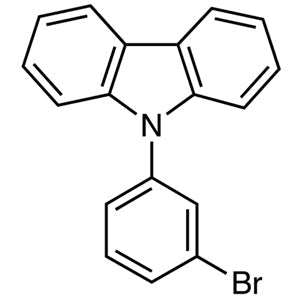
9-(3-Bromophenyl)carbazole is a chemical compound classified under heterocyclic building blocks, commonly used in organic chemistry laboratories. It serves as a foundational material for the synthesis of complex molecules with carbazole and bromo functional groups. This compound plays a crucial role in the development of new chemical structures, particularly in research involving bioactive compounds. Its versatility makes it a valuable resource for scientists aiming to explore molecular reactivity and functional group transformations.
The compound's unique structure, featuring a bromo group on an aromatic ring, contributes to its reactivity and polarity. These characteristics make it ideal for a variety of chemical reactions, including substitution, addition, and nucleophilic reactions. Its stability under controlled conditions ensures reliable performance in laboratory settings. The presence of the bromo group also enhances its compatibility with various reagents, enabling researchers to design and execute complex synthetic pathways effectively.
In Indonesian laboratories, 9-(3-Bromophenyl)carbazole is widely utilized in organic chemistry research, drug development, and biological activity studies. It is a preferred choice for institutions and academic centers conducting experiments that require precise molecular structures. Its availability in solid form and ease of handling further support its popularity among researchers working on advanced chemical synthesis projects.
TCI brochures (PDF)
- Carbazoles 2025-06-27 · p. 5
- Building Blocks for Organic Semiconductor 2026-03-24 · p. 18
Related TCI products
- TCI B5437 1616607-88-5 2-(2-Bromophenyl)-9-phenyl-9H-carbazole
- TCI B5107 1226860-66-7 3-Bromo-9-(4-bromophenyl)-9H-carbazole
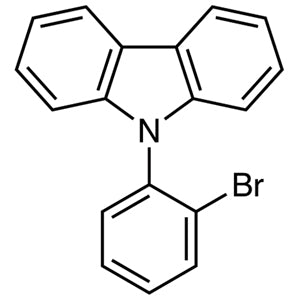
- TCI B4109 902518-11-0 9-(2-Bromophenyl)-9H-carbazole
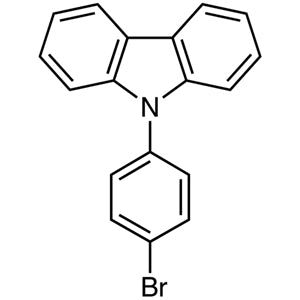
- TCI B3554 57102-42-8 9-(4-Bromophenyl)carbazole
- TCI D4563 73087-83-9 3,6-Dibromo-9-(4-bromophenyl)carbazole
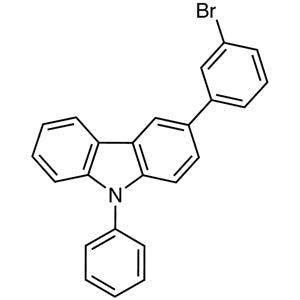
- TCI B5869 854952-59-3 3-(3-Bromophenyl)-9-phenyl-9H-carbazole
- Organic synthesis research benefits from this compound due to its structural versatility and reactivity, enabling the creation of complex molecules with desired functionalities.
- Drug development projects utilize it as a building block for synthesizing bioactive compounds, particularly those with antitumor or antioxidant properties.
- Biological activity studies rely on its ability to interact with various reagents, allowing researchers to investigate molecular interactions and potential therapeutic applications.
- Molecular structure analysis is enhanced by its stable chemical properties, making it suitable for spectroscopic and chromatographic studies.
- Academic research in chemistry and pharmacology frequently incorporates it to explore new synthetic methodologies and chemical transformations.
| Brand | TCI |
|---|---|
| CAS number | 185112-61-2 |
| Molecular formula | — |
| Purity | — |
| Category | Chemistry > Building Blocks > Heterocyclic Building Blocks |
| Pack sizes | Available in standard laboratory quantities |
| Physical form | Solid |
| Storage | Store in a cool, dry place away from light and moisture |
This compound should be stored in a cool, dry environment, away from direct light and moisture to maintain its chemical integrity. It is recommended to use airtight containers to prevent exposure to air and potential degradation. Due to its reactivity, it should be handled with care, using appropriate personal protective equipment such as gloves and safety goggles. In laboratory settings, it is important to ensure proper ventilation to minimize inhalation risks. Storage conditions should be consistent to avoid temperature fluctuations that may affect its stability. Regular inspection of storage containers is advised to ensure they remain sealed and intact.
—
Produk Terkait
-
2-(2-Bromophenyl)-9-phenyl-9H-carbazole TCI B5437
Regular price From Rp 1.246.350,00Regular priceRp 887.250,00Sale price From Rp 1.246.350,00 -
3-Bromo-9-(4-bromophenyl)-9H-carbazole TCI B5107
Regular price From Rp 2.623.950,00Regular priceRp 1.850.100,00Sale price From Rp 2.623.950,00 -
9-(2-Bromophenyl)-9H-carbazole TCI B4109
Regular price From Rp 875.700,00Regular priceRp 627.900,00Sale price From Rp 875.700,00 -
9-(4-Bromophenyl)carbazole TCI B3554
Regular price From Rp 1.405.950,00Regular priceRp 998.550,00Sale price From Rp 1.405.950,00 -
3,6-Dibromo-9-(4-bromophenyl)carbazole TCI D4563
Regular price From Rp 717.150,00Regular priceRp 1.683.150,00Sale price From Rp 717.150,00Sale -
3-(3-Bromophenyl)-9-phenyl-9H-carbazole TCI B5869
Regular price From Rp 1.431.150,00Regular priceRp 1.016.400,00Sale price From Rp 1.431.150,00 -
9-(4-Bromophenyl)-3,6-di-tert-butylcarbazole TCI B5313
Regular price From Rp 2.969.400,00Regular priceRp 2.091.600,00Sale price From Rp 2.969.400,00 -
3-(4-Bromophenyl)-9-phenylcarbazole TCI B4452
Regular price From Rp 530.250,00Regular priceRp 386.400,00Sale price From Rp 530.250,00