9-(2-Bromophenyl)-9H-carbazole is a chemical compound widely used in organic synthesis reactions within laboratory settings. This heterocyclic building block plays a crucial role in the development of complex molecules with specific biological activities. Its unique structure combines a carbazole core with a bromophenyl group, making it a versatile intermediate in various chemical processes. In research environments, it is often employed as a key component in substitution reactions, coupling reactions, and aromatic reactions that require controlled reactivity and structural stability.
The compound is valued for its chemical stability and reactivity under controlled conditions. It exhibits non-volatile properties, which enhance its usability in long-term storage and repeated experimental applications. Its ability to participate in reactions with specific reagents and catalysts makes it a preferred choice for organic chemists. Additionally, its resistance to degradation under normal laboratory conditions ensures consistent performance across multiple experiments.
In Indonesian laboratories, this compound is commonly used in organic chemistry research, compound development, and biological activity studies. Its role in creating new molecular structures and testing their potential applications makes it an essential tool for researchers. The compound is frequently utilized in academic and industrial settings to advance chemical innovation and scientific discovery.
TCI brochures (PDF)
- Carbazoles 2025-06-27 · p. 5
- Building Blocks for Organic Semiconductor 2026-03-24 · p. 18
Related TCI products
- TCI B5437 1616607-88-5 2-(2-Bromophenyl)-9-phenyl-9H-carbazole
- TCI B5107 1226860-66-7 3-Bromo-9-(4-bromophenyl)-9H-carbazole
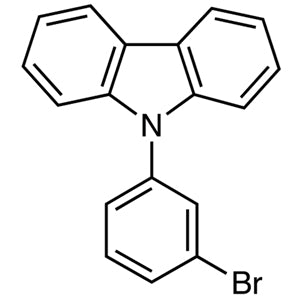
- TCI B4427 185112-61-2 9-(3-Bromophenyl)carbazole
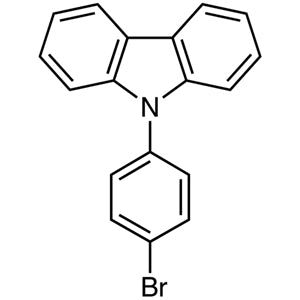
- TCI B3554 57102-42-8 9-(4-Bromophenyl)carbazole
- TCI D4563 73087-83-9 3,6-Dibromo-9-(4-bromophenyl)carbazole
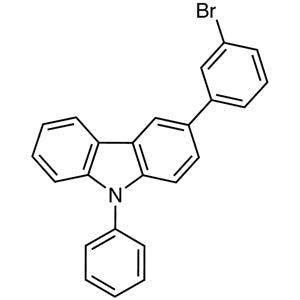
- TCI B5869 854952-59-3 3-(3-Bromophenyl)-9-phenyl-9H-carbazole
- Organic synthesis reactions benefit from this compound's structural versatility and reactivity, enabling the creation of complex molecules with desired biological properties.
- Coupling reactions often utilize this compound due to its ability to form stable intermediates under controlled conditions, enhancing reaction efficiency and yield.
- Aromatic substitution reactions rely on this compound's stability and reactivity, allowing for precise control over reaction pathways and product formation.
- Compound development projects use this material as a key building block to design new molecules with specific functional groups and biological activities.
- Research into biological activity frequently incorporates this compound to test its potential in drug discovery and molecular interaction studies.
| Brand | TCI |
|---|---|
| CAS number | 902518-11-0 |
| Molecular formula | — |
| Purity | — |
| Category | Chemistry > Building Blocks > Heterocyclic Building Blocks |
| Pack sizes | Available in various quantities as per supplier specifications |
| Physical form | Solid |
| Storage | Store in a cool, dry place away from light and moisture |
This compound should be stored in a cool, dry environment, away from direct light and moisture to maintain its chemical stability. It is recommended to use airtight containers to prevent exposure to air and humidity, which could affect its integrity. As a non-volatile compound, it does not require refrigeration but should be kept in a secure location to avoid contamination. In laboratory settings, it is essential to handle this material with care, using appropriate personal protective equipment to ensure safety. Due to its reactivity under specific conditions, it should be stored separately from incompatible substances to prevent unintended chemical interactions. Proper labeling and storage practices are crucial for maintaining the compound's effectiveness and safety in research applications.
—
Produk Terkait
-
2-(2-Bromophenyl)-9-phenyl-9H-carbazole TCI B5437
Regular price From Rp 1.246.350,00Regular priceRp 887.250,00Sale price From Rp 1.246.350,00 -
3-Bromo-9-(4-bromophenyl)-9H-carbazole TCI B5107
Regular price From Rp 2.623.950,00Regular priceRp 1.850.100,00Sale price From Rp 2.623.950,00 -
9-(3-Bromophenyl)carbazole TCI B4427
Regular price From Rp 1.351.350,00Regular priceRp 960.750,00Sale price From Rp 1.351.350,00 -
9-(4-Bromophenyl)carbazole TCI B3554
Regular price From Rp 1.405.950,00Regular priceRp 998.550,00Sale price From Rp 1.405.950,00 -
3,6-Dibromo-9-(4-bromophenyl)carbazole TCI D4563
Regular price From Rp 717.150,00Regular priceRp 1.683.150,00Sale price From Rp 717.150,00Sale -
3-(3-Bromophenyl)-9-phenyl-9H-carbazole TCI B5869
Regular price From Rp 1.431.150,00Regular priceRp 1.016.400,00Sale price From Rp 1.431.150,00 -
9-(4-Bromophenyl)-3,6-di-tert-butylcarbazole TCI B5313
Regular price From Rp 2.969.400,00Regular priceRp 2.091.600,00Sale price From Rp 2.969.400,00 -
3-(4-Bromophenyl)-9-phenylcarbazole TCI B4452
Regular price From Rp 530.250,00Regular priceRp 386.400,00Sale price From Rp 530.250,00