9-(4-Bromophenyl)carbazole is a chemical compound widely used in organic synthesis applications within laboratory settings. As a heterocyclic building block, it plays a crucial role in the development of complex molecular structures. This compound is particularly valuable for its ability to participate in substitution reactions and other synthetic processes that require brominated aromatic substituents. Its versatility makes it an essential component in the toolkit of chemists and researchers working on advanced synthetic pathways.
The compound's chemical stability under controlled conditions and its solubility in organic solvents make it a preferred choice for laboratory use. These properties facilitate efficient synthesis and purification processes, enhancing the reliability of experimental outcomes. Additionally, its structural complexity allows for a wide range of modifications, making it adaptable to various research objectives. The compound's predictable behavior in different reaction environments further supports its use in both academic and industrial research settings.
In Indonesian laboratories, 9-(4-Bromophenyl)carbazole is commonly used in scientific research, especially in the fields of organic chemistry and pharmacology. It is frequently found in studies aimed at developing new drugs, composite materials, and compounds with specific functional properties. Its availability and performance make it a reliable material for researchers seeking to explore synthetic chemistry and drug discovery.
TCI brochures (PDF)
- Carbazoles 2025-06-27 · p. 5
- Building Blocks for Organic Semiconductor 2026-03-24 · p. 18
Related TCI products
- TCI B5437 1616607-88-5 2-(2-Bromophenyl)-9-phenyl-9H-carbazole
- TCI B5107 1226860-66-7 3-Bromo-9-(4-bromophenyl)-9H-carbazole
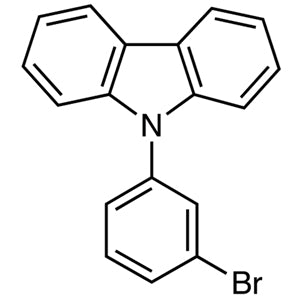
- TCI B4427 185112-61-2 9-(3-Bromophenyl)carbazole
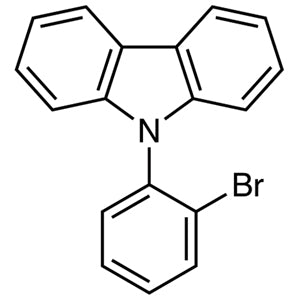
- TCI B4109 902518-11-0 9-(2-Bromophenyl)-9H-carbazole
- TCI D4563 73087-83-9 3,6-Dibromo-9-(4-bromophenyl)carbazole
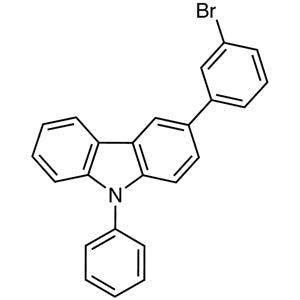
- TCI B5869 854952-59-3 3-(3-Bromophenyl)-9-phenyl-9H-carbazole
- Organic synthesis research benefits from this compound's ability to participate in substitution reactions, enabling the creation of complex molecular structures.
- Pharmaceutical development utilizes its brominated aromatic structure for designing new drug molecules with targeted biological activities.
- Material science applications leverage its chemical stability and solubility for synthesizing advanced composite materials.
- Analytical chemistry experiments use its predictable behavior in different reaction environments for consistent results.
- Academic research in Indonesian universities employs it as a key building block for teaching and experimental studies in synthetic chemistry.
| Brand | TCI |
|---|---|
| CAS number | 57102-42-8 |
| Molecular formula | — |
| Purity | — |
| Category | Chemistry > Building Blocks > Heterocyclic Building Blocks |
| Pack sizes | Available in standard laboratory quantities |
| Physical form | Solid |
| Storage | Store in a cool, dry place away from light |
This compound should be stored in a cool, dry place away from direct light to maintain its chemical stability. It is recommended to use airtight containers made of glass or high-density polyethylene to prevent contamination and moisture exposure. Due to its brominated structure, it is important to handle it with care, using appropriate personal protective equipment such as gloves and safety goggles. It should be kept away from incompatible substances like strong oxidizers. In laboratory settings, proper ventilation should be ensured when handling this material to minimize any potential risks. Regular inspection of storage conditions is advised to ensure the compound remains in optimal condition for use.
—
Produk Terkait
-
2-(2-Bromophenyl)-9-phenyl-9H-carbazole TCI B5437
Regular price From Rp 1.246.350,00Regular priceRp 887.250,00Sale price From Rp 1.246.350,00 -
3-Bromo-9-(4-bromophenyl)-9H-carbazole TCI B5107
Regular price From Rp 2.623.950,00Regular priceRp 1.850.100,00Sale price From Rp 2.623.950,00 -
9-(3-Bromophenyl)carbazole TCI B4427
Regular price From Rp 1.351.350,00Regular priceRp 960.750,00Sale price From Rp 1.351.350,00 -
9-(2-Bromophenyl)-9H-carbazole TCI B4109
Regular price From Rp 875.700,00Regular priceRp 627.900,00Sale price From Rp 875.700,00 -
3,6-Dibromo-9-(4-bromophenyl)carbazole TCI D4563
Regular price From Rp 717.150,00Regular priceRp 1.683.150,00Sale price From Rp 717.150,00Sale -
3-(3-Bromophenyl)-9-phenyl-9H-carbazole TCI B5869
Regular price From Rp 1.431.150,00Regular priceRp 1.016.400,00Sale price From Rp 1.431.150,00 -
9-(4-Bromophenyl)-3,6-di-tert-butylcarbazole TCI B5313
Regular price From Rp 2.969.400,00Regular priceRp 2.091.600,00Sale price From Rp 2.969.400,00 -
3-(4-Bromophenyl)-9-phenylcarbazole TCI B4452
Regular price From Rp 530.250,00Regular priceRp 386.400,00Sale price From Rp 530.250,00