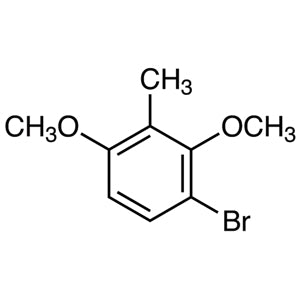
3-Bromo-5-methoxytoluene is a versatile organic compound widely used in laboratory settings for its role in synthetic chemistry. As a building block, it serves as a foundational material for the creation of more complex molecules, particularly in the development of heterocyclic compounds and their derivatives. Its presence in chemical laboratories is essential for researchers and students engaged in organic synthesis, offering a reliable starting point for a variety of chemical transformations. This compound is especially valuable in the exploration of new chemical structures with potential applications in pharmaceuticals and materials science.
The compound's unique structure, featuring both a bromo and methoxy group, contributes to its high reactivity and functional versatility. The bromo substituent makes it suitable for electrophilic and nucleophilic reactions, while the methoxy group provides stability and influences the overall reactivity profile. These properties make it a preferred choice for chemists looking to introduce specific functional groups into larger molecular frameworks. The combination of these substituents allows for a wide range of synthetic possibilities, making it an essential tool in the organic chemist’s toolkit.
In Indonesian laboratories, 3-Bromo-5-methoxytoluene is commonly used by researchers and students in organic chemistry. It plays a key role in the development of new compounds with potential pharmaceutical or material applications. Its availability and chemical properties make it a standard material in both academic and industrial research settings. The compound is frequently used in the synthesis of complex molecules, supporting innovation and discovery in various scientific fields.
- Organic synthesis is a primary application where this compound is used to build complex molecular structures, especially in the development of heterocyclic compounds and their derivatives.
- Pharmaceutical research benefits from its use in the synthesis of compounds with potential therapeutic applications, due to its reactivity and functional group versatility.
- Material science applications leverage its chemical properties to create new materials with specific functional characteristics, such as enhanced reactivity or stability.
- Educational institutions use it in teaching and research to demonstrate synthetic pathways and reaction mechanisms in organic chemistry.
- Industrial chemical processes incorporate it as a key intermediate in the production of specialized chemicals and compounds for various industries.
| Brand | TCI |
|---|---|
| CAS number | 29578-83-4 |
| Molecular formula | — |
| Purity | — |
| Category | Chemistry > Building Blocks > Non-Heterocyclic Building Blocks |
| Pack sizes | Available in standard laboratory quantities as specified by the supplier |
| Physical form | Liquid |
| Storage | Store in a cool, dry place away from light and incompatible substances |
This compound should be stored in a cool, dry environment, away from direct sunlight and sources of heat. It is recommended to use airtight containers made of materials that are chemically inert, such as glass or high-density polyethylene, to prevent contamination and degradation. Due to its reactivity, it should be kept separate from strong oxidizing agents and incompatible substances. In laboratory settings, it is important to handle the compound with appropriate personal protective equipment, including gloves and safety goggles, to ensure safety during handling and use. Proper ventilation should be maintained in the workspace to minimize exposure to vapors. Always follow standard laboratory safety protocols when working with reactive chemicals.
—
Produk Terkait
-
3-Bromo-4-methoxytoluene TCI B3032
Regular price Rp 848.400,00Regular priceRp 593.250,00Sale price Rp 848.400,00 -
5-Bromo-2-methoxytoluene TCI B1910
Regular price From Rp 1.087.800,00Regular priceRp 760.200,00Sale price From Rp 1.087.800,00 -
2-Bromo-5-methoxytoluene TCI B1782
Regular price From Rp 2.068.500,00Regular priceRp 1.445.850,00Sale price From Rp 2.068.500,00 -
2,3,4,5-Tetramethoxytoluene TCI T2626
Regular price From Rp 2.068.500,00Regular priceRp 1.445.850,00Sale price From Rp 2.068.500,00 -
3,4,5-Trimethoxytoluene TCI T1236
Regular price Rp 1.115.100,00Regular priceRp 779.100,00Sale price Rp 1.115.100,00 -
3-Bromo-2,6-dimethoxytoluene TCI B4745
Regular price From Rp 769.650,00Regular priceRp 537.600,00Sale price From Rp 769.650,00 -
3-Methoxytoluene TCI M0151
Regular price Rp 955.500,00Regular priceRp 667.800,00Sale price Rp 955.500,00 -
2-Methoxytoluene TCI M0150
Regular price From Rp 1.326.150,00Regular priceRp 927.150,00Sale price From Rp 1.326.150,00