TCI B3633, with the CAS number 71255-78-2, is a complex chemical compound used in laboratory settings as a polymerization reagent. It belongs to the category of reactive materials, specifically designed for use in polymer synthesis and the creation of organic compounds. This compound is known for its ability to participate in chemical reactions that lead to the formation of stable and strong chemical bonds. Its molecular structure includes a 1,3-benzodioxol-5-yl group and two trichloromethyl groups attached to a 1,3,5-triazine ring, making it highly reactive and versatile in chemical applications.
The compound’s unique molecular structure contributes to its high reactivity and compatibility with various molecules. This makes it a preferred choice for researchers working on precise and complex chemical reactions. Its consistent chemical and physical properties ensure reliable results in laboratory experiments. The stability and predictability of its behavior are essential for scientific research, especially in the development of new materials and organic compounds. Its ability to form strong chemical bonds also supports the synthesis of polymers with specific properties.
In Indonesian laboratories, this compound is widely used in material science and organic chemistry research. It is commonly found in studies related to polymer synthesis, the development of new materials, and the investigation of chemical reactivity. Many research institutions and universities rely on this compound for its reliability and effectiveness in creating complex chemical structures. Its availability and performance make it a valuable resource for scientific innovation and experimentation.
TCI brochures (PDF)
- Photo- and Thermal-Cationic Polymerization Initiators 2024-05-22 · p. 2
- Photo-Acid Generators 2026-05-26 · p. 2
- Polymerization Initiators 2025-09-17 · p. 6
- Biomaterials Research Reagents 2025-02-19 · p. 27
Related TCI products
- TCI M2140 42573-57-9 2-(4-Methoxystyryl)-4,6-bis(trichloromethyl)-1,3,5-triazine
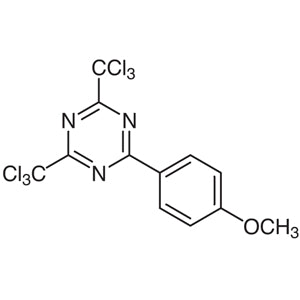
- TCI M1245 3584-23-4 2-(4-Methoxyphenyl)-4,6-bis(trichloromethyl)-1,3,5-triazine
- TCI M1209 156360-76-8 2-[2-(5-Methylfuran-2-yl)vinyl]-4,6-bis(trichloromethyl)-1,3,5-triazine
- TCI F0362 154880-05-4 2-[2-(Furan-2-yl)vinyl]-4,6-bis(trichloromethyl)-1,3,5-triazine
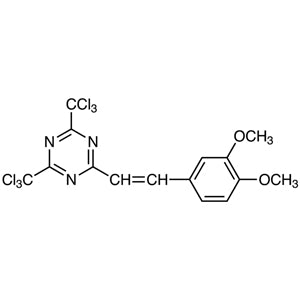
- TCI D2963 42880-07-9 2-(3,4-Dimethoxystyryl)-4,6-bis(trichloromethyl)-1,3,5-triazine
- TCI A0104 121-71-1 3'-Hydroxyacetophenone
- Polymer synthesis research benefits from this compound due to its ability to form stable chemical bonds during polymerization processes.
- Organic chemistry studies utilize it for the creation of complex organic compounds through controlled chemical reactions.
- Material development projects rely on its reactivity to design new materials with specific structural and functional properties.
- Chemical reactivity analysis uses it to study how different molecules interact under various reaction conditions.
- Industrial research applications leverage its stability and predictability for large-scale chemical synthesis and process optimization.
| Brand | TCI |
|---|---|
| CAS number | 71255-78-2 |
| Molecular formula | — |
| Purity | — |
| Category | Materials Science > Polymer/Macromolecule Reagents > Polymerization Reagents |
| Pack sizes | — |
| Physical form | — |
| Storage | Store in a cool, dry place away from light and incompatible substances |
This compound should be stored in a cool, dry environment, away from direct sunlight and sources of heat. It is recommended to keep it in a sealed container to prevent exposure to moisture and air. Due to its reactivity, it should be handled with care, using appropriate personal protective equipment such as gloves and safety goggles. It is important to ensure that it is stored separately from incompatible materials to avoid any potential chemical reactions. Regular monitoring of storage conditions is advised to maintain its stability and effectiveness for laboratory use.
—
Product Categories
Produk Terkait
-
2-(4-Methoxystyryl)-4,6-bis(trichloromethyl)-1,3,5-triazine TCI M2140
Regular price From Rp 1.510.950,00Regular priceRp 1.072.050,00Sale price From Rp 1.510.950,00 -
2-(4-Methoxyphenyl)-4,6-bis(trichloromethyl)-1,3,5-triazine TCI M1245
Regular price From Rp 1.590.750,00Regular priceRp 1.127.700,00Sale price From Rp 1.590.750,00 -
2-[2-(5-Methylfuran-2-yl)vinyl]-4,6-bis(trichloromethyl)-1,3,5-triazine TCI M1209
Regular price Rp 1.881.600,00Regular priceRp 1.331.400,00Sale price Rp 1.881.600,00 -
2-[2-(Furan-2-yl)vinyl]-4,6-bis(trichloromethyl)-1,3,5-triazine TCI F0362
Regular price Rp 1.272.600,00Regular priceRp 905.100,00Sale price Rp 1.272.600,00 -
2-(3,4-Dimethoxystyryl)-4,6-bis(trichloromethyl)-1,3,5-triazine TCI D2963
Regular price Rp 1.510.950,00Regular priceRp 1.072.050,00Sale price Rp 1.510.950,00 -
3'-Hydroxyacetophenone TCI A0104
Regular price From Rp 1.113.000,00Regular priceRp 793.800,00Sale price From Rp 1.113.000,00 -
Anthraquinone TCI A0502
Regular price From Rp 477.750,00Regular priceRp 333.900,00Sale price From Rp 477.750,00 -
SodiumAnthraquinone-2-sulfonateMonohydrate TCI A0508
Regular price From Rp 822.150,00Regular priceRp 590.100,00Sale price From Rp 822.150,00