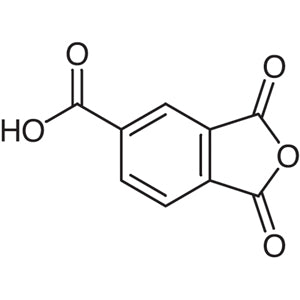
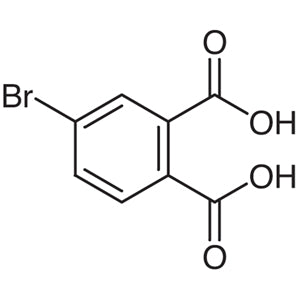
3-Bromophthalic Anhydride is a chemical compound widely used as a building block in various chemical reactions, particularly in the synthesis of heterocyclic compounds and other organic molecules. This compound is derived from phthalic anhydride with the addition of a bromo group, which significantly enhances its reactivity. In laboratory settings, it serves as a key reagent in substitution and covalent reactions due to its unique chemical structure. Its versatility makes it a valuable resource for chemists engaged in synthetic chemistry and molecular modification.
The compound’s reactivity stems from its anhydride structure and the presence of the bromo group, which allows it to participate in high-electron-activating reactions. These properties make it ideal for applications requiring precise chemical transformations. However, it is important to note that 3-Bromophthalic Anhydride is sensitive to moisture and air exposure, which can affect its stability. Despite this, its chemical properties make it a preferred choice for many synthetic processes in research laboratories.
In Indonesian laboratories, 3-Bromophthalic Anhydride is commonly used in organic chemistry research, especially in the pharmaceutical and chemical materials industries. It plays a crucial role in the synthesis of new compounds and molecular modifications. Its application extends to the development of new drugs and advanced materials, making it an essential component in modern chemical research.
Related TCI products
- TCI B1693 86-90-8 4-Bromophthalic Anhydride
- TCI M2757 1240685-26-0 4-(1-Propynyl)phthalic Anhydride
- TCI E1412 129808-00-0 4,4'-(Ethyne-1,2-diyl)diphthalic Anhydride (purified by sublimation)
- TCI E1164 129808-00-0 4,4'-(Ethyne-1,2-diyl)diphthalic Anhydride
- TCI C0046 552-30-7 Trimellitic Anhydride
- TCI B2257 6968-28-1 4-Bromophthalic Acid
- Synthesis of heterocyclic compounds for the development of new pharmaceuticals due to its reactivity and structural versatility.
- Organic synthesis reactions requiring high electron activation, benefiting from its anhydride and bromo group characteristics.
- Molecular modification studies in chemical materials research, where precise chemical transformations are essential.
- Drug development processes involving compound synthesis and structural changes, leveraging its chemical reactivity.
- Research into new compound synthesis, where its stability under controlled conditions supports accurate experimental outcomes.
| Brand | TCI |
|---|---|
| CAS number | 82-73-5 |
| Molecular formula | — |
| Purity | — |
| Category | Chemistry > Building Blocks > Non-Heterocyclic Building Blocks |
| Pack sizes | Available in standard laboratory quantities |
| Physical form | Solid |
| Storage | Store in a dry, cool, and well-ventilated area away from moisture and air exposure |
3-Bromophthalic Anhydride should be stored in a dry, cool, and well-ventilated area to prevent moisture and air exposure, which can compromise its stability. It is recommended to use airtight containers made of materials such as glass or polyethylene to minimize contact with atmospheric moisture. Due to its reactivity, it should be handled in a fume hood to ensure proper ventilation and safety. Avoid direct contact with skin and eyes, and use appropriate personal protective equipment when handling. Proper storage and handling are essential to maintain its chemical integrity and ensure safe use in laboratory environments.
—
Produk Terkait
-
4-BromophthalicAnhydride TCI B1693
Regular price From Rp 2.386.650,00Regular priceRp 1.668.450,00Sale price From Rp 2.386.650,00 -
4-(1-Propynyl)phthalicAnhydride TCI M2757
Regular price From Rp 2.597.700,00Regular priceRp 1.816.500,00Sale price From Rp 2.597.700,00 -
4,4'-(Ethyne-1,2-diyl)diphthalicAnhydride(purifiedbysublimation) TCI E1412
Regular price From Rp 1.035.300,00Regular priceRp 723.450,00Sale price From Rp 1.035.300,00 -
4,4'-(Ethyne-1,2-diyl)diphthalicAnhydride TCI E1164
Regular price From Rp 1.378.650,00Regular priceRp 963.900,00Sale price From Rp 1.378.650,00 -
TrimelliticAnhydride TCI C0046
Regular price From Rp 505.050,00Regular priceRp 352.800,00Sale price From Rp 505.050,00 -
4-BromophthalicAcid TCI B2257
Regular price From Rp 584.850,00Regular priceRp 408.450,00Sale price From Rp 584.850,00 -
TetrabromophthalicAnhydride(purifiedbysublimation) TCI T3871
Regular price Rp 2.625.000,00Regular priceRp 1.835.400,00Sale price Rp 2.625.000,00 -
N-Bromophthalimide TCI B1697
Regular price From Rp 928.200,00Regular priceRp 664.650,00Sale price From Rp 928.200,00