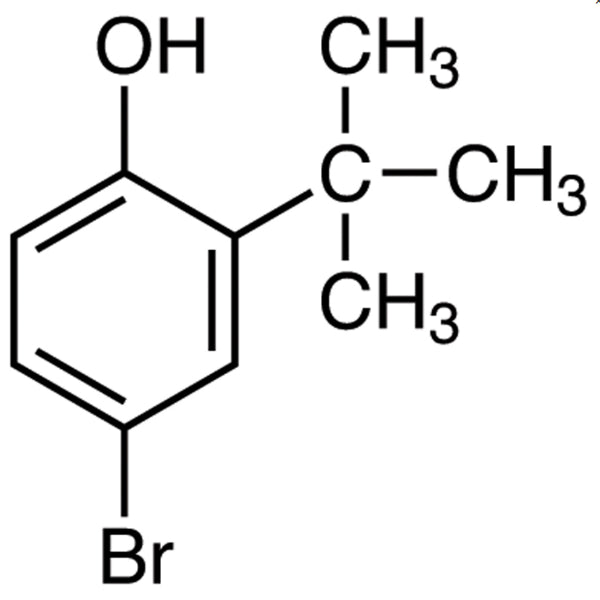
4-Bromo-2-tert-butylphenol is a chemical compound widely used as a building block in the synthesis of complex organic compounds. It serves as a key reagent in various chemical reactions, particularly those involving bromine substitution on phenolic structures. In the laboratory, this compound plays a crucial role in the development of new substances, especially in pharmaceutical and chemical material research. Its reactivity makes it an essential component in electrophilic substitution and oxidation reactions, enabling the creation of a wide range of functional derivatives.
The compound's unique chemical properties stem from its phenolic structure combined with bromo and tert-butyl substituents. The bromo group enhances its reactivity, making it suitable for a variety of synthetic transformations, while the tert-butyl group provides structural stability. These characteristics make it a preferred choice for researchers seeking a versatile and effective reagent. Its ability to participate in multiple reaction types ensures its relevance in both academic and industrial settings.
In Indonesian laboratories, 4-Bromo-2-tert-butylphenol is commonly used by researchers and industry professionals for the development of chemical products. It is particularly valuable in pharmacological studies and the synthesis of bioactive compounds. Its availability and chemical versatility make it a reliable material for ongoing research and innovation in the chemical sciences.
- Pharmaceutical research utilizes this compound for the synthesis of bioactive molecules due to its reactivity and structural versatility.
- Organic synthesis applications benefit from its ability to undergo various substitution reactions, making it ideal for complex molecule construction.
- Material science experiments leverage its chemical properties to develop new polymers and functional materials.
- Analytical chemistry uses it as a reference standard for testing and characterizing other compounds in reaction systems.
- Industrial chemical development incorporates it in the creation of specialty chemicals and intermediates for diverse applications.
| Brand | TCI |
|---|---|
| CAS number | 10323-39-4 |
| Molecular formula | — |
| Purity | — |
| Category | Chemistry > Building Blocks > Non-Heterocyclic Building Blocks |
| Pack sizes | Available in standard laboratory quantities |
| Physical form | Solid, crystalline |
| Storage | Store in a cool, dry place away from light and moisture |
This compound should be stored in a cool, dry place, away from direct light and moisture to maintain its stability and reactivity. It is recommended to use airtight containers made of materials resistant to chemical degradation, such as glass or high-density polyethylene. Due to its reactivity, it should be handled with appropriate personal protective equipment, including gloves and safety goggles. Avoid exposure to heat or incompatible substances to prevent unwanted reactions. In a laboratory setting, it should be kept in a designated chemical storage area with proper ventilation and access control. Regular monitoring of storage conditions ensures the compound remains in optimal condition for use in research and development.
—
Produk Terkait
-
2-Bromo-4-tert-butylphenol TCI B3763
Regular price From Rp 1.644.300,00Regular priceRp 1.149.750,00Sale price From Rp 1.644.300,00 -
4-Bromo-2,6-di-tert-butylphenol TCI B1758
Regular price Rp 6.333.600,00Regular priceRp 4.428.900,00Sale price Rp 6.333.600,00 -
4-sec-Butyl-2,6-di-tert-butylphenol TCI B2774
Regular price From Rp 557.550,00Regular priceRp 405.300,00Sale price From Rp 557.550,00 -
4-Butylphenol TCI B1026
Regular price From Rp 1.723.050,00Regular priceRp 1.220.100,00Sale price From Rp 1.723.050,00 -
2-tert-Butylphenol TCI B0734
Regular price Rp 505.050,00Regular priceRp 368.550,00Sale price Rp 505.050,00 -
4-sec-Butylphenol TCI B0733
Regular price From Rp 980.700,00Regular priceRp 701.400,00Sale price From Rp 980.700,00 -
2-sec-Butylphenol TCI B0732
Regular price From Rp 557.550,00Regular priceRp 405.300,00Sale price From Rp 557.550,00 -
3-tert-Butylphenol TCI B0731
Regular price From Rp 1.988.700,00Regular priceRp 1.405.950,00Sale price From Rp 1.988.700,00