TCI B4373, with the CAS number 502693-09-6, is a complex metal compound featuring ruthenium(II) coordinated with various ligands, including isothiocyanato, 2,2'-bipyridyl-4,4'-dicarboxylato, and 4,4'-dinonyl-2,2'-bipyridyl. This unique structure makes it a valuable tool in laboratory settings, particularly in catalytic reactions and transition metal studies. Its molecular design allows for precise control over reaction pathways, making it essential for advanced chemical research. The compound is widely used in both academic and industrial laboratories for its versatility and effectiveness in a range of chemical processes.
The compound is preferred due to its stable complex structure and catalytic efficiency. It maintains its integrity under various reaction conditions, including oxidative and reductive environments, which is crucial for consistent results. Its thermal stability ensures it remains effective during prolonged experiments and analytical procedures. Additionally, its specific chemical properties enable it to participate in a wide array of chemical transformations, making it a versatile choice for researchers. The compound’s ability to act as a catalyst without significant degradation enhances its reliability in repeated use.
In Indonesian laboratories, this compound is commonly used by chemists, material scientists, and graduate students. It plays a key role in catalysis research, coordination chemistry, and structural characterization studies. Its application extends to the synthesis of organometallic compounds and the investigation of transition metal behavior. The compound’s importance in both teaching and research makes it a standard item in many Indonesian chemical laboratories.
TCI brochures (PDF)
- Bipyridine/Terpyridine Ligands Bearing Phosphonate Ester Moieties 2025-08-07 · p. 1
- Solar Cell Materials 2026-04-21 · p. 12
Related TCI products
- TCI B4372 141460-19-7 Bis(isothiocyanato)bis(2,2'-bipyridyl-4,4'-dicarboxylato)ruthenium(II)
- TCI B3514 207347-46-4 Bis(tetrabutylammonium) Dihydrogen Bis(isothiocyanato)bis(2,2'-bipyridyl-4,4'-dicarboxylato)ruthenium(II)
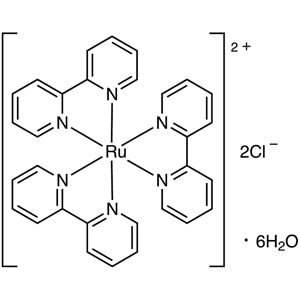
- TCI T1655 50525-27-4 Tris(2,2'-bipyridyl)ruthenium(II) Chloride Hexahydrate
- TCI T3902 304695-79-2 Dichlorotris(1,10-phenanthroline)ruthenium(II) Monohydrate
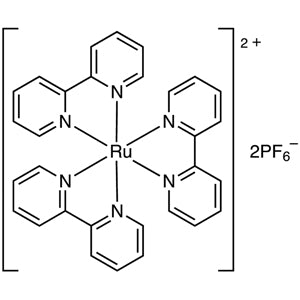
- TCI T3435 60804-74-2 Tris(2,2'-bipyridine)ruthenium(II) Bis(hexafluorophosphate)
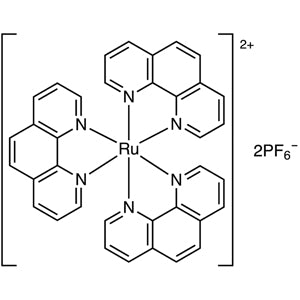
- TCI T3208 60804-75-3 Tris(1,10-phenanthroline)ruthenium(II) Bis(hexafluorophosphate)
- Catalytic Reaction Studies: This compound is ideal for studying reaction mechanisms due to its stable complex structure and catalytic activity.
- Coordination Chemistry Research: Its unique ligand-metal interactions make it suitable for investigating coordination environments and metal-ligand bonding.
- Organometallic Compound Synthesis: The compound’s ability to act as a catalyst supports the synthesis of various organometallic compounds in controlled environments.
- Structural Characterization of Metal Complexes: Its well-defined structure allows for detailed analysis using spectroscopic and analytical techniques.
- Oxidative and Reductive Reaction Testing: The compound’s stability under different redox conditions makes it useful for studying reaction pathways in varied chemical environments.
| Brand | TCI |
|---|---|
| CAS number | 502693-09-6 |
| Molecular formula | — |
| Purity | — |
| Category | Chemistry > Catalysis and Inorganic Chemistry > Transition Elements |
| Pack sizes | Available in various quantities as per standard laboratory supply formats |
| Physical form | Solid, as per standard chemical compound specifications |
| Storage | Store in a cool, dry place away from direct light and moisture |
This compound should be stored in a cool, dry environment, away from direct sunlight and moisture to maintain its stability. It is recommended to use airtight containers to prevent exposure to air and humidity. Due to its chemical nature, it should be handled with appropriate personal protective equipment, including gloves and safety goggles. Avoid contact with skin and eyes, and ensure proper ventilation when working with the compound. It is important to store it separately from incompatible substances to prevent any potential chemical reactions. Regular monitoring of storage conditions ensures the compound remains effective for laboratory use.
—
Product Categories
Produk Terkait
-
Bis(isothiocyanato)bis(2,2'-bipyridyl-4,4'-dicarboxylato)ruthenium(II) TCI B4372
Regular price Rp 3.949.050,00Regular priceRp 2.777.250,00Sale price Rp 3.949.050,00 -
Bis(tetrabutylammonium)DihydrogenBis(isothiocyanato)bis(2,2'-bipyridyl-4,4'-dicarboxylato)ruthenium(II) TCI B3514
Regular price Rp 3.870.300,00Regular priceRp 2.721.600,00Sale price Rp 3.870.300,00 -
Tris(2,2'-bipyridyl)ruthenium(II)ChlorideHexahydrate TCI T1655
Regular price From Rp 2.835.000,00Regular priceRp 1.998.150,00Sale price From Rp 2.835.000,00 -
Dichlorotris(1,10-phenanthroline)ruthenium(II)Monohydrate TCI T3902
Regular price Rp 5.246.850,00Regular priceRp 3.684.450,00Sale price Rp 5.246.850,00 -
Tris(2,2'-bipyridine)ruthenium(II)Bis(hexafluorophosphate) TCI T3435
Regular price Rp 4.133.850,00Regular priceRp 2.906.400,00Sale price Rp 4.133.850,00 -
Tris(1,10-phenanthroline)ruthenium(II)Bis(hexafluorophosphate) TCI T3208
Regular price From Rp 1.881.600,00Regular priceRp 1.331.400,00Sale price From Rp 1.881.600,00 -
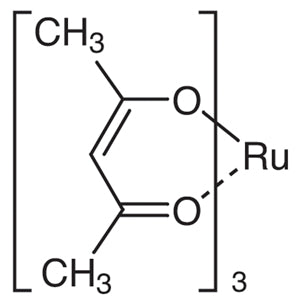
Tris(2,4-pentanedionato)ruthenium(III) TCI T2183
Regular price From Rp 2.411.850,00Regular priceRp 1.702.050,00Sale price From Rp 2.411.850,00 -
[(R)-2,2'-Bis(diphenylphosphino)-1,1'-binaphthyl]ruthenium(II)Dichloride TCI B3067
Regular price Rp 5.485.200,00Regular priceRp 3.851.400,00Sale price Rp 5.485.200,00