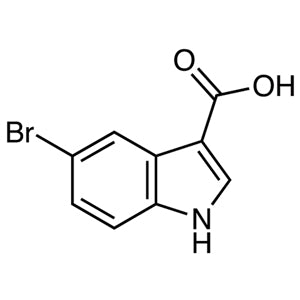
5-Bromoindole-3-carboxylic Acid is a chemical compound belonging to the heterocyclic category, widely used as a building block in the synthesis of complex molecules. Its indole core is a fundamental structure found in many biologically active compounds, including alkaloids and their derivatives. In the laboratory, this compound plays a crucial role in the development of molecules with specific pharmacological activities, such as receptor modulators and enzyme inhibitors. Due to its structural complexity and reactivity, it is a key component in the synthesis of heterocyclic compounds, making it highly valuable in organic chemistry and pharmaceutical research.
This compound is preferred for its solubility in organic solvents, which simplifies processing and chemical reactions. Its chemical stability and reactivity make it suitable for a wide range of synthetic applications. The presence of bromine and carboxylic acid groups enhances its utility in functional group transformations and derivatization reactions. These properties ensure that it remains a reliable and versatile reagent in modern chemical synthesis.
In Indonesian laboratories, 5-Bromoindole-3-carboxylic Acid is commonly used in scientific research, particularly in organic chemistry, pharmacology, and biochemistry. It is employed by research institutions and universities to develop new compounds with potential therapeutic or industrial applications. Its role in the synthesis of heterocyclic compounds makes it an essential tool for advancing chemical and pharmaceutical research in the region.
Related TCI products
- Heterocyclic Compound Synthesis: This compound is ideal for creating complex heterocyclic structures due to its indole core and reactive functional groups.
- Pharmacological Research: It is widely used in drug development to design molecules with receptor-modulating or enzyme-inhibiting properties.
- Organic Chemistry Studies: Its solubility and reactivity make it a preferred building block for synthetic pathways in organic chemistry.
- Biochemical Investigations: It supports the development of compounds that may have biological activity, aiding in biochemical research.
- Industrial Chemical Development: Its versatility allows for the synthesis of compounds with potential industrial applications, such as dyes or agrochemicals.
| Brand | TCI |
|---|---|
| CAS number | 10406-06-1 |
| Molecular formula | — |
| Purity | — |
| Category | Chemistry > Building Blocks > Heterocyclic Building Blocks |
| Pack sizes | 1g, 5g, 25g |
| Physical form | Powder |
| Storage | Store in a cool, dry place away from light |
This compound should be stored in a cool, dry environment, away from direct sunlight and sources of heat. It is recommended to keep it in a sealed container to prevent moisture absorption and maintain its chemical integrity. Due to its reactivity, it should be handled with appropriate personal protective equipment, such as gloves and safety goggles. It is not flammable but may react with strong oxidizing agents. Proper ventilation should be maintained when working with this compound to ensure safe laboratory practices. Always follow standard chemical handling protocols to minimize risks and ensure safe usage in the laboratory setting.
—
Produk Terkait
-
6-Bromoindole-2-carboxylicAcid TCI B4334
Regular price From Rp 2.491.650,00Regular priceRp 1.757.700,00Sale price From Rp 2.491.650,00 -
5-Bromoindole-2-carboxylicAcid TCI B3836
Regular price Rp 2.464.350,00Regular priceRp 1.738.800,00Sale price Rp 2.464.350,00 -
5-Bromoindole-3-carboxaldehyde TCI B4840
Regular price From Rp 769.650,00Regular priceRp 553.350,00Sale price From Rp 769.650,00 -
7-Bromoindole TCI B2873
Regular price From Rp 1.643.250,00Regular priceRp 1.164.450,00Sale price From Rp 1.643.250,00 -
6-Bromoindole-3-carboxaldehyde TCI B2778
Regular price From Rp 1.510.950,00Regular priceRp 1.072.050,00Sale price From Rp 1.510.950,00 -
4-Bromoindole-3-carboxaldehyde TCI B2773
Regular price From Rp 1.696.800,00Regular priceRp 1.202.250,00Sale price From Rp 1.696.800,00 -
4-Bromoindole TCI B1797
Regular price From Rp 1.033.200,00Regular priceRp 738.150,00Sale price From Rp 1.033.200,00 -
6-Bromoindole TCI B1794
Regular price From Rp 1.801.800,00Regular priceRp 1.275.750,00Sale price From Rp 1.801.800,00