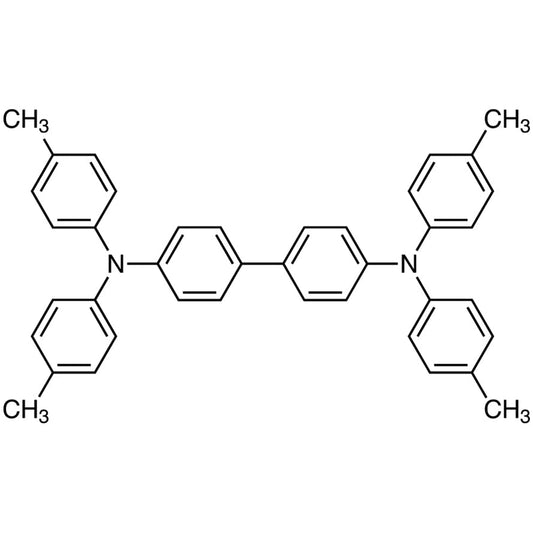
3,3'-Bis[di(p-tolyl)amino]biphenyl is an organic compound widely used in material research for optoelectronic applications. This compound plays a crucial role in the development of organic light-emitting diodes (OLEDs), where it functions as an emissive layer. Its ability to efficiently transport electrons and emit light makes it a key component in the fabrication of OLED devices. In laboratory settings, it is essential for creating high-performance light-emitting materials that are used in various electronic applications.
The compound is favored for its complex molecular structure and its capacity to absorb and emit light within specific wavelength ranges. These properties make it highly effective in producing light with high efficiency and color purity. Additionally, its chemical stability ensures that it maintains its performance under various experimental conditions. This stability is particularly important in laboratory environments where consistent results are required.
In Indonesian laboratories, 3,3'-Bis[di(p-tolyl)amino]biphenyl is commonly used in material science and optoelectronic research. Researchers in educational institutions and research organizations utilize it for the development of OLEDs and related technologies. Its application extends to the study of light-emitting materials, contributing to advancements in display technologies and electronic devices. The compound is also part of research initiatives focused on energy-efficient lighting solutions.
TCI brochures (PDF)
- Organic Light-Emitting Diode (OLED) Materials 2026-08-18 · p. 5
Related TCI products
- TCI T2251 124729-98-2 4,4',4''-Tris[phenyl(m-tolyl)amino]triphenylamine
- TCI B2079 58473-78-2 1,1-Bis[4-[N,N-di(p-tolyl)amino]phenyl]cyclohexane
- TCI T3656 952431-34-4 N,N,N',N'-Tetra([1,1'-biphenyl]-4-yl)[1,1':4',1''-terphenyl]-4,4''-diamine
- TCI B5435 1242056-42-3 N-[[1,1'-Biphenyl]-4-yl]-9,9-dimethyl-N-[4-(9-phenyl-9H-carbazol-3-yl)phenyl]-9H-fluoren-2-amine
- TCI B5675 838862-47-8 4,4'-Bis(3,6-di-tert-butyl-9H-carbazol-9-yl)-1,1'-biphenyl
- TCI T3265 76185-65-4 N,N,N',N'-Tetrakis(p-tolyl)benzidine (purified by sublimation)
- OLED Material Development: This compound is essential for creating high-efficiency light-emitting layers in OLEDs, enhancing the performance of display technologies.
- Optoelectronic Research: It is widely used in studies involving light emission and electron transport, supporting advancements in electronic devices.
- Material Science Studies: Researchers use it to investigate the properties of organic materials, contributing to the understanding of light-emitting compounds.
- Light-Emitting Diode Fabrication: Its ability to emit light with high efficiency makes it a preferred choice in the production of OLED-based lighting solutions.
- Energy-Efficient Lighting Research: The compound is integral to studies aimed at developing sustainable and energy-efficient light sources.
| Brand | TCI |
|---|---|
| CAS number | 161485-60-5 |
| Molecular formula | — |
| Purity | — |
| Category | Materials Science > Electronic Materials > Organic Light-Emitting Diode (OLED) Materials |
| Pack sizes | Available in various quantities as per standard laboratory supply |
| Physical form | Solid |
| Storage | Store in a cool, dry place away from direct light and moisture |
This compound should be stored in a cool, dry environment, away from direct sunlight and moisture to maintain its chemical stability. It is recommended to use airtight containers to prevent exposure to air and humidity. Due to its organic nature, it should be handled in a well-ventilated area to minimize inhalation risks. Proper personal protective equipment, such as gloves and safety goggles, should be worn when handling the material. It is important to keep the compound away from incompatible substances, such as strong oxidizers, to ensure safe storage and usage in the laboratory.
—
Produk Terkait
-
4,4',4''-Tris[phenyl(m-tolyl)amino]triphenylamine TCI T2251
Regular price Rp 1.563.450,00Regular priceRp 1.108.800,00Sale price Rp 1.563.450,00 -
1,1-Bis[4-[N,N-di(p-tolyl)amino]phenyl]cyclohexane TCI B2079
Regular price Rp 3.074.400,00Regular priceRp 2.165.100,00Sale price Rp 3.074.400,00 -
N,N,N',N'-Tetra([1,1'-biphenyl]-4-yl)[1,1':4',1''-terphenyl]-4,4''-diamine TCI T3656
Regular price Rp 4.001.550,00Regular priceRp 2.814.000,00Sale price Rp 4.001.550,00 -
N-[[1,1'-Biphenyl]-4-yl]-9,9-dimethyl-N-[4-(9-phenyl-9H-carbazol-3-yl)phenyl]-9H-fluoren-2-amine TCI B5435
Regular price From Rp 2.121.000,00Regular priceRp 1.498.350,00Sale price From Rp 2.121.000,00 -
4,4'-Bis(3,6-di-tert-butyl-9H-carbazol-9-yl)-1,1'-biphenyl TCI B5675
Regular price Rp 6.042.750,00Regular priceRp 4.240.950,00Sale price Rp 6.042.750,00 -
N,N,N',N'-Tetrakis(p-tolyl)benzidine(purifiedbysublimation) TCI T3265
Regular price Rp 2.147.250,00Regular priceRp 1.517.250,00Sale price Rp 2.147.250,00 -
N,N,N',N'-Tetrakis(p-tolyl)benzidine TCI T2269
Regular price Rp 3.498.600,00Regular priceRp 2.462.250,00Sale price Rp 3.498.600,00 -
2,7-Bis[N-(m-tolyl)anilino]-9,9'-spirobi[9H-fluorene] TCI B4882
Regular price From Rp 1.988.700,00Regular priceRp 1.405.950,00Sale price From Rp 1.988.700,00