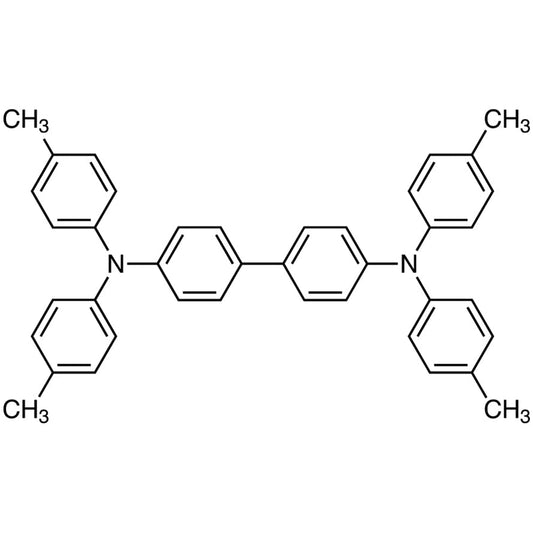
TCI B2079, also known as 1,1-Bis[4-[N,N-di(p-tolyl)amino]phenyl]cyclohexane, is an organic compound widely used in OLED (Organic Light-Emitting Diode) material research. This compound plays a critical role in the development and testing of materials used to manufacture OLED displays, which are now a cornerstone of modern electronic devices. In the laboratory, it serves as a key component in the production of active layers that generate light through electroluminescence. Its presence ensures the efficiency and stability of the light-emitting process, making it indispensable for high-performance OLED applications.
The compound's unique molecular structure allows for precise tuning of optical and electronic properties, making it a preferred choice for researchers aiming to optimize OLED performance. Its ability to emit light with high efficiency and maintain stability under various environmental conditions is a major advantage. These characteristics make it suitable for applications where long-term reliability and consistent performance are essential. The compound's complex structure also enables researchers to tailor its properties for specific applications, enhancing its versatility in material science.
In Indonesian laboratories, this compound is commonly used in advanced material research for information and communication technology applications. It is a key component in the development of next-generation display technologies, including flexible and wearable electronics. Many research institutions and universities in Indonesia utilize this material to explore new possibilities in OLED technology, contributing to the growth of the local scientific community and innovation in the field.
TCI brochures (PDF)
- Hole-injection and Charge-generation Material with Strong Electron-Accepting Ability HAT-CN 6 2024-10-21 · p. 2
- Organic Light-Emitting Diode (OLED) Materials 2026-08-18 · p. 5
Related TCI products
- TCI T2251 124729-98-2 4,4',4''-Tris[phenyl(m-tolyl)amino]triphenylamine
- TCI B4874 161485-60-5 3,3'-Bis[di(p-tolyl)amino]biphenyl
- TCI T3265 76185-65-4 N,N,N',N'-Tetrakis(p-tolyl)benzidine (purified by sublimation)
- TCI T2269 76185-65-4 N,N,N',N'-Tetrakis(p-tolyl)benzidine
- TCI B4882 1033035-83-4 2,7-Bis[N-(m-tolyl)anilino]-9,9'-spirobi[9H-fluorene]
- TCI D4920 143886-11-7 9,9-Dimethyl-2,7-bis[N-(m-tolyl)anilino]fluorene
- OLED Material Development: This compound is essential for creating high-performance OLED materials, as it contributes to the efficiency and stability of light emission in organic devices.
- Active Layer Fabrication: It is used to produce the active layers in OLEDs, where light is generated through electroluminescence, ensuring optimal device performance.
- Research in Flexible Electronics: Due to its compatibility with flexible substrates, it is ideal for developing bendable and wearable electronic devices.
- Stability Testing of Organic Materials: Its inherent stability under various environmental conditions makes it suitable for testing the durability of OLED materials.
- Advanced Display Technology Innovation: It supports the development of next-generation display technologies, including high-resolution and energy-efficient screens.
| Brand | TCI |
|---|---|
| CAS number | 58473-78-2 |
| Molecular formula | — |
| Purity | — |
| Category | Materials Science > Electronic Materials > Organic Light-Emitting Diode (OLED) Materials |
| Pack sizes | Available in various quantities as per standard laboratory supply |
| Physical form | Solid (exact form may vary based on supplier packaging) |
| Storage | Store in a cool, dry place away from direct light and moisture |
This compound should be stored in a cool, dry environment, away from direct sunlight and moisture to maintain its chemical integrity. It is recommended to use airtight containers made of materials that are chemically inert, such as glass or high-density polyethylene, to prevent contamination and degradation. In laboratory settings, it is important to handle the compound with care, using appropriate personal protective equipment to minimize exposure. Proper labeling of storage containers is essential for safety and traceability. Regular monitoring of storage conditions ensures that the material remains stable and suitable for use in OLED research applications.
—
Produk Terkait
-
4,4',4''-Tris[phenyl(m-tolyl)amino]triphenylamine TCI T2251
Regular price Rp 1.563.450,00Regular priceRp 1.108.800,00Sale price Rp 1.563.450,00 -
3,3'-Bis[di(p-tolyl)amino]biphenyl TCI B4874
Regular price From Rp 3.100.650,00Regular priceRp 2.184.000,00Sale price From Rp 3.100.650,00 -
N,N,N',N'-Tetrakis(p-tolyl)benzidine(purifiedbysublimation) TCI T3265
Regular price Rp 2.147.250,00Regular priceRp 1.517.250,00Sale price Rp 2.147.250,00 -
N,N,N',N'-Tetrakis(p-tolyl)benzidine TCI T2269
Regular price Rp 3.498.600,00Regular priceRp 2.462.250,00Sale price Rp 3.498.600,00 -
2,7-Bis[N-(m-tolyl)anilino]-9,9'-spirobi[9H-fluorene] TCI B4882
Regular price From Rp 1.988.700,00Regular priceRp 1.405.950,00Sale price From Rp 1.988.700,00 -
9,9-Dimethyl-2,7-bis[N-(m-tolyl)anilino]fluorene TCI D4920
Regular price From Rp 2.147.250,00Regular priceRp 1.517.250,00Sale price From Rp 2.147.250,00 -
N,N'-Diphenyl-N,N'-bis(p-tolyl)-1,4-phenylenediamine TCI D4905
Regular price From Rp 2.173.500,00Regular priceRp 1.535.100,00Sale price From Rp 2.173.500,00 -
N,N'-Diphenyl-N,N'-di(p-tolyl)benzidine TCI D4834
Regular price From Rp 2.439.150,00Regular priceRp 1.720.950,00Sale price From Rp 2.439.150,00