

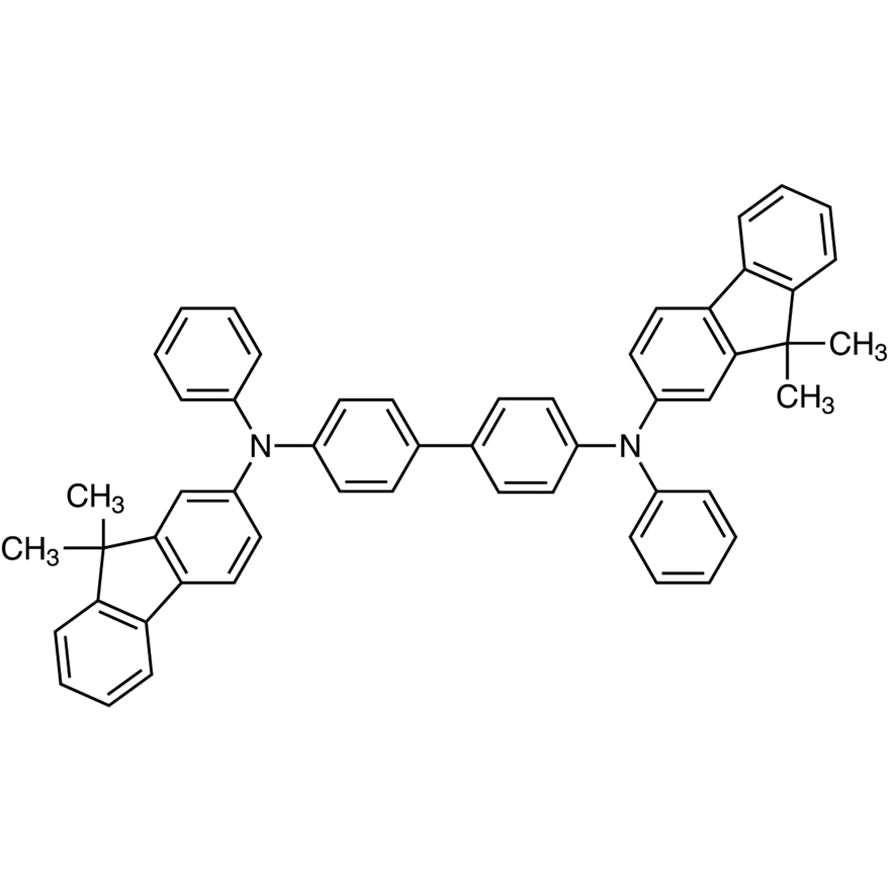
N,N’-Bis(9,9-dimethyl-9H-fluoren-2-yl)-N,N’-diphenylbenzidine is an organic compound widely used in laboratory research for its role in electroluminescent materials. This compound is a key component in the development of Organic Light-Emitting Diodes (OLEDs), which are essential for modern electronic displays and lighting systems. In the laboratory, it serves as a critical material for studying and improving the performance of OLEDs, enabling researchers to explore new applications in optoelectronics and display technologies. Its presence in research settings supports the advancement of high-efficiency and durable lighting solutions.
The compound is valued for its molecular structure, which allows for efficient electron and hole transport, making it ideal for light-emitting applications. Its ability to emit light at specific wavelengths enhances its utility in OLED development. Additionally, the compound exhibits good thermal stability, which is crucial for maintaining performance under various operating conditions. These properties make it a preferred choice for researchers aiming to develop high-performance OLED materials with long-term reliability and consistent performance.
In Indonesian laboratories, this compound is frequently used by researchers in materials science, electronics, and information technology. It plays a vital role in the development of innovative technologies, particularly in the field of electro-optics and screen technologies. Its stability and reliability make it a trusted material for both academic and industrial research projects in Indonesia.
TCI brochures (PDF)
- Organic Light-Emitting Diode (OLED) Materials 2026-08-18 · p. 5
- Fluorenes and Fluorenones 2026-04-15 · p. 5
Related TCI products
- TCI B5435 1242056-42-3 N-[[1,1'-Biphenyl]-4-yl]-9,9-dimethyl-N-[4-(9-phenyl-9H-carbazol-3-yl)phenyl]-9H-fluoren-2-amine
- TCI B5117 209980-53-0 N,N'-Bis[4-(diphenylamino)phenyl]-N,N'-diphenylbenzidine
- TCI D5177 182507-83-1 N,N'-Di(9-phenanthrenyl)-N,N'-diphenylbenzidine
- TCI D5126 123847-85-8 N,N'-Di-1-naphthyl-N,N'-diphenylbenzidine
- TCI D4253 139255-17-7 N,N'-Di-2-naphthyl-N,N'-diphenylbenzidine
- TCI D3970 123847-85-8 N,N'-Di-1-naphthyl-N,N'-diphenylbenzidine (purified by sublimation)
- OLED material development for high-efficiency and stable light-emitting diodes due to its excellent electron and hole transport properties.
- Research in electro-optic technologies where precise light emission and thermal stability are critical for device performance.
- Display technology innovation for next-generation screens requiring high brightness and long operational life.
- Material science studies focused on improving the efficiency and durability of organic semiconductors.
- Electronic component testing for applications in advanced lighting systems and flexible display technologies.
| Brand | TCI |
|---|---|
| CAS number | 361486-60-4 |
| Molecular formula | — |
| Purity | — |
| Category | Materials Science > Electronic Materials > Organic Light-Emitting Diode (OLED) Materials |
| Pack sizes | Available in various quantities as per standard laboratory supply practices |
| Physical form | Solid |
| Storage | Store in a cool, dry place away from direct light and moisture |
This compound should be stored in a cool, dry place, away from direct light and moisture to maintain its chemical integrity. It is recommended to use airtight containers to prevent exposure to air and humidity, which could affect its stability. In laboratory settings, it should be handled with appropriate personal protective equipment, such as gloves and safety goggles, to ensure safety during use and storage. Due to its organic nature, it should be kept in a well-ventilated area to minimize any potential risks. Proper labeling of storage containers is essential for safe handling and to prevent accidental exposure. Regular monitoring of storage conditions ensures the material remains in optimal condition for research applications.
—
Produk Terkait
-
N-[[1,1'-Biphenyl]-4-yl]-9,9-dimethyl-N-[4-(9-phenyl-9H-carbazol-3-yl)phenyl]-9H-fluoren-2-amine TCI B5435
Regular price From Rp 2.121.000,00Regular priceRp 1.498.350,00Sale price From Rp 2.121.000,00 -
N,N'-Bis[4-(diphenylamino)phenyl]-N,N'-diphenylbenzidine TCI B5117
Regular price From Rp 1.749.300,00Regular priceRp 1.239.000,00Sale price From Rp 1.749.300,00 -
N,N'-Di(9-phenanthrenyl)-N,N'-diphenylbenzidine TCI D5177
Regular price From Rp 1.961.400,00Regular priceRp 1.387.050,00Sale price From Rp 1.961.400,00 -
N,N'-Di-1-naphthyl-N,N'-diphenylbenzidine TCI D5126
Regular price From Rp 2.068.500,00Regular priceRp 1.461.600,00Sale price From Rp 2.068.500,00 -
N,N'-Di-2-naphthyl-N,N'-diphenylbenzidine TCI D4253
Regular price Rp 5.830.650,00Regular priceRp 4.092.900,00Sale price Rp 5.830.650,00 -
N,N'-Di-1-naphthyl-N,N'-diphenylbenzidine(purifiedbysublimation) TCI D3970
Regular price Rp 3.232.950,00Regular priceRp 2.276.400,00Sale price Rp 3.232.950,00 -
N,N'-Bis[4-di(m-tolyl)aminophenyl]-N,N'-diphenylbenzidine TCI B5634
Regular price From Rp 2.730.000,00Regular priceRp 1.924.650,00Sale price From Rp 2.730.000,00 -
N,N,N',N'-Tetraphenylbenzidine(purifiedbysublimation) TCI T3266
Regular price From Rp 2.173.500,00Regular priceRp 1.535.100,00Sale price From Rp 2.173.500,00


