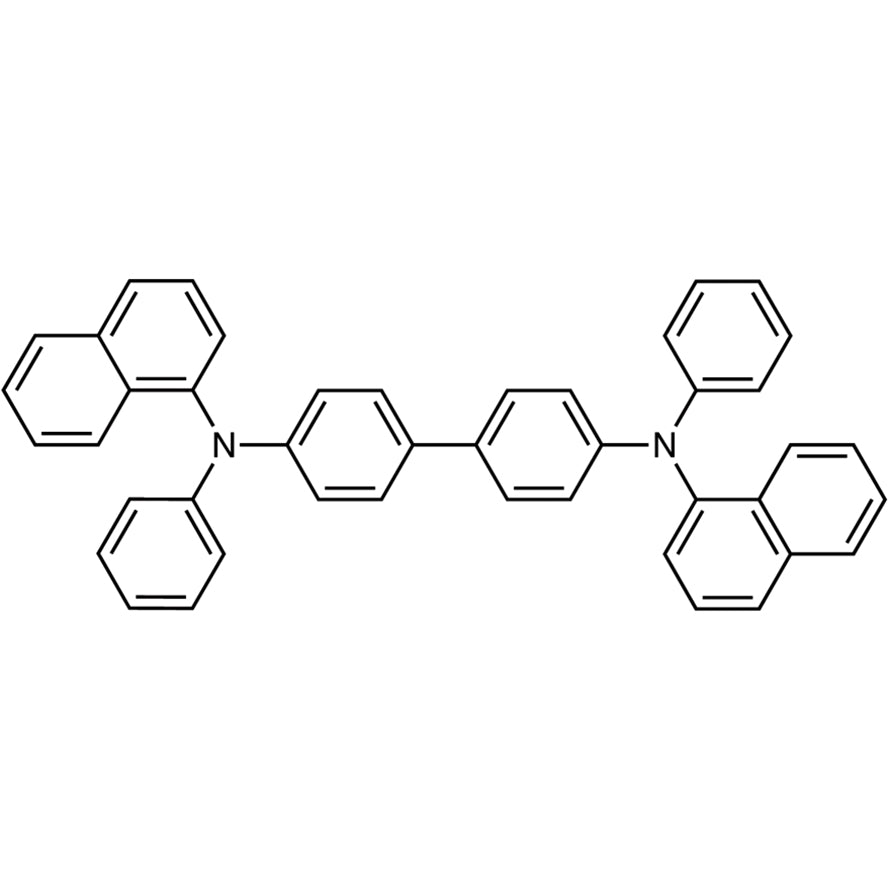
N,N’-Di-1-naphthyl-N,N’-diphenylbenzidine (DNDPB) is an organic compound widely used in the development of materials for organic light-emitting diodes (OLEDs). This material plays a crucial role in laboratory settings where researchers are focused on creating high-efficiency light-emitting devices. Its unique molecular structure enables it to function as an emissive layer in OLEDs, contributing to the production of light with high efficiency and color purity. Due to its importance in the field of optoelectronics, DNDPB is a key component in the study of organic materials for display technologies.
The properties of DNDPB that make it a preferred choice include its stable chemical nature and controlled reactivity, which allow it to be processed under various laboratory conditions. Its molecular structure facilitates effective interaction between electrons and holes, enhancing the efficiency of light emission. This makes DNDPB an ideal candidate for the development of OLEDs with specific color outputs. Additionally, its chemical stability ensures that it maintains its performance over time, making it a reliable material for both research and industrial applications.
In Indonesian laboratories, DNDPB is commonly used in applied research related to OLEDs, LEDs, and organic semiconductors. It is a key material in projects aimed at creating more efficient and environmentally friendly lighting technologies. Researchers in Indonesia rely on DNDPB to develop advanced display technologies and explore new possibilities in the field of optoelectronics. Its availability and reliability make it a valuable resource for scientific innovation in the region.
- OLED development: DNDPB is ideal for creating emissive layers in OLEDs due to its high light emission efficiency and color purity.
- Organic semiconductor research: Its molecular structure allows for effective charge carrier interaction, making it suitable for studying organic semiconductors.
- LED material testing: DNDPB is used in experiments to evaluate the performance of LED materials under various conditions.
- Display technology innovation: It is a key component in developing next-generation display technologies with improved brightness and energy efficiency.
- Environmental lighting research: DNDPB contributes to the development of eco-friendly lighting solutions by enhancing energy efficiency in light-emitting devices.
| Brand | TCI |
|---|---|
| CAS number | 123847-85-8 |
| Molecular formula | — |
| Purity | — |
| Category | Materials Science > Electronic Materials > Organic Light-Emitting Diode (OLED) Materials |
| Pack sizes | Available in various quantities as per standard laboratory supply |
| Physical form | Solid powder |
| Storage | Store in a cool, dry place away from light and moisture |
DNDPB should be stored in a cool, dry environment to maintain its chemical stability and prevent degradation. It is recommended to use airtight containers to protect the material from moisture and air exposure. Due to its organic nature, it should be handled in a well-ventilated area to minimize inhalation risks. Proper personal protective equipment, such as gloves and safety goggles, should be worn during handling. Avoid direct contact with skin and eyes, and ensure that the material is kept away from incompatible substances. Regular monitoring of storage conditions ensures the material remains suitable for laboratory use.
—
Produk Terkait
-
N,N'-Bis[4-di(m-tolyl)aminophenyl]-N,N'-diphenylbenzidine TCI B5634
Regular price From Rp 2.677.500,00Regular price -
N,N-Bis(4'-diphenylamino-4-biphenylyl)amine TCI B5676
Regular price From Rp 1.590.750,00Regular price -
1,4-Bis[4-(N,N-diphenylamino)styryl]benzene TCI B5820
Regular price Rp 2.889.600,00Regular price -
(1R,2R)-1,2-Bis(2,4,6-trimethylphenyl)ethylenediamineDihydrochloride TCI B5914
Regular price Rp 2.199.750,00Regular price -
(1R,2R)-1,2-Bis(4-methylphenyl)ethylenediamineDihydrochloride TCI B6240
Regular price Rp 2.174.550,00Regular price -
(1S,2S)-N~1~,N~2~-Dibenzylcyclohexane-1,2-diamineDihydrochloride TCI B6390
Regular price From Rp 3.605.700,00Regular price -
(1R,2R)-N1,N2-Dibenzylcyclohexane-1,2-diamineDihydrochloride TCI B6393
Regular price From Rp 3.605.700,00Regular price -
1,4-BenzenediethanamineDihydroiodide TCI B6570
Regular price From Rp 2.068.500,00Regular price
![N,N'-Bis[4-di(m-tolyl)aminophenyl]-N,N'-diphenylbenzidine (CAS 199121-98-7) - TCI B5634 - AMI Scientific](http://amiscientific.com/cdn/shop/files/TCI2510B5634.jpg?v=1771058153&width=533)

![1,4-Bis[4-(N,N-diphenylamino)styryl]benzene (CAS 55035-42-2) - TCI B5820 - AMI Scientific](http://amiscientific.com/cdn/shop/files/TCI2510B5820.jpg?v=1771057994&width=533)