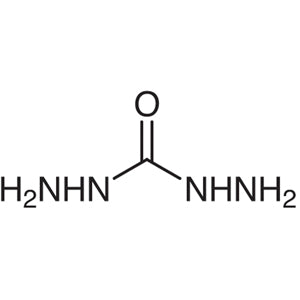
TCI B6401 is Benzene-1,3,5-tricarbohydrazide, CAS number 36997-31-6. It is an aromatic compound with three hydrazide groups (–CONHNH2) at the 1, 3 and 5 positions of a benzene ring. It belongs to the Non-Heterocyclic Building Blocks category used in synthetic chemistry. In the laboratory it serves as a symmetrical trifunctional building block. That makes it a useful branching core: researchers can build larger molecules or materials outward from it, using its three reactive arms.
Several features make this compound a preferred choice. Its hydrazide groups are nucleophilic and are known to react with aldehydes or ketones to form hydrazone linkages. This gives chemists a dependable way to connect the core to other molecular units. The C3 symmetry of the benzene-1,3,5 framework also makes the molecule attractive for designing ordered structures, because all three arms are placed evenly around the central ring. Taken together, these features suit researchers who assemble covalent organic frameworks, branched polymers or hydrogen-bonded supramolecular aggregates. The hydrazide groups can also act as metal-binding sites, so the compound is useful in coordination chemistry. Physical property data for a specific lot can be found on the manufacturer's label and data sheet.
In Indonesia, this material suits organic chemistry, materials chemistry and polymer chemistry laboratories that develop new materials and functional molecules. University research groups, postgraduate students and institutional research laboratories can use it in projects on porous frameworks, branched macromolecules, supramolecular assemblies and metal–ligand systems. Because it is a TCI reagent, laboratories get a recognised brand for building-block chemistry. For research and teaching work, its symmetry and well-defined reactive groups make it a practical starting point for exploratory synthesis.
TCI brochures (PDF)
- Hydrazide Linkers for Covalent Organic Flameworks (COFs) 2026-08-25 · p. 1
- Covalent Organic Framework (COF) Linkers 2026-05-18 · p. 6
Related TCI products
- TCI T4080 5329-29-3 Hydrazinecarbohydrazonohydrazide Hydrochloride
- TCI T4192 1,1',1''-[(1,3,5-Triazine-2,4,6-triyl)tris(benzene-4,1-diyl)]triurea
- TCI C0803 497-18-7 Carbohydrazide
- TCI A1211 5351-17-7 4-Aminobenzohydrazide
- TCI F1252 118688-53-2 1,3,5-Tris(4-formylphenyl)benzene
- TCI B6003 3163-76-6 Benzene-1,3,5-tricarbaldehyde
- Covalent organic framework synthesis: its three hydrazide arms can condense with multi-aldehyde linkers to form hydrazone-linked networks, and its C3 symmetry supports ordered, extended framework structures.
- Branched and dendritic polymer construction: as a symmetrical trifunctional core, it serves as a central branching point from which three polymer or oligomer chains can grow in a controlled arrangement.
- Hydrazone chemistry and dynamic covalent studies: its nucleophilic hydrazide groups react with aldehydes or ketones to form hydrazone bonds, making it a convenient model substrate for studying this linkage.
- Supramolecular assembly research: its hydrazide groups and evenly spaced aromatic framework favour hydrogen-bonding interactions, which helps researchers design and study self-assembled supramolecular aggregates.
- Coordination chemistry exploration: the hydrazide groups can bind metal ions, so the compound is a candidate multidentate ligand for exploring metal complexes and metal–organic assemblies.
| Brand | TCI (product code B6401) |
|---|---|
| CAS number | 36997-31-6 |
| Molecular formula | — |
| Purity | — |
| Category | Chemistry > Building Blocks > Non-Heterocyclic Building Blocks |
| Pack sizes | please refer to the available options on the product listing |
| Physical form | refer to the manufacturer's label and data sheet for lot-specific details |
| Storage | keep tightly closed under the conditions stated on the manufacturer's label |
Store Benzene-1,3,5-tricarbohydrazide in its original, tightly sealed container. Keep it in a cool, dry, well-ventilated area away from direct sunlight, moisture and sources of heat. Follow any specific storage temperature on the manufacturer's label. Keep it separate from strong oxidising agents and from reactive carbonyl compounds, such as aldehydes and ketones, unless they are being used on purpose. If you transfer portions, use clean, dry, chemically compatible containers that are clearly labelled. Handle the material in line with standard laboratory practice: wear gloves, safety glasses and a lab coat. Work in a fume hood or a well-ventilated area, and avoid creating or breathing in dust. Read the manufacturer's Safety Data Sheet before use, and dispose of waste according to local regulations.
—
Product Categories
Produk Terkait
-
HydrazinecarbohydrazonohydrazideHydrochloride TCI T4080
Regular price From Rp 2.677.500,00Regular priceRp 1.887.900,00Sale price From Rp 2.677.500,00 -
TCI T4192 1,1',1''-[(1,3,5-Triazine-2,4,6-triyl)tris(benzene-4,1-diyl)]triurea
Regular price Rp 3.870.300,00Regular priceRp 2.721.600,00Sale price Rp 3.870.300,00 -
Carbohydrazide TCI C0803
Regular price From Rp 955.500,00Regular priceRp 683.550,00Sale price From Rp 955.500,00 -
4-Aminobenzohydrazide TCI A1211
Regular price Rp 2.306.850,00Regular priceRp 1.628.550,00Sale price Rp 2.306.850,00 -
1,3,5-Tris(4-formylphenyl)benzene TCI F1252
Regular price From Rp 2.625.000,00Regular priceRp 1.835.400,00Sale price From Rp 2.625.000,00 -
Benzene-1,3,5-tricarbaldehyde TCI B6003
Regular price From Rp 1.961.400,00Regular priceRp 1.371.300,00Sale price From Rp 1.961.400,00 -
Cyclopropanecarbohydrazide TCI C3879
Regular price From Rp 3.074.400,00Regular priceRp 2.165.100,00Sale price From Rp 3.074.400,00 -
1,2,4,5-Tetrakis(4-carboxyphenyl)benzene TCI T3894
Regular price From Rp 2.837.100,00Regular priceRp 1.983.450,00Sale price From Rp 2.837.100,00