

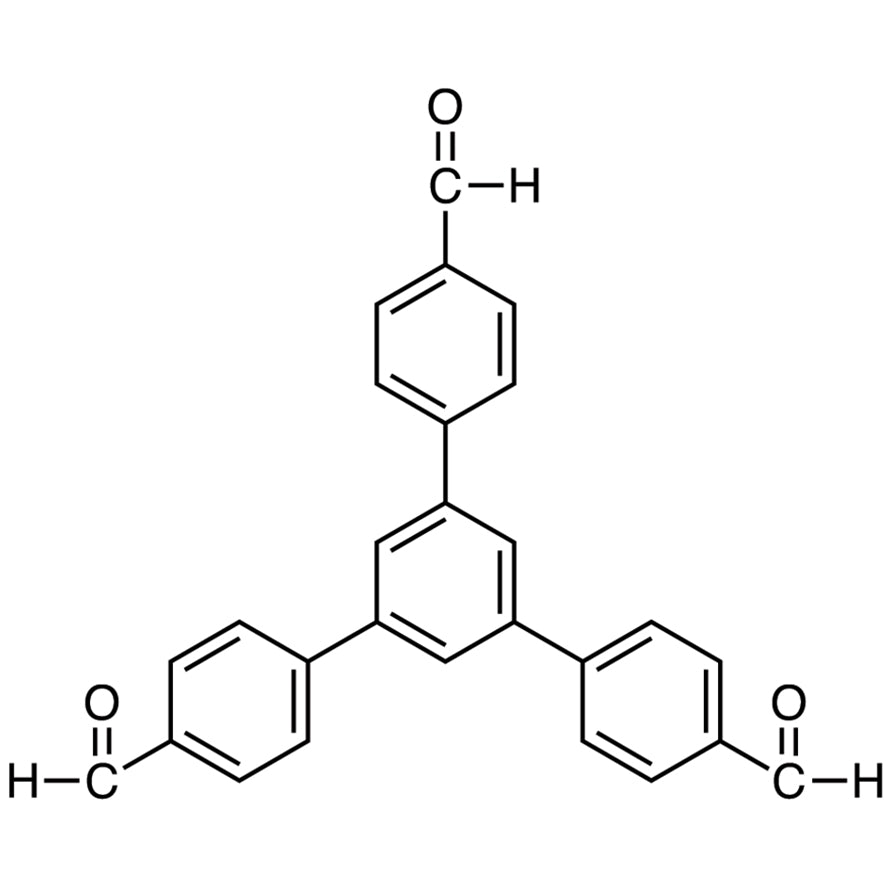
1,3,5-Tris(4-formylphenyl)benzene is a complex organic compound used as a foundational building block in the synthesis of various organic molecules. Its aromatic structure features three formyl groups attached to the carbon atoms at position 4 of the phenyl rings. This compound plays a crucial role in laboratory settings where the construction of complex molecules is required. It is commonly employed in reactions such as condensation and substitution to form more intricate chemical structures. Its versatility makes it a valuable resource for researchers working in diverse fields of organic chemistry.
The compound’s chemical stability and controlled reactivity make it a preferred choice for laboratory applications. Its ability to participate in multiple chemical reactions without rapid degradation ensures consistent results in experimental processes. Additionally, its non-heterocyclic nature allows it to be used in applications requiring a simple yet flexible molecular structure. These characteristics contribute to its popularity among scientists and researchers who need reliable and predictable chemical building blocks.
In Indonesian laboratories, 1,3,5-Tris(4-formylphenyl)benzene is widely utilized in organic chemistry research. It is commonly found in studies related to drug development, industrial chemical production, and the creation of new materials. Its high purity and consistent quality make it a trusted material for both academic and industrial research in the region. The compound’s reliability and adaptability have made it an essential component in the chemical supply chain of Indonesian scientific institutions.
TCI brochures (PDF)
- Covalent Organic Framework (COF) Linkers 2026-05-18 · p. 5
- Building Blocks for Organic Semiconductor 2026-03-24 · p. 7
Related TCI products
- Organic Synthesis: This compound is ideal for constructing complex organic molecules due to its aromatic structure and multiple reactive formyl groups.
- Drug Development: It serves as a key intermediate in the synthesis of pharmaceutical compounds, supporting research into new therapeutic agents.
- Industrial Chemistry: Its use in industrial chemical production allows for the development of specialized materials and chemical products.
- Material Science Research: The compound's flexibility and stability make it suitable for creating new materials with tailored properties.
- Academic Research: It is frequently used in university and research institute settings for teaching and experimental studies in organic chemistry.
| Brand | TCI |
|---|---|
| CAS number | 118688-53-2 |
| Molecular formula | — |
| Purity | — |
| Category | Chemistry > Building Blocks > Non-Heterocyclic Building Blocks |
| Pack sizes | Available in various quantities as per standard laboratory supply formats |
| Physical form | Solid |
| Storage | Store in a cool, dry place away from direct sunlight and moisture |
This compound should be stored in a cool, dry environment to maintain its chemical stability and prevent degradation. It is recommended to use airtight containers to protect it from moisture and air exposure. Due to its chemical nature, it should be handled with care in a well-ventilated laboratory setting. Avoid direct contact with skin and eyes, and ensure proper personal protective equipment is worn when handling. The compound is non-hazardous under normal storage conditions but should be kept away from incompatible materials. Regular monitoring of storage conditions ensures the compound remains in optimal condition for use in laboratory applications.
—
Product Categories
- Material Building BlocksCovalent Organic Frameworks (COFs) LinkersAldehyde Linkers [Covalent Organic Frameworks (COFs) Linkers]
- Material Building BlocksSmall Molecule Semiconductor Building BlocksTriphenylbenzenes [Small Molecule Semiconductor Building Blocks]
- Polymer/Macromolecule ReagentsCovalent Organic Frameworks (COFs) LinkersAldehyde Linkers [Covalent Organic Frameworks (COFs) Linkers]
- Polymer/Macromolecule ReagentsDendrimer Building Blocks
Produk Terkait
-
Tris(4-formylphenyl)amine TCI T2310
Regular price Rp 2.147.250,00Regular priceRp 1.517.250,00Sale price Rp 2.147.250,00 -
1,3,5-Tris(4-carboxyphenyl)benzene TCI T2647
Regular price From Rp 3.683.400,00Regular priceRp 2.575.650,00Sale price From Rp 3.683.400,00 -
Benzene-1,3,5-tricarbaldehyde TCI B6003
Regular price From Rp 1.961.400,00Regular priceRp 1.371.300,00Sale price From Rp 1.961.400,00 -
Bis(4-formylphenyl)phenylamine TCI B2843
Regular price Rp 5.114.550,00Regular priceRp 3.592.050,00Sale price Rp 5.114.550,00 -
Bis(4-formylphenyl)Ether TCI B5099
Regular price From Rp 2.677.500,00Regular priceRp 1.872.150,00Sale price From Rp 2.677.500,00 -
Bis(2-formylphenyl)Ether TCI B1646
Regular price From Rp 2.094.750,00Regular priceRp 1.464.750,00Sale price From Rp 2.094.750,00 -
2-Ethoxy-4-formylphenylAcetate TCI E1415
Regular price From Rp 769.650,00Regular priceRp 537.600,00Sale price From Rp 769.650,00 -
TCI T4192 1,1',1''-[(1,3,5-Triazine-2,4,6-triyl)tris(benzene-4,1-diyl)]triurea
Regular price Rp 3.870.300,00Regular priceRp 2.721.600,00Sale price Rp 3.870.300,00




![1,1',1''-[(1,3,5-Triazine-2,4,6-triyl)tris(benzene-4,1-diyl)]triurea - AMI Scientific](http://amiscientific.com/cdn/shop/files/TCI2510T4192.jpg?v=1769181367&width=533)