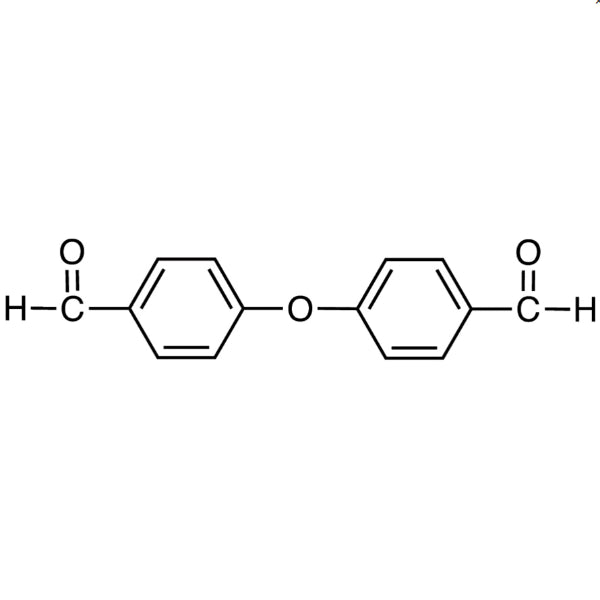
Bis(4-formylphenyl) Ether is a chemical compound widely used in organic reactions to construct complex molecular structures. As a building block in chemistry, it serves as a versatile intermediate that can be modified through various chemical reactions to create compounds with specific functionalities. This compound is particularly valuable in the synthesis of heterocyclic and aromatic compounds, which have broad applications in pharmaceutical and organic chemistry research. Its ability to participate in multiple chemical transformations makes it an essential tool for researchers aiming to develop new materials or drugs.
The compound exhibits a stable molecular structure and moderate reactivity, which allows it to undergo substitution reactions and other chemical processes effectively. These properties make it a preferred choice for laboratory use, as it offers reliable performance in a variety of synthetic pathways. Its chemical stability ensures that it remains effective even under different reaction conditions, making it a dependable reagent for both academic and industrial research settings.
In Indonesian laboratories, Bis(4-formylphenyl) Ether is commonly used in organic chemistry research, especially in the synthesis of compounds requiring aromatic structures and specific functional groups. It is a key component in projects focused on drug development, material science, and chemical innovation. Its availability in solid form and ease of handling further enhance its utility for researchers working in diverse chemical applications.
Related TCI products
- Organic synthesis projects benefit from Bis(4-formylphenyl) Ether due to its role as a versatile building block in creating complex molecular structures.
- Pharmaceutical research utilizes this compound for the development of new drugs, as it can be modified to produce compounds with specific pharmacological properties.
- Aromatic compound synthesis relies on this reagent for constructing rings and functional groups essential in many bioactive molecules.
- Material science experiments use it to develop new polymers and functional materials through chemical modifications.
- Academic research in chemical engineering incorporates this compound to explore new synthetic methodologies and reaction mechanisms.
| Brand | TCI |
|---|---|
| CAS number | 2215-76-1 |
| Molecular formula | — |
| Purity | — |
| Category | Chemistry > Building Blocks > Non-Heterocyclic Building Blocks |
| Pack sizes | Available in various quantities as per standard laboratory supply |
| Physical form | Solid |
| Storage | Store in a cool, dry place away from direct sunlight |
Bis(4-formylphenyl) Ether should be stored in a cool, dry environment to maintain its chemical stability and prevent degradation. It is recommended to keep the compound in a sealed container to avoid exposure to moisture and air, which may affect its reactivity. Suitable storage conditions include a controlled temperature range, typically between 15°C and 25°C, to ensure long-term usability. Laboratory personnel should handle the compound with care, using appropriate personal protective equipment such as gloves and safety goggles. Proper labeling and storage in a designated chemical cabinet are essential to ensure safe handling and prevent accidental exposure. Always follow standard laboratory safety protocols when working with this compound to maintain a secure research environment.
—
Produk Terkait
-
Bis(2-formylphenyl)Ether TCI B1646
Regular price From Rp 2.094.750,00Regular priceRp 1.464.750,00Sale price From Rp 2.094.750,00 -
Tris(4-formylphenyl)amine TCI T2310
Regular price Rp 2.147.250,00Regular priceRp 1.517.250,00Sale price Rp 2.147.250,00 -
Bis(4-formylphenyl)phenylamine TCI B2843
Regular price Rp 5.114.550,00Regular priceRp 3.592.050,00Sale price Rp 5.114.550,00 -
1,3,5-Tris(4-formylphenyl)benzene TCI F1252
Regular price From Rp 2.625.000,00Regular priceRp 1.835.400,00Sale price From Rp 2.625.000,00 -
2-Ethoxy-4-formylphenylAcetate TCI E1415
Regular price From Rp 769.650,00Regular priceRp 537.600,00Sale price From Rp 769.650,00 -
BenzoinIsopropylEther TCI B0942
Regular price From Rp 557.550,00Regular priceRp 405.300,00Sale price From Rp 557.550,00 -
EthyleneGlycolMonobutylEtherAcetate TCI B0700
Regular price From Rp 452.550,00Regular priceRp 316.050,00Sale price From Rp 452.550,00 -
PropyleneGlycol1-MonomethylEther2-Acetate TCI P1171
Regular price Rp 610.050,00Regular priceRp 426.300,00Sale price Rp 610.050,00