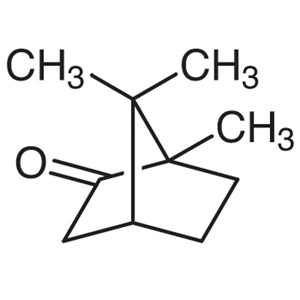
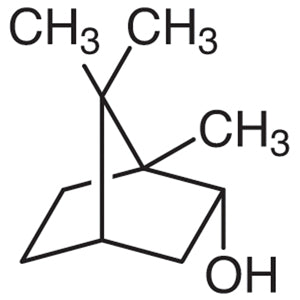
(1R)-Camphor Oxime from TCI is the oxime derivative of (1R)-camphor, a naturally occurring bicyclic compound that has long been valued as an inexpensive and readily available source of chirality. The oxime group forms when the carbonyl group of camphor reacts with hydroxylamine. This functional group opens many routes to further transformations while the rigid bornane skeleton stays intact. In synthetic laboratories, the compound serves as a chiral building block for optically active molecules, chiral ligands, and auxiliaries used in asymmetric synthesis.
Researchers choose this material for two combined advantages: a defined absolute configuration and a rigid carbon framework. Because the bicyclic structure is rigid, the steric environment around the reaction centre is predictable, which makes the compound very useful for controlling stereoselectivity. The oxime group can be reduced to a primary amine, can undergo Beckmann rearrangement or fragmentation, or can act as a coordination site for metals. This versatility means a single starting material can give many different chiral derivatives without time-consuming resolution of racemates.
In Indonesia, this material is relevant to chemistry research groups at universities and research institutions working on asymmetric synthesis, natural product chemistry, and the development of chiral ligands and catalysts. Graduate students and synthetic chemists can use it as a dependable chiral starting point for multi-step synthesis projects and methodology studies. It also suits teaching laboratories that show how a natural chiral pool compound can be turned into useful stereodefined intermediates for modern organic synthesis.
TCI brochures (PDF)
- Terpenes 2025-09-22 · p. 5
- Chiral Building Blocks 2025-04-14 · p. 12
- Synthesis of chiral primary amines: the oxime group can be reduced to an amine on the rigid bornane skeleton, giving stereodefined amines for further derivatization and ligand construction.
- Preparation of chiral ligands for metal catalysis: the oxime can act as a metal coordination site, and the rigid camphor framework gives a predictable steric environment for asymmetric catalysis research.
- Development of chiral auxiliaries: its defined absolute configuration and rigid bicyclic structure help researchers control stereoselectivity in reactions where predictable facial selectivity is essential.
- Beckmann rearrangement and fragmentation studies: the oxime group undergoes these transformations, so it is useful for accessing new chiral nitrogen-containing scaffolds and for studying reaction mechanisms in teaching and research laboratories.
- Chiral pool synthesis of optically active molecules: as a derivative of naturally abundant camphor, it gives an economical entry point to many chiral derivatives without the need for racemate resolution.
| Brand | TCI |
|---|---|
| CAS number | 2792-42-9 |
| Molecular formula | — |
| Purity | — |
| Category | Chemistry > Asymmetric Synthesis > Chiral Building Blocks |
| Pack sizes | standard TCI pack sizes; please contact AMI Scientific for available options |
| Physical form | — |
| Storage | keep in a tightly closed container in a cool, dry place; refer to the TCI label and Safety Data Sheet |
- Product code: C0013
Store (1R)-Camphor Oxime in its original, tightly closed container in a cool, dry, well-ventilated area, away from heat sources, direct sunlight, and strong oxidizing agents. Keep the container closed when not in use to protect the material from moisture and contamination. Handle the compound in a fume hood or a well-ventilated workspace and wear suitable personal protective equipment, including safety glasses, gloves, and a laboratory coat. Avoid creating dust or inhaling it, and avoid contact with skin and eyes. Always follow the TCI Safety Data Sheet for specific hazard information, storage requirements, and disposal instructions under your institution's chemical waste procedures.
—
Produk Terkait
-
(-)-Camphor TCI C1251
Regular price Rp 2.677.500,00Regular priceRp 1.887.900,00Sale price Rp 2.677.500,00 -
(+)-Camphor TCI C0010
Regular price From Rp 530.250,00Regular priceRp 386.400,00Sale price From Rp 530.250,00 -
3-(4-Methylbenzylidene)camphor TCI M3357
Regular price Rp 1.431.150,00Regular priceRp 1.000.650,00Sale price Rp 1.431.150,00 -
(+/-)-Camphor TCI C0011
Regular price From Rp 530.250,00Regular priceRp 386.400,00Sale price From Rp 530.250,00 -
(-)-Verbenone TCI V0072
Regular price Rp 1.405.950,00Regular priceRp 998.550,00Sale price Rp 1.405.950,00 -
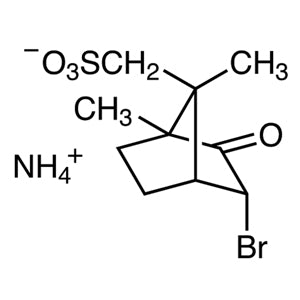
(-)-3-Bromocamphor-8-sulfonicAcidAmmoniumSalt TCI B4412
Regular price Rp 1.220.100,00Regular priceRp 868.350,00Sale price Rp 1.220.100,00 -
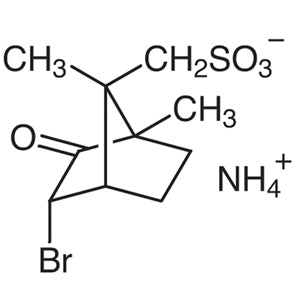
(+)-3-Bromocamphor-8-sulfonicAcidAmmoniumSalt TCI B1125
Regular price From Rp 1.113.000,00Regular priceRp 793.800,00Sale price From Rp 1.113.000,00 -
(-)-Borneol TCI B1012
Regular price From Rp 928.200,00Regular priceRp 664.650,00Sale price From Rp 928.200,00