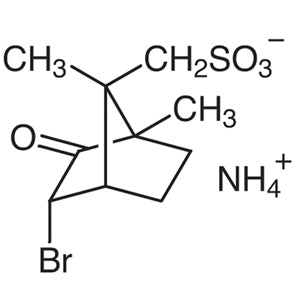
(-)-3-Bromocamphor-8-sulfonic Acid Ammonium Salt is a chiral compound widely used in asymmetric synthesis, playing a crucial role in the development of chiral molecules. This compound is essential in laboratories where the synthesis of enantiomerically pure compounds is required. Its unique molecular structure allows it to act as a chiral building block, enabling the creation of molecules with specific stereochemical configurations. This makes it a valuable tool for researchers working in organic chemistry and pharmaceutical development.
The compound is known for its chemical stability under controlled conditions and its solubility in various organic solvents, which enhances its versatility in laboratory applications. Its ability to function as both a reagent and a catalyst in asymmetric reactions makes it a preferred choice for chemists seeking efficient and selective synthetic pathways. The molecular complexity of this compound allows for the formation of products with precise stereochemical outcomes, which is critical in drug discovery and synthetic chemistry.
In Indonesian laboratories, this compound is commonly used in research settings focused on organic synthesis and asymmetric catalysis. It is particularly favored in academic and industrial research for its reliability and effectiveness in producing chiral compounds with desired biological activities. Its application is widespread in both educational and commercial laboratories, supporting advancements in chemical research and pharmaceutical development.
TCI brochures (PDF)
- Terpenes 2025-09-22 · p. 5
- Chiral Building Blocks 2025-04-14 · p. 15
- Asymmetric Synthesis: This compound is ideal for asymmetric synthesis due to its chiral structure, enabling the selective formation of enantiomers in complex molecules.
- Chiral Building Block Development: It serves as a fundamental component in the design of chiral molecules, supporting the creation of compounds with specific stereochemical configurations.
- Pharmaceutical Research: Its use in drug development is critical for synthesizing compounds with targeted biological activities and improved pharmacological profiles.
- Organic Chemistry Education: It is frequently used in academic settings to teach students about chiral synthesis and asymmetric reaction mechanisms.
- Industrial Chemical Production: It is employed in industrial laboratories to produce chiral intermediates for a variety of chemical and pharmaceutical applications.
| Brand | TCI |
|---|---|
| CAS number | 55870-50-3 |
| Molecular formula | — |
| Purity | — |
| Category | Chemistry > Asymmetric Synthesis > Chiral Building Blocks |
| Pack sizes | Available in various quantities as per standard laboratory supply |
| Physical form | Solid powder |
| Storage | Store in a cool, dry place away from light and moisture |
This compound should be stored in a cool, dry environment, away from direct light and moisture to maintain its chemical stability. It is recommended to use airtight containers to prevent exposure to humidity and contaminants. Due to its chiral nature, it is important to handle it with care to avoid contamination or degradation. Laboratory personnel should wear appropriate personal protective equipment, such as gloves and safety goggles, when handling the compound. Proper labeling of storage containers is essential to ensure safe handling and prevent accidental use. Regular inspection of storage conditions is advised to maintain the integrity of the compound for laboratory use.
—
Produk Terkait
-
(+)-3-Bromocamphor-8-sulfonicAcidAmmoniumSalt TCI B1125
Regular price From Rp 1.113.000,00Regular priceRp 793.800,00Sale price From Rp 1.113.000,00 -
(+)-3-Bromocamphor TCI B0567
Regular price Rp 742.350,00Regular priceRp 534.450,00Sale price Rp 742.350,00 -
(+)-3,9-Dibromocamphor TCI D2715
Regular price From Rp 3.735.900,00Regular priceRp 2.628.150,00Sale price From Rp 3.735.900,00 -
(-)-Verbenone TCI V0072
Regular price Rp 1.405.950,00Regular priceRp 998.550,00Sale price Rp 1.405.950,00 -
(-)-Borneol TCI B1012
Regular price From Rp 928.200,00Regular priceRp 664.650,00Sale price From Rp 928.200,00 -
(1S,2S,3R,5S)-(+)-2,3-Pinanediol TCI P1934
Regular price From Rp 2.306.850,00Regular priceRp 1.628.550,00Sale price From Rp 2.306.850,00 -
(1R)-(+)-alpha-Pinene TCI P1099
Regular price From Rp 584.850,00Regular priceRp 408.450,00Sale price From Rp 584.850,00 -
(-)-beta-Pinene TCI P0441
Regular price From Rp 505.050,00Regular priceRp 352.800,00Sale price From Rp 505.050,00