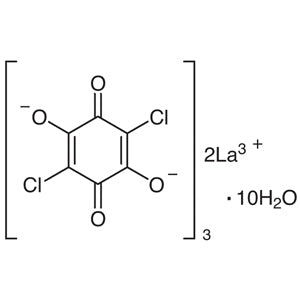
Chloranilic Acid Sodium Salt from TCI is the sodium salt of chloranilic acid. Chloranilic acid is a benzoquinone derivative that carries two chlorine atoms and two hydroxyl groups on its ring. Its conjugated, electron-accepting structure has made it well known in analytical chemistry and coordination chemistry. In the laboratory it is used as a reagent for forming coloured complexes, as a bridging ligand for metal ions, and as a building block for quinone-based materials. AMI Scientific supplies it in TCI's Non-Heterocyclic Building Blocks range for research and analytical work.
The main advantage of the sodium salt over the free acid is that it is easier to handle and dissolves in aqueous media, so reagent solutions can be prepared more conveniently. The chloranilate anion binds metal ions through its oxygen atoms. This lets it form both discrete complexes and coordination polymers with interesting electronic and magnetic properties. Because it accepts electrons, it can also form charge-transfer complexes with donor compounds. The coloured complexes it produces can be monitored by UV-Vis spectrophotometry, a method available in almost every laboratory, so it suits routine analysis as well as exploratory research.
In Indonesia, this reagent is useful for analytical chemistry laboratories at universities, for testing laboratories, and for research groups in coordination chemistry and materials science. University teaching and research labs can use it to show how coloured complexes and charge-transfer complexes form, with simple UV-Vis measurements. Testing laboratories can include it in spectrophotometric methods based on colour formation. Materials research groups can use it as a quinone-based building block when designing coordination compounds and polymers whose electronic or magnetic behaviour they want to study.
- Coloured complex formation for analysis: the reagent forms coloured complexes that can be measured by UV-Vis spectrophotometry, which supports straightforward analytical methods in most laboratories.
- Charge-transfer complex studies: the electron-accepting chloranilate structure forms charge-transfer complexes with donor compounds, so it is useful for studying donor–acceptor interactions and their spectra.
- Bridging ligand in coordination chemistry: the chloranilate anion binds metal ions through its oxygen atoms and can link metal centres, which makes it suitable for building multinuclear complexes.
- Coordination polymer synthesis: its ability to bridge metal ions lets researchers build coordination polymers and examine their electronic and magnetic properties in materials research programs.
- Quinone-based material building block: as a functionalised benzoquinone derivative with chlorine and hydroxyl groups, it is a practical starting point for designing and synthesising new quinone-based materials.
| Brand | TCI (product code C0081) |
|---|---|
| CAS number | 36275-66-8 |
| Molecular formula | — |
| Purity | — |
| Category | Chemistry > Building Blocks > Non-Heterocyclic Building Blocks |
| Pack sizes | available in TCI's standard pack sizes; please ask AMI Scientific which sizes are currently offered |
| Physical form | — |
| Storage | keep tightly closed in a cool, dry place, following the TCI label and Safety Data Sheet |
- Chemical identity: sodium salt of chloranilic acid, a benzoquinone derivative with two chlorine atoms and two hydroxyl groups
Store Chloranilic Acid Sodium Salt in its original, tightly closed container in a cool, dry, well-ventilated area, away from direct sunlight, moisture, and incompatible substances. If you move the material to another container, use a clean, dry, chemically resistant container that is clearly labelled. Wear standard personal protective equipment when handling it, including a lab coat, safety glasses, and chemical-resistant gloves. Avoid creating dust and avoid contact with skin and eyes. Weigh and prepare solutions in a well-ventilated area or a fume hood. Always read the TCI Safety Data Sheet before use, and dispose of waste according to your institution's procedures and local regulations.
—
Produk Terkait
-
ChloranilicAcid TCI C0077
Regular price Rp 2.013.900,00Regular priceRp 1.423.800,00Sale price Rp 2.013.900,00 -
BariumChloranilateTrihydrate TCI C0078
Regular price Rp 4.691.400,00Regular priceRp 3.295.950,00Sale price Rp 4.691.400,00 -
ChloranilicAcidLanthanum(III)SaltDecahydrate TCI C0079
Regular price From Rp 689.850,00Regular priceRp 497.700,00Sale price From Rp 689.850,00