TCI C0511 Cyclopentene is an unsaturated cyclic hydrocarbon. Its molecule is a five-membered ring with one carbon-carbon double bond. In the laboratory it is used as a non-heterocyclic building block, meaning a starting material whose ring framework can be modified to make other molecules. The double bond reacts readily with electrophilic reagents and with transition metal catalysts. For this reason, cyclopentene is often chosen to study addition, oxidation, and polymerization reactions in cyclic alkenes.
Chemists choose cyclopentene because it combines a five-membered ring with a single reactive double bond. The ring has enough strain to drive ring-opening reactions such as metathesis. The alkene group can be turned into an epoxide or a diol, or reduced to a saturated compound by hydrogenation. The material is a liquid, so it is easy to measure by volume and to dispense with a pipette or syringe. It is volatile and flammable, so it must be handled with care. Its volatility also has an advantage: excess reagent and solvent are easy to remove after a reaction.
In Indonesian laboratories, cyclopentene is relevant to research groups in organic chemistry, polymer chemistry, and catalysis at universities and research institutions. Graduate students and researchers use it as a model substrate when they develop new catalytic methods or study how cyclic alkenes behave. It also helps in teaching, where it shows how ring structure and unsaturation affect reactivity. Laboratories that synthesize functionalized cyclopentane derivatives may also keep it as a basic starting material for multistep work.
Related TCI products
- TCI C1617 142-29-0 Cyclopentene
- TCI M0727 693-89-0 1-Methyl-1-cyclopentene
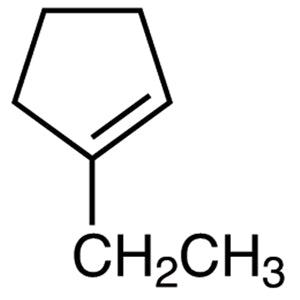
- TCI E0293 2146-38-5 1-Ethyl-1-cyclopentene
- TCI V0062 3048-64-4 5-Vinylbicyclo[221]hept-2-ene (stabilized with BHT)
- TCI T4428 13929-58-3 1,4,4a,5,8,8a-Hexahydro-1,4:5,8-dimethanonaphthalene (mixture of isomers) (stabilized with BHT)
- TCI T1817 21635-90-5 Tetracyclo[6211(3,6)0(2,7)]dodec-4-ene
- Ring-opening metathesis studies: the strained five-membered ring makes cyclopentene a useful substrate for metathesis reactions with transition metal catalysts, including ring-opening polymerization research.
- Epoxidation and dihydroxylation: the single double bond can be converted into an epoxide or a diol, so cyclopentene is a clear model for testing oxidation reagents and conditions.
- Catalytic hydrogenation experiments: the alkene can be reduced to a saturated ring, so researchers can use it to evaluate hydrogenation catalysts and compare how well they perform on cyclic alkenes.
- Electrophilic addition studies: the electron-rich double bond reacts readily with electrophilic reagents, so it suits mechanistic and teaching work on addition reactions to cyclic alkenes.
- Synthesis of non-heterocyclic building blocks: as a starting material, its five-membered carbocyclic framework can be functionalized step by step into more complex cyclopentane-based target molecules.
| Brand | TCI (product code C0511) |
|---|---|
| CAS number | 142-29-0 |
| Molecular formula | — |
| Purity | — |
| Category | Chemistry > Building Blocks > Non-Heterocyclic Building Blocks |
| Pack sizes | see the available options on the product page |
| Physical form | liquid; volatile and flammable |
| Storage | tightly closed container, cool and well-ventilated area away from ignition sources |
Store cyclopentene in its original tightly sealed container in a cool, dry, well-ventilated area designated for flammable liquids. Keep it away from heat, sparks, open flames, and strong oxidizing agents. Because the liquid is volatile, keep containers closed when not in use to limit vapour loss and build-up. Dispense it in a fume hood with a pipette or syringe, and ground equipment where appropriate. Wear safety glasses, chemical-resistant gloves, and a lab coat. Read the supplier's Safety Data Sheet before use, and dispose of waste according to institutional and local regulations.
—
Produk Terkait
-
Cyclopentene TCI C1617
Regular price From Rp 468.000,00Regular priceRp 318.000,00Sale price From Rp 468.000,00 -
1-Methyl-1-cyclopentene TCI M0727
Regular price From Rp 1.505.000,00Regular priceRp 1.024.000,00Sale price From Rp 1.505.000,00 -
1-Ethyl-1-cyclopentene TCI E0293
Regular price Rp 9.157.000,00Regular priceRp 6.230.000,00Sale price Rp 9.157.000,00 -
5-Vinylbicyclo[221]hept-2-ene(stabilizedwithBHT) TCI V0062
Regular price From Rp 753.000,00Regular priceRp 512.000,00Sale price From Rp 753.000,00 -
1,4,4a,5,8,8a-Hexahydro-1,4:5,8-dimethanonaphthalene(mixtureofisomers)(stabilizedwithBHT) TCI T4428
Regular price From Rp 3.970.000,00Regular priceRp 2.701.000,00Sale price From Rp 3.970.000,00 -
Tetracyclo[6211(3,6)0(2,7)]dodec-4-ene TCI T1817
Regular price From Rp 1.868.000,00Regular priceRp 1.271.000,00Sale price From Rp 1.868.000,00 -
2,5-Norbornadiene(stabilizedwithBHT) TCI N0346
Regular price From Rp 1.246.000,00Regular priceRp 848.000,00Sale price From Rp 1.246.000,00 -
2-Norbornene TCI N0166
Regular price From Rp 598.000,00Regular priceRp 406.000,00Sale price From Rp 598.000,00