TCI C1617 Cyclopentene (CAS 142-29-0) is a five-membered cyclic hydrocarbon with one carbon-carbon double bond inside its ring. It is a cycloalkene and one of the simplest non-heterocyclic building blocks used in organic synthesis. In the laboratory, cyclopentene is a starting material for building five-carbon ring frameworks. It is also a model substrate for studying addition reactions on alkenes and a monomer in polymerisation research. Because its structure is compact, it is widely used in teaching and research to show how cyclic alkenes typically behave.
Chemists choose cyclopentene because its reactive double bond sits inside a slightly strained ring. This makes it readily undergo electrophilic addition, epoxidation, dihydroxylation, hydroboration and ring-opening metathesis. The molecule is symmetrical, so its reaction products are relatively easy to predict and to analyse by NMR spectroscopy and gas chromatography. As a TCI product, the material offers consistent quality from lot to lot, so researchers can repeat experiments and compare the results. It is supplied as a liquid, which makes it easy to measure and transfer in routine synthetic work.
In Indonesian laboratories, cyclopentene is mainly used in university organic chemistry departments, in research groups working on synthetic methods, and in polymer science laboratories. Lecturers and students use it as a clear example of how cyclic alkenes react in practical classes and final-year research projects. Research teams use it as a starting material for five-membered carbocyclic targets, and as a reference substrate when they test new catalysts or reaction conditions before moving on to more complex molecules.
Related TCI products
- TCI C0511 142-29-0 Cyclopentene
- TCI M0727 693-89-0 1-Methyl-1-cyclopentene
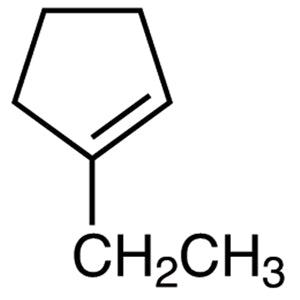
- TCI E0293 2146-38-5 1-Ethyl-1-cyclopentene
- TCI V0062 3048-64-4 5-Vinylbicyclo[221]hept-2-ene (stabilized with BHT)
- TCI T4428 13929-58-3 1,4,4a,5,8,8a-Hexahydro-1,4:5,8-dimethanonaphthalene (mixture of isomers) (stabilized with BHT)
- TCI T1817 21635-90-5 Tetracyclo[6211(3,6)0(2,7)]dodec-4-ene
- Five-membered ring construction: cyclopentene gives a ready-made five-carbon ring framework, so chemists can add functional groups directly instead of forming the ring from scratch.
- Alkene addition studies: the reactive double bond in a symmetrical ring makes it a good model substrate for studying electrophilic addition, hydroboration and the selectivity of these reactions.
- Epoxidation and dihydroxylation: the slightly strained cyclic alkene reacts readily with oxidising reagents, which makes it useful for preparing cyclic epoxides and diols and for comparing oxidation methods.
- Ring-opening metathesis polymerisation research: the ring strain and internal double bond let cyclopentene act as a monomer in studies of metathesis catalysts and polymerisation behaviour.
- Teaching and analytical demonstrations: its simple, symmetrical structure gives products that are easy to predict and to analyse by NMR and gas chromatography, which suits instructional laboratories.
| Brand | TCI (product code C1617) |
|---|---|
| CAS number | 142-29-0 |
| Molecular formula | — |
| Purity | — |
| Category | Chemistry > Building Blocks > Non-Heterocyclic Building Blocks |
| Pack sizes | please check the available options on the product listing |
| Physical form | liquid |
| Storage | keep tightly closed in a cool, well-ventilated area away from ignition sources |
Store cyclopentene in its original, tightly sealed container in a cool, dry and well-ventilated place, away from heat, sparks, open flames and other ignition sources. Keep it away from strong oxidising agents. As an organic liquid, it should be handled in a fume hood while wearing safety glasses, chemical-resistant gloves and a laboratory coat. Use only the amount needed for each experiment, close the container straight after use, and label any secondary containers clearly. Always read the supplier's Safety Data Sheet before use, and dispose of waste according to your institution's chemical waste procedures and local regulations.
—
Produk Terkait
-
Cyclopentene TCI C0511
Regular price From Rp 875.700,00Regular priceRp 612.150,00Sale price From Rp 875.700,00 -
1-Methyl-1-cyclopentene TCI M0727
Regular price From Rp 1.538.250,00Regular priceRp 1.075.200,00Sale price From Rp 1.538.250,00 -
1-Ethyl-1-cyclopentene TCI E0293
Regular price Rp 9.354.450,00Regular priceRp 6.541.500,00Sale price Rp 9.354.450,00 -
5-Vinylbicyclo[221]hept-2-ene(stabilizedwithBHT) TCI V0062
Regular price From Rp 769.650,00Regular priceRp 537.600,00Sale price From Rp 769.650,00 -
1,4,4a,5,8,8a-Hexahydro-1,4:5,8-dimethanonaphthalene(mixtureofisomers)(stabilizedwithBHT) TCI T4428
Regular price From Rp 4.056.150,00Regular priceRp 2.836.050,00Sale price From Rp 4.056.150,00 -
Tetracyclo[6211(3,6)0(2,7)]dodec-4-ene TCI T1817
Regular price From Rp 1.908.900,00Regular priceRp 1.334.550,00Sale price From Rp 1.908.900,00 -
2,5-Norbornadiene(stabilizedwithBHT) TCI N0346
Regular price From Rp 1.273.650,00Regular priceRp 890.400,00Sale price From Rp 1.273.650,00 -
2-Norbornene TCI N0166
Regular price From Rp 610.050,00Regular priceRp 426.300,00Sale price From Rp 610.050,00