

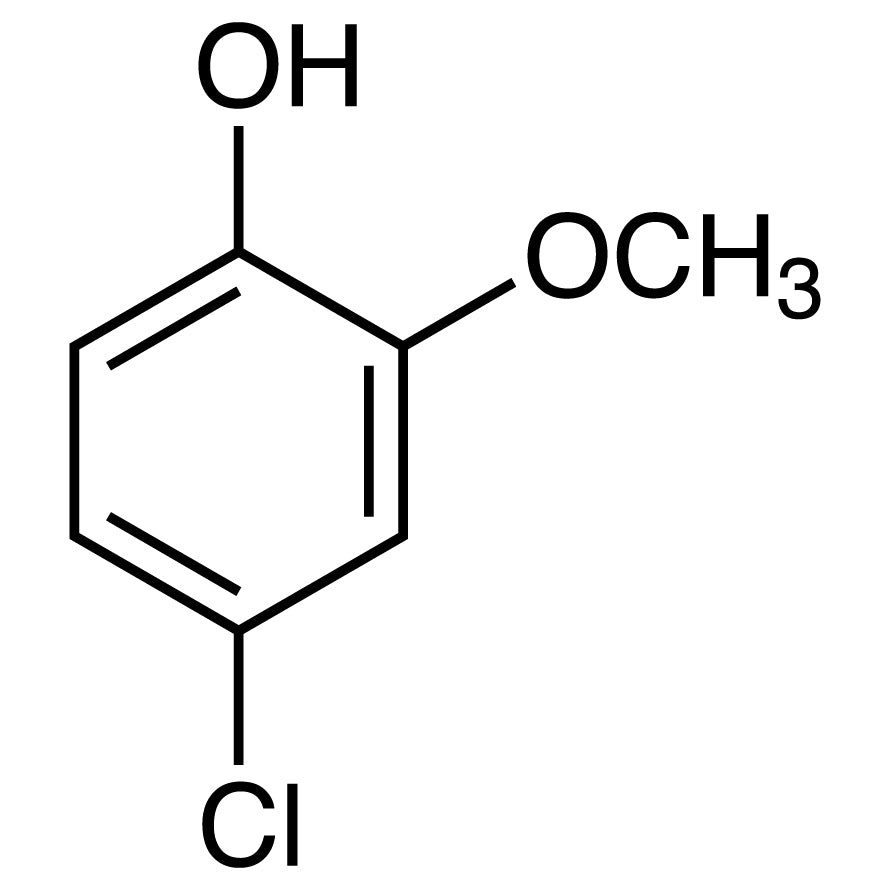
4-Chloro-2-methoxyphenol from TCI (product code C1517), also known as 4-chloroguaiacol, is a chlorinated phenol derivative. It carries a methoxy group at the ortho position and a chlorine atom at the para position relative to the hydroxyl group. In the laboratory, it serves two purposes: a non-heterocyclic building block for organic synthesis, and a reference compound in environmental analysis. Its guaiacol framework is closely related to the structural units of lignin, so the compound appears often in wood and pulp chemistry studies.
Chemists choose this compound because it combines three useful features: the reactivity of a phenol, the electron-donating effect of the methoxy group, and a chlorine atom that can serve as a point for further modification. The hydroxyl group can be etherified or esterified, the aromatic ring can undergo further substitution, and the chlorine atom can take part in coupling reactions. In environmental analysis, chlorinated guaiacols are known as one group of compounds that can form during chlorine-based pulp bleaching, so a pure standard is needed for reliable identification. Technical data for this product are based on the TCI certificate of analysis.
Indonesia has a large pulp and paper industry. Environmental testing laboratories, university research groups, and industrial quality control units in the country therefore have practical reasons to work with chlorinated guaiacol compounds. Typical users include analysts studying effluent and water samples, academic researchers in wood chemistry and lignin chemistry, and synthetic chemists who need a functionalized aromatic intermediate. AMI Scientific supplies this TCI reagent to these laboratories for both routine and research work.
- Organic synthesis building block: the phenolic hydroxyl group, methoxy substituent, and chlorine atom give chemists several reactive sites for building more complex aromatic molecules step by step.
- Environmental reference standard: as a chlorinated guaiacol, it is used to identify compounds that can form during chlorine-based pulp bleaching when analysts examine water and effluent samples.
- Wood and pulp chemistry research: its guaiacol framework is closely related to lignin structural units, so it is a relevant model compound for studies of lignin chemistry and pulp processing.
- Etherification and esterification studies: the free hydroxyl group can be converted into ethers or esters, so the compound is a convenient substrate for preparing protected or modified phenolic derivatives.
- Coupling reaction development: the chlorine atom on the aromatic ring can serve as a handle for coupling reactions, which lets researchers attach new groups to the substituted phenol core.
| Brand | TCI (product code C1517) |
|---|---|
| CAS number | 16766-30-6 |
| Molecular formula | — |
| Purity | — |
| Category | Chemistry > Building Blocks > Non-Heterocyclic Building Blocks |
| Pack sizes | as listed on the product page |
| Physical form | refer to the TCI certificate of analysis |
| Storage | follow the conditions stated on the TCI label and certificate of analysis |
Store 4-Chloro-2-methoxyphenol in its original, tightly closed container in a cool, dry, well-ventilated place, away from direct sunlight, heat sources, and incompatible materials such as strong oxidizing agents. Always follow the specific storage conditions printed on the TCI label and certificate of analysis. As with other chlorinated phenols, handle the compound in a fume hood and wear suitable protective gloves, safety glasses, and a laboratory coat. Avoid contact with skin and eyes, and avoid inhaling dust or vapour. Read the Safety Data Sheet before use, and dispose of waste according to local regulations for halogenated organic chemicals.
—
Produk Terkait
-
2-Chloro-4-methoxyphenol TCI C1487
Regular price From Rp 1.246.350,00Regular priceRp 887.250,00Sale price From Rp 1.246.350,00 -
2-Bromo-4,5-dimethoxyphenol TCI B5297
Regular price Rp 2.518.950,00Regular priceRp 1.776.600,00Sale price Rp 2.518.950,00 -
2-Bromo-6-methoxyphenol TCI B5026
Regular price From Rp 1.298.850,00Regular priceRp 924.000,00Sale price From Rp 1.298.850,00 -
4-Bromo-2-methoxyphenol TCI B4056
Regular price From Rp 1.670.550,00Regular priceRp 1.183.350,00Sale price From Rp 1.670.550,00 -
5-Bromo-2-methoxyphenol TCI B3342
Regular price From Rp 1.060.500,00Regular priceRp 757.050,00Sale price From Rp 1.060.500,00 -
2-Bromo-4-methoxyphenol TCI B3135
Regular price From Rp 2.650.200,00Regular priceRp 1.869.000,00Sale price From Rp 2.650.200,00 -
4-tert-Butoxyphenol TCI B2390
Regular price From Rp 3.975.300,00Regular priceRp 2.795.100,00Sale price From Rp 3.975.300,00 -
4-Butoxyphenol TCI B0923
Regular price Rp 1.246.350,00Regular priceRp 887.250,00Sale price Rp 1.246.350,00


