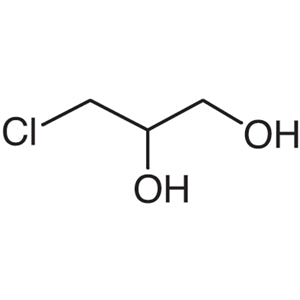
TCI C1542 (S)-(+)-3-Chloro-1,2-propanediol is a three-carbon chiral building block. Its molecule carries two hydroxyl groups, one primary and one secondary, together with a primary chlorine atom, and its stereogenic centre has the (S) configuration. In asymmetric synthesis it serves as a ready-made source of chirality. Researchers can introduce a defined chiral centre into a target molecule without having to resolve a racemate or develop an asymmetric catalytic step from scratch. Structurally, the compound is closely related to glycerol and glycidol.
Chemists choose this compound because its functional groups complement each other. The chlorine atom is a good leaving group for nucleophilic substitution. The neighbouring hydroxyl groups allow intramolecular cyclisation to a chiral epoxide under basic conditions. Both hydroxyl groups can also be protected selectively, for example as an acetonide, so that later reactions can be directed precisely. Because the material is a single enantiomer, its derivatives keep their stereochemical information. This matters in the synthesis of pharmaceutical compounds, whose biological activity often depends on absolute configuration.
In Indonesia, the material is relevant to university organic chemistry laboratories, pharmaceutical research and development groups, and research institutions working on stereoselective synthesis. Graduate students and researchers can use it as a starting material in multistep routes to chiral intermediates. Teaching laboratories can also use it to show how a defined stereocentre carries through substitution, cyclisation and protection steps. Supplied under the TCI brand, it gives Indonesian laboratories a consistent, well-documented reagent for chiral building-block chemistry.
TCI brochures (PDF)
- Chiral Building Blocks 2025-04-14 · p. 16
Related TCI products
- Chiral epoxide preparation: under basic conditions, the hydroxyl group next to the chlorine-bearing carbon cyclises intramolecularly, giving an enantiomerically defined epoxide for further ring-opening chemistry.
- Nucleophilic substitution studies: the primary chlorine atom is a good leaving group, so amines, thiols, azides and other nucleophiles can be attached while the (S) stereocentre is kept.
- Pharmaceutical intermediate synthesis: as a single enantiomer, it carries a defined absolute configuration into drug candidates, whose biological activity often depends on correct stereochemistry.
- Protecting-group strategy: both hydroxyl groups can be protected selectively, for example as an acetonide, so chemists can direct later reactions precisely to the intended position.
- Chiral pool and teaching work: its close structural link to glycerol and glycidol makes it a clear example for showing how chirality is introduced without racemate resolution or asymmetric catalysis.
| Brand | TCI (product code C1542) |
|---|---|
| CAS number | 60827-45-4 |
| Molecular formula | — |
| Purity | — |
| Category | Chemistry > Asymmetric Synthesis > Chiral Building Blocks |
| Pack sizes | see the options listed on the product page |
| Physical form | refer to the manufacturer's certificate of analysis and safety data sheet |
| Storage | follow the conditions printed on the TCI label and safety data sheet |
Keep the product in its original, tightly closed manufacturer's container in a cool, dry, well-ventilated chemical storage area, away from direct sunlight, heat sources and incompatible materials such as strong bases and strong oxidising agents. Follow the exact storage conditions on the TCI label and safety data sheet. Because the compound is a chlorinated organic substance, handle it in a fume hood. Wear chemical-resistant gloves, safety glasses and a laboratory coat, and avoid skin contact and inhaling vapour. To keep the enantiomeric material intact, close the container promptly after each use and avoid contamination from shared spatulas or pipettes. Dispose of residues as halogenated organic waste according to local regulations.
—
Produk Terkait
-
(R)-(-)-3-Chloro-1,2-propanediol TCI M0967
Regular price From Rp 1.749.300,00Regular priceRp 1.223.250,00Sale price From Rp 1.749.300,00 -
(S)-(-)-3-Benzyloxy-1,2-propanediol TCI B2142
Regular price From Rp 980.700,00Regular priceRp 685.650,00Sale price From Rp 980.700,00 -
(R)-(+)-3-Benzyloxy-1,2-propanediol TCI B2141
Regular price From Rp 848.400,00Regular priceRp 609.000,00Sale price From Rp 848.400,00 -
(R)-(-)-1,2-Propanediol TCI P1152
Regular price From Rp 1.801.800,00Regular priceRp 1.275.750,00Sale price From Rp 1.801.800,00 -
(S)-(+)-1,2-Propanediol TCI P1129
Regular price From Rp 2.068.500,00Regular priceRp 1.461.600,00Sale price From Rp 2.068.500,00 -
3-Chloro-1,2-propanediol TCI C0268
Regular price From Rp 505.050,00Regular priceRp 352.800,00Sale price From Rp 505.050,00 -
Methyl2-Chloro-L-mandelate TCI M2383
Regular price Rp 1.801.800,00Regular priceRp 1.275.750,00Sale price Rp 1.801.800,00 -
Methyl2-Chloro-D-mandelate TCI M2382
Regular price From Rp 1.696.800,00Regular priceRp 1.202.250,00Sale price From Rp 1.696.800,00