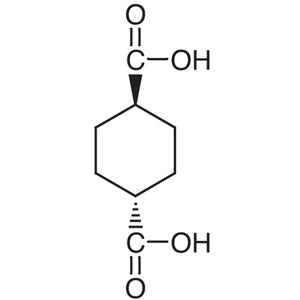
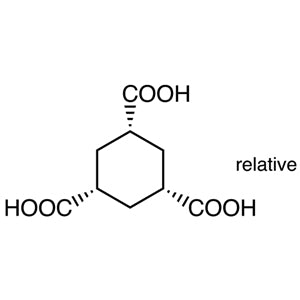
1,3,5-Cyclohexanetricarboxylic Acid (cis- and trans- mixture) is a versatile organic compound widely used in chemical and materials science research. This compound is a key component in the synthesis of complex molecules, particularly in the development of organic-inorganic hybrid materials. Its cyclic structure with three carboxylic acid groups positioned at specific sites makes it a valuable reagent for creating stable and functional chemical structures. In laboratory settings, it serves as a foundational material for various experimental processes, including the formation of metal-organic frameworks (MOFs) and other advanced materials.
The compound's chemical stability and controlled reactivity make it a preferred choice for researchers aiming to achieve precise chemical reactions or crystalline structures. Its non-toxic nature and availability in the chemical market further enhance its appeal for routine laboratory use. Additionally, its non-volatile properties and good solubility in both organic solvents and water allow it to be used in a wide range of experimental conditions. These characteristics ensure that it remains a reliable and efficient material for diverse applications in modern research.
In Indonesian laboratories, 1,3,5-Cyclohexanetricarboxylic Acid is commonly used in the study and development of hybrid materials, especially in the synthesis of Metal Organic Frameworks (MOFs). Its role in creating stable and functional materials has made it an essential reagent in both academic and industrial research settings. The compound's reliability and adaptability make it a go-to choice for researchers working on advanced material science projects.
- Metal Organic Frameworks (MOFs) synthesis benefits from its cyclic structure and carboxylic acid groups, enabling coordination with metal ions to form stable porous materials.
- Organic-inorganic hybrid material development utilizes its chemical stability and reactivity to create functional composite structures with unique properties.
- Chemical reaction intermediates in synthesis processes rely on its controlled reactivity and solubility, making it suitable for a variety of reaction conditions.
- Crystal growth experiments take advantage of its non-volatile nature and solubility, allowing for the formation of well-defined crystalline structures.
- Material characterization studies use its consistent properties to ensure reproducibility and accuracy in analytical techniques.
| Brand | TCI |
|---|---|
| CAS number | 25357-95-3 |
| Molecular formula | — |
| Purity | — |
| Category | Materials Science > Organic-Inorganic Hybrid Materials > Metal Organic Frameworks (MOF) and Their Raw Materials |
| Pack sizes | Available in various quantities as per standard chemical supply specifications |
| Physical form | Solid, crystalline powder |
| Storage | — |
This compound should be stored in a cool, dry, and well-ventilated area away from direct sunlight and sources of heat. It is recommended to use airtight containers to prevent moisture absorption and maintain its chemical integrity. As a non-volatile and non-toxic material, it does not require special handling beyond standard laboratory safety protocols. When working with this compound, it is advisable to use appropriate personal protective equipment, such as gloves and safety goggles, to ensure safe handling. Its good solubility in both organic and aqueous solvents means it can be safely used in a wide range of experimental setups without significant risk. Proper storage and handling ensure its effectiveness and safety in laboratory environments.
—
Produk Terkait
-
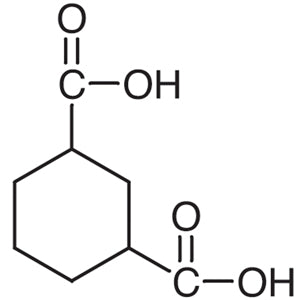
1,3-CyclohexanedicarboxylicAcid(cis-andtrans-mixture) TCI C2186
Regular price From Rp 1.856.400,00Regular price -
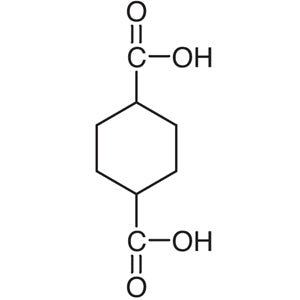
1,4-CyclohexanedicarboxylicAcid(cis-andtrans-mixture) TCI C0788
Regular price Rp 743.400,00Regular price -
[1,1'-Biphenyl]-3,4',5-tricarboxylicAcid TCI B5795
Regular price Rp 6.281.100,00Regular price -
Decahydro-1,4-naphthalenedicarboxylicAcid(mixtureofisomers) TCI D4383
Regular price Rp 3.605.700,00Regular price -
trans,trans-MuconicAcid TCI M0473
Regular price Rp 1.510.950,00Regular price -
trans-1,4-CyclohexanedicarboxylicAcid TCI C0475
Regular price From Rp 1.881.600,00Regular price -
trans-1,2-CyclohexanedicarboxylicAcid TCI C0474
Regular price From Rp 2.199.750,00Regular price -
(1alpha,3alpha,5alpha)-1,3,5-CyclohexanetricarboxylicAcid TCI C2063
Regular price From Rp 2.916.900,00Regular price
![[1,1'-Biphenyl]-3,4',5-tricarboxylic Acid (CAS 677010-20-7) - TCI B5795 - AMI Scientific](http://amiscientific.com/cdn/shop/files/TCI2510B5795.jpg?v=1767092758&width=533)