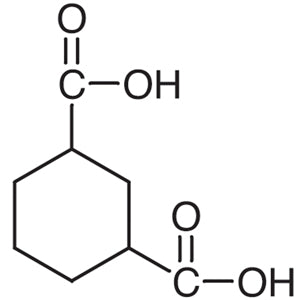
TCI C2186 1,3-Cyclohexanedicarboxylic Acid is supplied as a mixture of cis and trans isomers. It is an alicyclic dicarboxylic acid in which two carboxyl groups are attached at the 1 and 3 positions of a cyclohexane ring. The material is categorised as a raw material for Metal Organic Frameworks within the organic-inorganic hybrid materials group. Its role in the laboratory is to act as an organic linker — the bridging unit that connects metal nodes to build three-dimensional porous frameworks. Beyond framework construction, the compound is also used as a monomer and as an intermediate in polymer research and in general organic synthesis that calls for a cycloaliphatic backbone.
The characteristic that makes this compound attractive is its saturated and flexible cyclohexane backbone, which differs from rigid aromatic linkers such as terephthalic acid. Conformational flexibility of the ring allows a variety of framework topologies to form, including structures that can respond to changes in their environment. The mixture of cis and trans isomers presents two different bond-angle geometries, and researchers frequently exploit this to explore structural diversity during exploratory work. The absence of an aromatic ring also means the resulting framework carries a distinctly different electronic and steric character from aromatic-linker systems.
In Indonesian laboratories, this material is typically used in university and institutional research settings where porous materials, coordination polymers, and polymer chemistry are studied. It suits exploratory synthesis programmes in which several linker geometries are screened before a target framework is selected. Working groups in materials science and organic synthesis draw on it when a saturated cycloaliphatic diacid is required, and it is normally handled in ordinary bench-scale glassware alongside other MOF raw materials held in the laboratory chemical inventory.
TCI brochures (PDF)
- Biomaterials Research Reagents 2025-02-19 · p. 21
Related TCI products
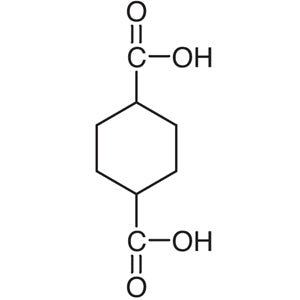
- TCI C0788 1076-97-7 1,4-Cyclohexanedicarboxylic Acid (cis- and trans- mixture)
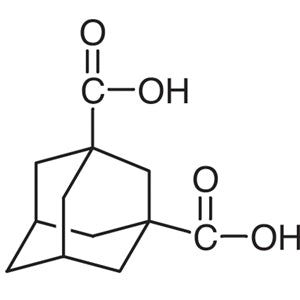
- TCI A1358 39269-10-8 1,3-Adamantanedicarboxylic Acid
- TCI N0753 1724-08-9 2,3-Norbornanedicarboxylic Acid
- TCI A0088 142-45-0 Acetylenedicarboxylic Acid
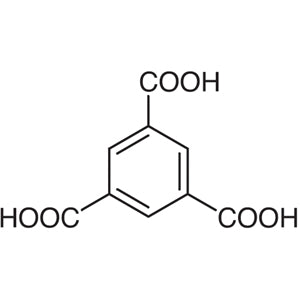
- TCI B0043 554-95-0 1,3,5-Benzenetricarboxylic Acid
- TCI T0166 100-21-0 Terephthalic Acid
- Metal organic framework synthesis — serves as the organic linker bridging metal nodes into three-dimensional porous frameworks, with ring flexibility permitting topologies unavailable to rigid aromatic linkers.
- Coordination polymer research — the two carboxyl groups at the 1 and 3 ring positions provide reliable coordination sites for building extended metal-carboxylate networks under exploratory conditions.
- Framework topology screening — the cis and trans isomer mixture supplies two distinct bond-angle geometries in a single material, letting researchers survey structural diversity efficiently at the exploratory stage.
- Polymer research as a monomer — the dicarboxylic acid functionality supports polycondensation chemistry where a saturated cycloaliphatic unit is wanted instead of an aromatic one.
- General organic synthesis intermediate — used wherever a synthetic route requires a cycloaliphatic diacid backbone, contributing a non-aromatic scaffold with different steric and electronic character.
| Brand | TCI |
|---|---|
| CAS number | 3971-31-1 |
| Molecular formula | — |
| Purity | — |
| Category | Materials Science > Organic-Inorganic Hybrid Materials > Metal Organic Frameworks (MOF) and Their Raw Materials |
| Pack sizes | — |
| Physical form | — |
| Storage | keep in a cool, dry place in a tightly closed container, following the supplier's label and safety data sheet |
- Product code: C2186
- Composition: mixture of cis and trans isomers
Store the container tightly closed in a cool, dry, and well-ventilated area, away from direct sunlight, moisture, and incompatible materials. The original supplier container is preferred; if transfer is necessary, use clean, chemically compatible, and clearly labelled containers, and reseal promptly after each use to limit moisture uptake. Handle the material in a fume hood or a well-ventilated workspace, and wear standard laboratory personal protective equipment including a lab coat, safety glasses, and suitable chemical-resistant gloves. Avoid the generation and inhalation of dust, and avoid contact with skin and eyes. Use dedicated clean spatulas when weighing to prevent cross-contamination of the stock. Always consult the manufacturer's safety data sheet before use, and dispose of residues and contaminated materials in accordance with applicable laboratory waste regulations.
—
Product Categories
- Organic-Inorganic Hybrid MaterialsMetal Organic Frameworks (MOF) and Their Raw MaterialsOrganic Linker Molecules [Metal Organic Frameworks (MOFs) Precursors]
- Polymer/Macromolecule ReagentsMetal Organic Frameworks (MOF) and Their Raw MaterialsOrganic Linker Molecules [Metal Organic Frameworks (MOFs) Precursors]
- Polymer/Macromolecule ReagentsMonomersDicarboxylic Acid Monomers
- Biomaterials/Biocompatible Materials Research ReagentsMonomers and Macromonomers [Biomaterials/Biocompatible Materials Research Reagents]Dicarboxylic Acid Monomers [Biomaterials/Biocompatible Materials Research Reagents]
Produk Terkait
-
1,4-CyclohexanedicarboxylicAcid(cis-andtrans-mixture) TCI C0788
Regular price Rp 743.400,00Regular price -
1,3-AdamantanedicarboxylicAcid TCI A1358
Regular price From Rp 1.749.300,00Regular price -
2,3-NorbornanedicarboxylicAcid TCI N0753
Regular price Rp 2.199.750,00Regular price -
AcetylenedicarboxylicAcid TCI A0088
Regular price From Rp 1.167.600,00Regular price -
1,3,5-BenzenetricarboxylicAcid TCI B0043
Regular price From Rp 1.035.300,00Regular price -
TerephthalicAcid TCI T0166
Regular price From Rp 452.550,00Regular price -
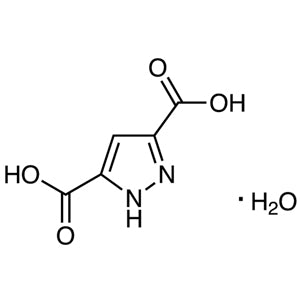
Pyrazole-3,5-dicarboxylicAcidMonohydrate TCI P1048
Regular price From Rp 1.431.150,00Regular price -
2,3-PyrazinedicarboxylicAcid TCI P0545
Regular price Rp 1.776.600,00Regular price