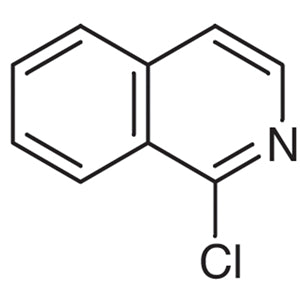
1-Chloroisoquinoline (CAS 19493-44-8) is an organic compound belonging to the heterocyclic group, consisting of an isoquinoline ring skeleton with a chlorine atom bonded at position 1. In the chemistry laboratory, this compound acts as a highly valuable building block used to construct more complex molecules through various substitution reactions, cross-coupling reactions, and functional group transformations. As an isoquinoline derivative, it serves as an important starting material in medicinal chemistry research, materials chemistry, and synthetic organic chemistry. The presence of the reactive chlorine atom provides a strategic point of attack for further modification, allowing researchers to introduce a wide range of substituents such as amines, ethers, or aryl groups onto the isoquinoline framework according to their synthetic objectives.
The key characteristic that makes 1-Chloroisoquinoline a preferred choice in the laboratory is the reactivity of the chlorine atom at position 1, which can be relatively easily replaced through nucleophilic aromatic substitution reactions as well as transition-metal-catalyzed cross-coupling reactions. This dependable reactivity gives synthetic chemists predictable access to a diverse array of functionalized isoquinoline derivatives under practical reaction conditions. The isoquinoline core itself is a structural motif frequently encountered in biologically active compounds, which further enhances the value of this reagent as a versatile intermediate. Its stability and straightforward handling under standard laboratory conditions also make it convenient for routine use in multi-step synthesis campaigns and method development studies.
In Indonesian laboratories, 1-chloroisoquinoline is typically employed in pharmaceutical and organic synthesis research conducted at universities, research institutes, and industrial research and development facilities. It is commonly used as a starting point for building nitrogen-containing heterocyclic scaffolds relevant to drug discovery, agrochemical development, and advanced materials. Researchers in these settings rely on this compound to prepare substituted isoquinolines for biological evaluation, structure-activity relationship studies, and the synthesis of natural product analogues. Because it enables efficient late-stage diversification of the isoquinoline ring, it supports a wide variety of ongoing research projects across Indonesia's growing chemistry community.
Related TCI products
- Scaffold construction in medicinal chemistry: as an isoquinoline building block, it provides the core ring system found in many biologically active molecules, enabling researchers to assemble drug-like compound libraries efficiently.
- Cross-coupling precursor: the chlorine at position 1 readily participates in transition-metal-catalyzed coupling reactions, allowing the introduction of aryl, amine, and other substituents onto the isoquinoline framework.
- Nucleophilic substitution substrate: the activated carbon at position 1 is easily attacked by nucleophiles, making it a straightforward route to alkoxy, amino, and thio-substituted isoquinoline derivatives.
- Functional group transformation intermediate: the halogen can be converted into other functional groups, such as boronic acids or organometallic species, enabling further synthetic elaboration of the ring system.
- Heterocyclic diversification for materials and agrochemical research: the compound supports the preparation of substituted isoquinolines used in luminescent materials, ligand design, and crop-protection chemistry programs.
| Brand | TCI |
|---|---|
| CAS number | 19493-44-8 |
| Molecular formula | — |
| Purity | — |
| Category | Chemistry > Building Blocks > Heterocyclic Building Blocks |
| Pack sizes | — |
| Physical form | solid |
| Storage | store in a cool, dry place; keep the container tightly closed and protect from light |
- Product code: C2097
Store 1-chloroisoquinoline in a cool, dry, and well-ventilated area, away from direct sunlight, heat sources, and incompatible materials such as strong oxidizing agents. Keep the container tightly closed when not in use to prevent moisture uptake and contamination, and store the product in its original packaging or a suitable glass container with a secure seal. Always wear appropriate personal protective equipment, including laboratory gloves, safety goggles, and a laboratory coat, when handling this compound. Work in a fume hood where possible to avoid inhaling dust or vapors, and avoid direct contact with skin and eyes. Wash hands thoroughly after handling, and clean up any spills immediately using standard laboratory procedures.
—
Produk Terkait
-
1,3-Dichloroisoquinoline TCI D4285
Regular price Rp 1.908.900,00Regular price -
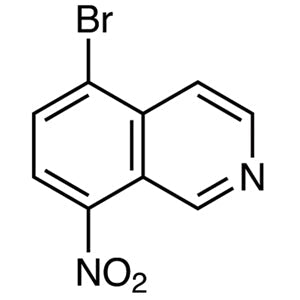
5-Bromo-8-nitroisoquinoline TCI B4163
Regular price Rp 637.350,00Regular price -
1-Iodoisoquinoline TCI I0750
Regular price From Rp 4.584.300,00Regular price -
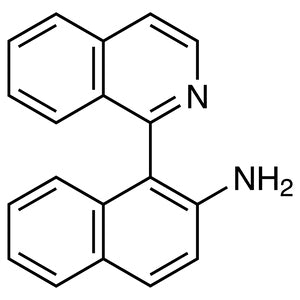
1-(2-Amino-1-naphthyl)isoquinoline TCI A2221
Regular price Rp 7.446.600,00Regular price -
Isoquinoline-3-carboxylicAcid TCI I1246
Regular price From Rp 2.809.800,00Regular price -
Isoquinoline-5-carboxaldehyde TCI I0942
Regular price From Rp 3.790.500,00Regular price -
Isoquinoline-1-carboxylicAcid TCI I0671
Regular price From Rp 1.590.750,00Regular price -
IsoquinolineN-Oxide TCI I0540
Regular price Rp 2.650.200,00Regular price