

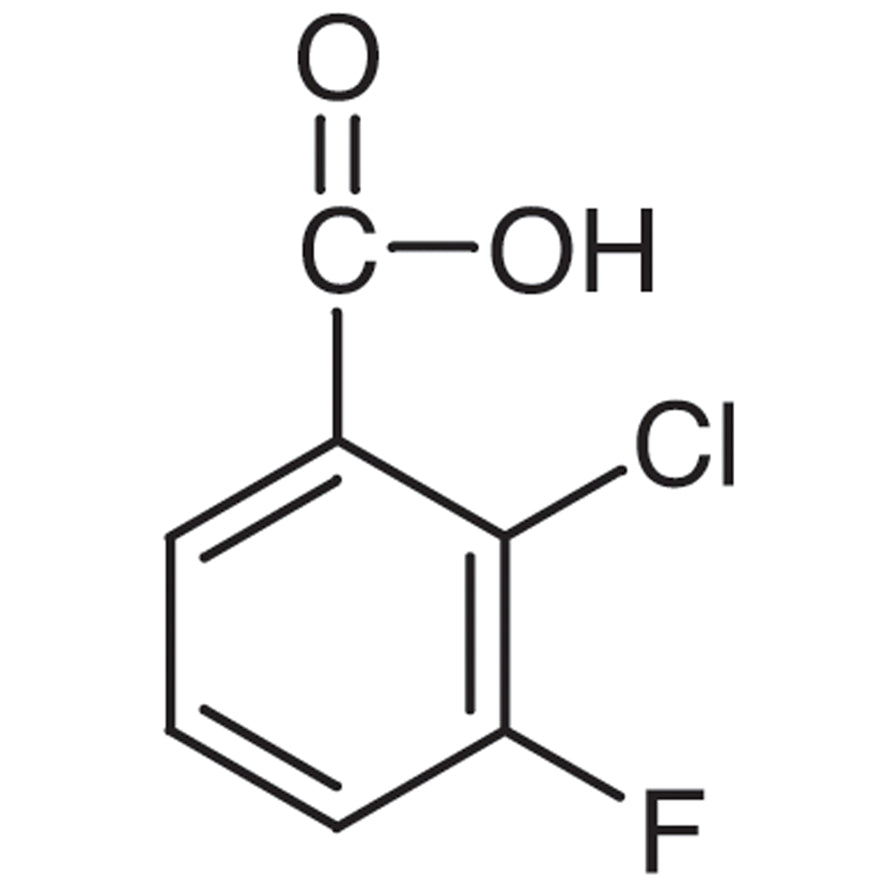
TCI C2128 2-Chloro-3-fluorobenzoic Acid is a benzoic acid carrying chlorine and fluorine atoms at adjacent positions on the aromatic ring, and it is classified as a fluorinated building block. In the laboratory, this material serves as a starting scaffold for constructing amides, esters, acid chlorides, and a variety of heterocyclic cores. Working from an already halogenated starting material is far more practical than attempting to install fluorine yourself, because direct fluorination of an aromatic ring normally demands specialised reagents, strict reaction conditions, and frequently produces isomer mixtures that are difficult to separate.
The important characteristics of this compound arise from the crowded arrangement of substituents around the carboxylic acid group. The chlorine atom in the ortho position introduces steric hindrance that influences the rate and selectivity of acylation, a factor that is in fact often exploited to direct a reaction along a chosen path. Both halogens withdraw electron density together, raising the acidity of the carboxylic group relative to ordinary benzoic acid. The fluorine atom contributes metabolic stability to target molecules, while the chlorine atom provides a working handle for palladium-catalysed cross-coupling in a later step. Its solid form makes accurate weighing straightforward.
In Indonesian laboratories, a fluorinated building block of this type is typically requested by synthetic chemistry groups in universities, pharmaceutical research units, and contract synthesis facilities that prepare intermediates on a small scale. Because it arrives as a defined, ready-to-use solid, it fits routine bench workflows where a reliable halogenated scaffold is needed for derivatisation, method development, or the preparation of reference compounds without committing resources to an in-house halogenation step.
Related TCI products
- Amide synthesis — the carboxylic acid group is activated in the usual way to give amide bonds, while the neighbouring halogens tune electronic character and steric access at the reaction centre.
- Ester and acid chloride preparation — the free carboxylic acid converts cleanly into esters or acid chlorides, giving intermediates that can be carried forward into further transformations at the bench.
- Heterocycle construction — the substituted benzoic acid core serves as a starting fragment for assembling various heterocyclic ring systems used in synthetic and medicinal chemistry programmes.
- Palladium-catalysed cross-coupling — the chlorine atom offers a defined working handle for subsequent coupling chemistry, allowing new carbon substituents to be introduced at a later stage of the route.
- Medicinal chemistry intermediates — the fluorine atom contributes metabolic stability to target molecules, making this scaffold useful when preparing candidate structures and their analogues for evaluation.
| Brand | TCI |
|---|---|
| CAS number | 102940-86-3 |
| Molecular formula | — |
| Purity | — |
| Category | Chemistry > Building Blocks > Fluorinated Building Blocks |
| Pack sizes | available in the standard catalogue pack sizes offered for this item |
| Physical form | solid, which allows accurate weighing |
| Storage | keep in the tightly closed original container, protected from moisture |
Store the material in its original, tightly closed container in a cool, dry place away from moisture, direct sunlight, and incompatible substances, since a solid organic acid of this type absorbs atmospheric humidity if left open. Use glass or chemically compatible containers for weighing, transfer, and storage, and reseal immediately after each use. Handle in a fume hood with a laboratory coat, safety glasses, and suitable gloves, as benzoic acid derivatives can irritate skin, eyes, and the respiratory tract. Avoid generating dust during weighing, keep containers clearly labelled, and follow institutional procedures for chemical waste disposal. Always consult the manufacturer's safety data sheet before first use.
—
Produk Terkait
-
4-Chloro-3-fluorobenzoicAcid TCI C2891
Regular price Rp 1.829.100,00Regular price -
3-Chloro-2-fluorobenzoicAcid TCI C2117
Regular price From Rp 769.650,00Regular price -
5-Chloro-2-fluorobenzoicAcid TCI C2094
Regular price From Rp 505.050,00Regular price -
2-Chloro-5-fluorobenzoicAcid TCI C2088
Regular price From Rp 955.500,00Regular price -
4-Chloro-2-fluorobenzoicAcid TCI C1668
Regular price Rp 610.050,00Regular price -
2-Chloro-4-fluorobenzoicAcid TCI C1350
Regular price From Rp 505.050,00Regular price -
3-Chloro-4-fluorobenzoicAcid TCI C1275
Regular price From Rp 823.200,00Regular price -
2-Chloro-6-fluorobenzoicAcid TCI C0992
Regular price Rp 928.200,00Regular price


