

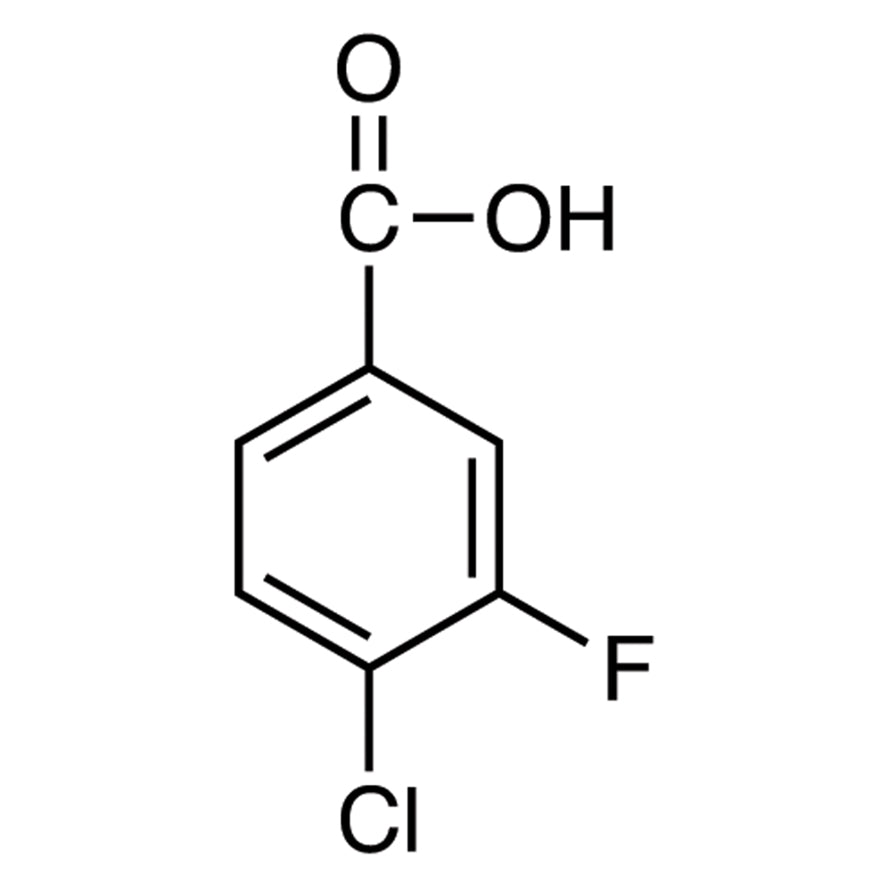
4-Chloro-3-fluorobenzoic acid is a versatile chemical compound widely used in laboratory settings for the synthesis of complex organic molecules. As a fluorinated building block, it plays a crucial role in organic chemistry by enabling the creation of compounds with specific functional groups and structural features. This compound is commonly utilized in research and development processes, serving as a foundational element in the design of new chemical entities. Its unique combination of fluorine and chlorine atoms contributes to its reactivity and stability, making it a valuable tool for chemists working on diverse synthetic pathways.
The compound’s fluorinated and chlorinated structure provides it with distinct chemical properties that make it a preferred choice in various synthetic applications. Its ability to participate in substitution reactions, electrophilic reactions, and other chemical transformations allows it to be a key player in the development of pharmaceuticals, industrial chemicals, and functional compounds. The solid form of this material ensures ease of handling and processing, which is essential for both small-scale experiments and larger research projects. These characteristics make it an essential component in the modern chemical laboratory.
In Indonesian laboratories, 4-Chloro-3-fluorobenzoic acid is frequently used in both academic and industrial research settings. It is a common reagent in the synthesis of new compounds, the optimization of chemical processes, and the study of organic reactivity. Many research institutions and educational facilities rely on this compound for its reliability and effectiveness in chemical synthesis. Its availability from trusted suppliers like TCI ensures that researchers have access to high-quality materials for their experiments.
TCI brochures (PDF)
- Fluorination Reagents, Fluorinated Building Blocks 2026-03-18 · p. 21
Related TCI products
- Pharmaceutical research utilizes this compound for the development of new drug molecules due to its reactivity and structural versatility.
- Organic synthesis applications benefit from its fluorinated and chlorinated structure, which allows for the creation of complex organic compounds.
- Industrial chemical production relies on this material for the synthesis of functional chemicals with specific properties.
- Academic research institutions use it to explore chemical reactivity and develop new synthetic methodologies.
- Analytical chemistry laboratories incorporate it as a standard reagent for testing and characterizing organic compounds.
| Brand | TCI |
|---|---|
| CAS number | 403-17-8 |
| Molecular formula | — |
| Purity | — |
| Category | Chemistry > Building Blocks > Fluorinated Building Blocks |
| Pack sizes | Available in various quantities as per supplier specifications |
| Physical form | Solid |
| Storage | Store in a cool, dry place away from moisture and direct sunlight |
This compound should be stored in a cool, dry environment to maintain its chemical integrity. It is recommended to keep it in a sealed container to prevent exposure to moisture and air. Due to its chemical nature, it should be handled with appropriate personal protective equipment, such as gloves and safety goggles. Avoid contact with incompatible substances and ensure proper ventilation in the workspace. Regular inspection of storage conditions is advised to ensure long-term stability and safety. Proper labeling and storage practices are essential to prevent accidental exposure and ensure safe handling in the laboratory.
—
Produk Terkait
-
2-Chloro-3-fluorobenzoicAcid TCI C2128
Regular price From Rp 557.550,00Regular price -
3-Chloro-2-fluorobenzoicAcid TCI C2117
Regular price From Rp 769.650,00Regular price -
5-Chloro-2-fluorobenzoicAcid TCI C2094
Regular price From Rp 505.050,00Regular price -
2-Chloro-5-fluorobenzoicAcid TCI C2088
Regular price From Rp 955.500,00Regular price -
4-Chloro-2-fluorobenzoicAcid TCI C1668
Regular price Rp 610.050,00Regular price -
2-Chloro-4-fluorobenzoicAcid TCI C1350
Regular price From Rp 505.050,00Regular price -
3-Chloro-4-fluorobenzoicAcid TCI C1275
Regular price From Rp 823.200,00Regular price -
2-Chloro-6-fluorobenzoicAcid TCI C0992
Regular price Rp 928.200,00Regular price


