

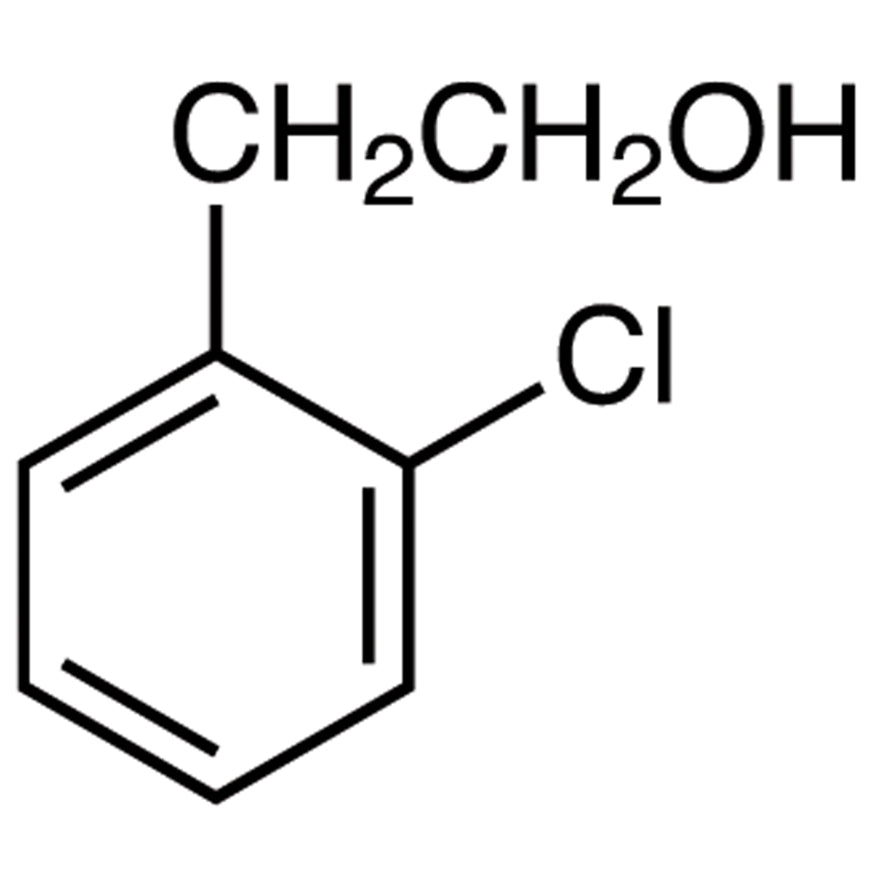
TCI C2169 2-(2-Chlorophenyl)ethanol is an organic compound belonging to the aromatic alcohol family, built from a benzene ring bearing a chlorine substituent at the ortho position together with an ethanol side chain. The material falls within the non-heterocyclic building block group, meaning small molecular frameworks used as starting points for constructing more complex chemical structures. In the organic synthesis laboratory its role is fundamental: it supplies a reactive primary hydroxyl group alongside a halogenated aromatic ring that is ready for further modification. The presence of two reactivity centres within a single molecule makes this material an efficient bridge between simple raw materials and the final target molecules a researcher has designed.
The characteristic that makes this compound a frequent choice is the balance it strikes between reactivity and stability. Its primary hydroxyl group is readily converted into a leaving group through tosylation, mesylation, or halogenation, opening the way to clean nucleophilic substitution pathways. At the same time, the chlorine atom at the ortho position contributes a distinctive steric and electronic influence that is often exploited to direct the regioselectivity of subsequent reactions, including coupling chemistry. Because both centres can be addressed under conditions that leave the other intact, synthetic routes can be planned in stages rather than compromised by competing side reactions.
In Indonesian laboratories, this building block is typically used in organic synthesis research groups at universities and in research institute laboratories, where small molecular scaffolds are elaborated step by step towards target structures. It is also drawn upon by industrial development laboratories carrying out route exploration and by analytical work requiring a well-defined aromatic alcohol as a reference material. Ordering in laboratory-scale pack sizes suits the batch-by-batch consumption pattern typical of academic and development work.
- Nucleophilic substitution route development — the primary hydroxyl group converts cleanly into tosylate, mesylate, or halide leaving groups, giving researchers a predictable handle for introducing nitrogen, sulfur, or carbon nucleophiles at the side chain.
- Cross-coupling and aromatic functionalisation studies — the ortho-chlorinated benzene ring provides a halogenated position ready for further modification, making the compound a convenient substrate for exploring coupling chemistry and regioselectivity effects.
- Multi-step synthesis of complex target molecules — as a non-heterocyclic building block it serves as an efficient bridge between simple starting materials and the elaborate final structures a synthetic programme is designed to reach.
- Regioselectivity investigations — the steric and electronic influence exerted by the chlorine atom at the ortho position is frequently used to direct the outcome of subsequent transformations under controlled laboratory conditions.
- Reference and method development work — a well-characterised aromatic alcohol of defined structure supports analytical method development, chromatographic system checks, and comparison work in organic chemistry teaching and research laboratories.
| Brand | TCI |
|---|---|
| CAS number | 19819-95-5 |
| Molecular formula | — |
| Purity | — |
| Category | Chemistry > Building Blocks > Non-Heterocyclic Building Blocks |
| Pack sizes | available in laboratory-scale packaging; please refer to the product listing for the sizes offered |
| Physical form | — |
| Storage | keep in a tightly closed container in a cool, dry, well-ventilated place away from direct sunlight |
- Catalogue number: C2169
Store the container tightly closed in a cool, dry, well-ventilated area, protected from direct sunlight and away from heat sources and ignition sources. Keep the material in its original manufacturer packaging or in a compatible, clearly labelled chemically resistant container, and reseal it immediately after each withdrawal to limit exposure to atmospheric moisture. Handle within a fume hood and wear appropriate personal protective equipment, including safety goggles, chemically resistant gloves, and a laboratory coat. Avoid contact with skin and eyes and avoid inhaling vapours. Keep separate from strong oxidising agents and other incompatible chemicals, and always consult the manufacturer's safety data sheet before use, storage, or disposal.
—
Produk Terkait
-
2-(3-Chlorophenyl)ethanol TCI C2907
Regular price From Rp 1.246.350,00Regular price -
2-(4-Chlorophenyl)ethanol TCI C2233
Regular price From Rp 557.550,00Regular price -
2-(Benzyloxy)ethanol TCI B0426
Regular price From Rp 557.550,00Regular price -
1-(2-Naphthyl)ethanol TCI N0788
Regular price From Rp 1.936.200,00Regular price -
2-(1-Naphthyl)ethanol TCI N0575
Regular price From Rp 1.326.150,00Regular price -
2-(4-Nitrophenyl)ethanol TCI N0569
Regular price From Rp 1.353.450,00Regular price -
1-(1-Naphthyl)ethanol TCI N0395
Regular price From Rp 2.016.000,00Regular price -
1-(3-Methoxyphenyl)ethanol TCI M3577
Regular price From Rp 2.571.450,00Regular price


