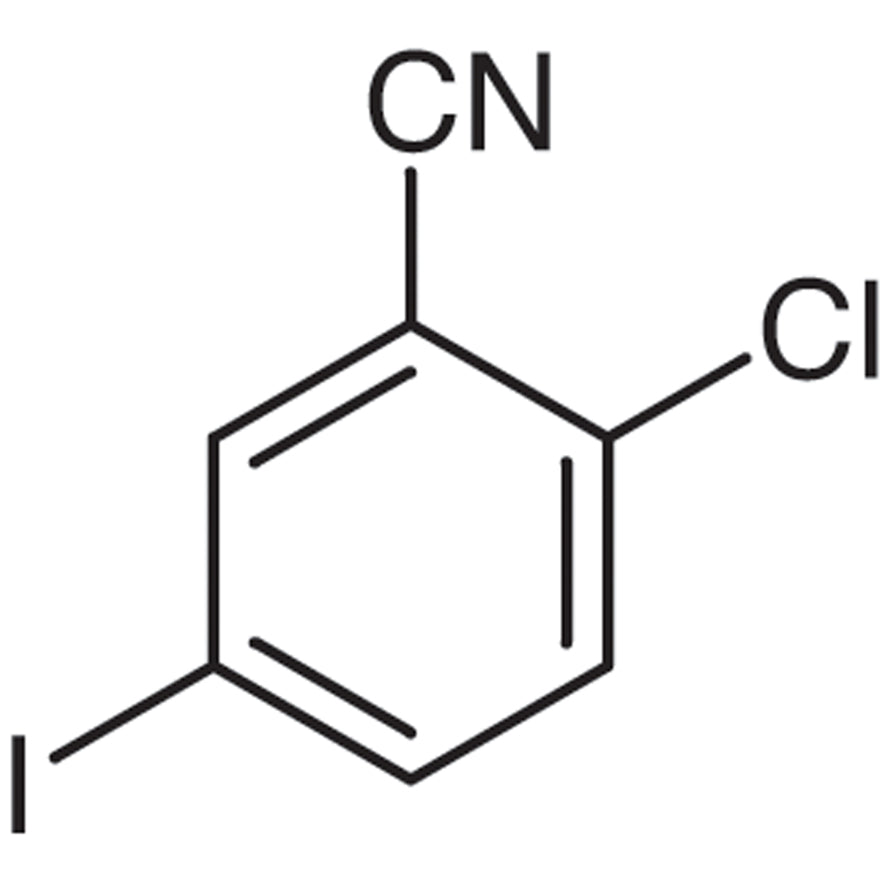
2-Chloro-5-iodobenzonitrile (TCI C2212) is a non-heterocyclic aromatic building block that carries three different functional groups on a single benzene ring: a chlorine atom, an iodine atom, and a nitrile group. This combination makes it a highly valued material in modern organic synthesis, particularly in medicinal chemistry and agrochemical research. In the laboratory, the compound serves as a core scaffold that can be elaborated in stages, so that a single starting material can give rise to many structural variations for the screening of active compounds as well as for structure–activity relationship studies.
The main value of this building block lies in the orthogonal reactivity between its functional groups. The carbon–iodine bond is far more reactive than the carbon–chlorine bond in palladium-catalysed cross-coupling reactions, so the iodine position can be functionalised first through Suzuki, Sonogashira, or Negishi chemistry while the chlorine remains intact as a point of modification in a later step. The nitrile group is itself a versatile handle that can be hydrolysed to a carboxylic acid or amide, reduced to an amine, or converted into a tetrazole as a bioisostere of a carboxylic acid. The electron-withdrawing character of the nitrile also influences the reactivity of the ring.
In Indonesian laboratories, this building block is typically used in university research groups, pharmaceutical development units, and agrochemical laboratories that carry out multi-step organic synthesis. It fits work where a small library of analogues has to be prepared from one common intermediate, and where sequential, controlled functionalisation is preferred over building each target molecule from scratch. Researchers working on candidate active compounds and structure–activity relationship programmes are the usual users of this material.
- Palladium-catalysed cross-coupling research: the highly reactive carbon–iodine bond allows selective Suzuki, Sonogashira, or Negishi coupling at the iodine position while the chlorine substituent is left untouched for later use.
- Medicinal chemistry scaffold elaboration: the three distinct functional groups on one ring let chemists build many analogue structures from a single starting material for the screening of biologically active compounds.
- Structure–activity relationship studies: sequential functionalisation of the iodine, chlorine, and nitrile positions produces systematic structural variations needed to correlate molecular structure with observed biological activity.
- Agrochemical synthesis programmes: the halogenated benzonitrile framework is a recognised starting point for preparing candidate agrochemical molecules through staged modification of each reactive site.
- Nitrile group transformation work: the cyano function can be hydrolysed to carboxylic acid or amide, reduced to an amine, or converted into tetrazole as a carboxylic acid bioisostere.
| Brand | TCI |
|---|---|
| CAS number | 289039-29-8 |
| Molecular formula | — |
| Purity | — |
| Category | Chemistry > Building Blocks > Non-Heterocyclic Building Blocks |
| Pack sizes | available in the standard catalogue pack sizes offered for this item |
| Physical form | — |
| Storage | store according to the conditions stated on the manufacturer's label and safety data sheet |
- Product code: C2212
Store this building block in its original tightly closed container, in a cool, dry, and well-ventilated place away from direct sunlight, moisture, and incompatible materials, following the conditions given on the manufacturer's label and safety data sheet. Keep containers clearly labelled and reseal them promptly after each use. Handle the material inside a fume hood using appropriate personal protective equipment, including safety glasses, chemical-resistant gloves, and a laboratory coat. Avoid inhalation of dust and contact with skin and eyes, and wash hands thoroughly after handling. Dispose of residues and contaminated materials in accordance with applicable laboratory waste regulations.
—
Produk Terkait
-
5-Bromo-2-iodobenzonitrile TCI B2215
Regular price Rp 743.400,00Regular price -
4-Amino-3-iodobenzonitrile TCI A2747
Regular price From Rp 743.400,00Regular price -
4-Iodobenzonitrile TCI I0661
Regular price From Rp 1.724.100,00Regular price -
3-Iodobenzonitrile TCI I0660
Regular price From Rp 2.466.450,00Regular price -
2-Iodobenzonitrile TCI I0659
Regular price From Rp 1.749.300,00Regular price -
1-Bromo-2-chloro-4-nitrobenzene TCI B5348
Regular price From Rp 1.298.850,00Regular price -
4-Bromo-1-chloro-2-nitrobenzene TCI B4374
Regular price From Rp 1.246.350,00Regular price -
2-Bromo-6-chloro-4-nitroaniline TCI B1771
Regular price Rp 477.750,00Regular price