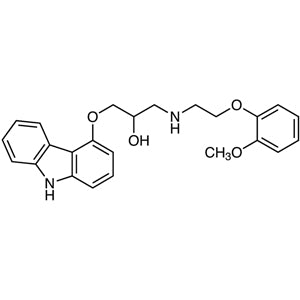
Carvedilol from TCI, supplied under catalogue code C2260, is a pharmaceutical compound belonging to the adrenergic blocker class, widely known as a non-selective beta-blocker with additional alpha-1 receptor blocking activity. Within this catalogue the material is offered as a pharmaceutical research reagent for experimental use, not as a finished medicinal product. Its role in the laboratory is to provide an active substance of defined identity for quality analysis, method development, formulation studies, and pharmacological research requiring a reference compound whose mechanism of action is already well understood.
The characteristic that makes Carvedilol scientifically interesting is its unusual dual activity profile. In addition to blocking beta receptors, the compound also blocks alpha-1 receptors and thereby produces a vasodilatory effect, while its carbazole structure confers antioxidant properties that have been extensively studied. From an analytical standpoint, the fluorescent carbazole group greatly facilitates detection at low concentrations using fluorescence detectors, while the aromatic framework provides strong ultraviolet absorption. The molecule also possesses a chiral centre, which is why it is frequently used in work concerned with stereochemistry and enantiomeric separation.
In Indonesian laboratories, this material is typically held by pharmaceutical quality control units, university research groups in pharmacy and biomedical sciences, and analytical service laboratories that develop and validate assay procedures. It is ordinarily purchased in small quantities appropriate to research-scale consumption, logged into a controlled chemical inventory, and handled under the institution's standard procedures for pharmacologically active substances. Documentation supplied with the material supports identity traceability throughout the study.
TCI brochures (PDF)
- Carbazoles 2025-06-27 · p. 2
- Pharmaceutical Ingredients for Research and Experimental Use 2026-03-09 · p. 20
- Analytical method development for beta-blockers, where the defined identity of the compound allows chromatographic conditions, detector settings, and system suitability parameters to be established reliably.
- High-performance liquid chromatography with fluorescence or ultraviolet detection, taking direct advantage of the fluorescent carbazole group and the strong aromatic absorption for sensitive determination at low levels.
- Chiral separation and stereochemical studies, since the molecule carries a chiral centre that makes it a practical subject for enantiomeric resolution work and chiral column evaluation.
- Pharmacological research on adrenergic receptors, where the dual beta and alpha-1 blocking profile provides a well-characterised comparator compound for receptor binding and functional response investigations.
- Formulation and quality assessment studies, in which the material serves as a defined active substance for dissolution work, stability-indicating method design, and comparative evaluation of preparation approaches.
| Brand | TCI (Tokyo Chemical Industry) |
|---|---|
| CAS number | 72956-09-3 |
| Molecular formula | — |
| Purity | — |
| Category | Life Science > Biochemicals and Reagents > Pharmaceutical Research Reagents (for Experimental Use) |
| Pack sizes | available in research-scale packaging; please refer to the current catalogue listing for the sizes offered |
| Physical form | — |
| Storage | store according to the conditions stated on the product label and accompanying documentation |
- Product code: C2260
Store the container tightly closed in a cool, dry place, protected from direct sunlight and away from heat sources, following the specific conditions indicated on the product label. Original manufacturer packaging or amber glass containers with well-sealed closures are suitable, as they limit exposure to light and moisture. Because this is a pharmacologically active substance intended for experimental use only, handle it with laboratory gloves, safety glasses, and a laboratory coat, and carry out weighing and transfer operations in a fume hood or a well-ventilated area to avoid dust inhalation. Avoid contact with skin and eyes, do not eat or drink in the handling area, and wash hands thoroughly after use. Record each withdrawal in the chemical inventory, keep the material clearly labelled, and dispose of residues and contaminated consumables through the institution's chemical waste procedures.
—
Product Categories
- Biochemicals and ReagentsPharmaceutical Research Reagents (for Experimental Use)Antihypertensive Ingredients (for Research and Experimental Use)
- Biochemicals and Reagents
- Pharmaceutical Development and Drug Discovery ResearchPharmaceutical Research Reagents (for Experimental Use)Antihypertensive Ingredients (for Research and Experimental Use)
Produk Terkait
-
Irbesartan TCI I0859
Regular price From Rp 1.008.000,00Regular priceRp 720.300,00Sale price From Rp 1.008.000,00 -
VerapamilHydrochloride TCI V0118
Regular price From Rp 1.618.050,00Regular priceRp 1.146.600,00Sale price From Rp 1.618.050,00 -
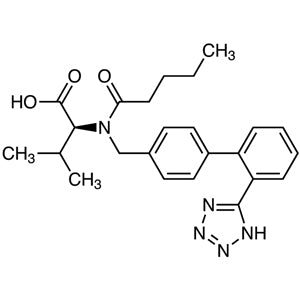
Valsartan TCI V0112
Regular price From Rp 1.087.800,00Regular priceRp 775.950,00Sale price From Rp 1.087.800,00 -
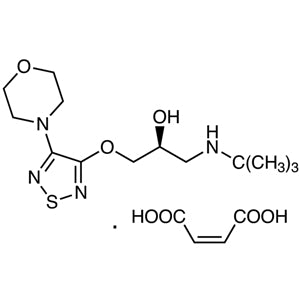
TimololMaleate TCI T2905
Regular price Rp 3.578.400,00Regular priceRp 2.517.900,00Sale price Rp 3.578.400,00 -
Telmisartan TCI T2861
Regular price From Rp 2.013.900,00Regular priceRp 1.423.800,00Sale price From Rp 2.013.900,00 -
BetaxololHydrochloride TCI B4474
Regular price From Rp 3.365.250,00Regular priceRp 2.368.800,00Sale price From Rp 3.365.250,00 -
BenazeprilHydrochloride TCI B3611
Regular price Rp 2.491.650,00Regular priceRp 1.757.700,00Sale price Rp 2.491.650,00 -
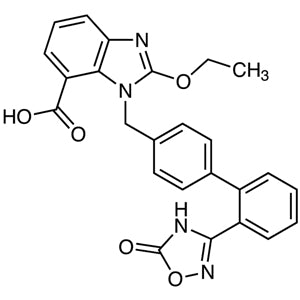
Azilsartan TCI A2601
Regular price From Rp 2.384.550,00Regular priceRp 1.683.150,00Sale price From Rp 2.384.550,00