trans-1,4-Cyclohexanediol is an alicyclic diol in which two hydroxyl groups sit at the 1 and 4 positions of a cyclohexane ring in the trans configuration. In synthetic chemistry laboratories it is a versatile non-heterocyclic building block. Both hydroxyl groups can be converted into esters, ethers, carbonates, or leaving groups such as tosylates and mesylates. This makes the compound a common starting point for molecules that need a rigid, symmetrical cyclohexane framework. It is used in organic chemistry, polymer chemistry, and materials development research.
The main advantage of this compound is its defined stereochemistry. In the trans isomer, both substituents can occupy equatorial positions in the chair conformation, so the molecule is relatively linear, symmetrical, and conformationally stable. This matters when researchers need predictable geometry, for example in spacers for liquid crystal materials, in monomers for polyesters and polyurethanes, or in bridging ligands. Because the two hydroxyl groups are equivalent, difunctionalization reactions proceed more uniformly. Having the pure trans isomer also makes NMR analysis and the interpretation of reaction outcomes more straightforward.
In Indonesian laboratories, trans-1,4-Cyclohexanediol is mainly found in university organic chemistry research groups, polymer and materials science laboratories, and research and development units working on new functional materials. Researchers use it to prepare derivatives with a rigid cyclohexane core, to study how stereochemistry affects material properties, and as a model diol in teaching and in method development. Supplied under the TCI brand, it gives research teams a consistent starting material for synthesis work that depends on a defined trans geometry.
TCI brochures (PDF)
- Monomers 2025-05-28 · p. 24
Related TCI products
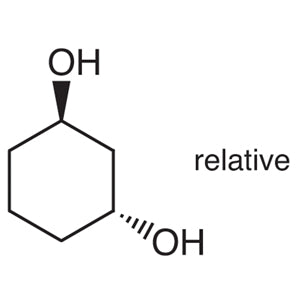
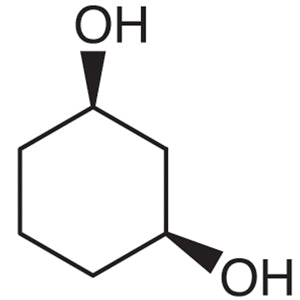
- TCI C2323 5515-64-0 trans-1,3-Cyclohexanediol
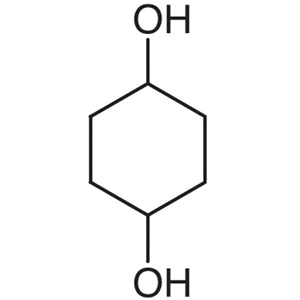
- TCI C0482 556-48-9 1,4-Cyclohexanediol (cis- and trans- mixture)
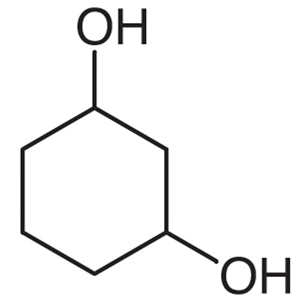
- TCI C0481 504-01-8 1,3-Cyclohexanediol (cis- and trans- mixture)
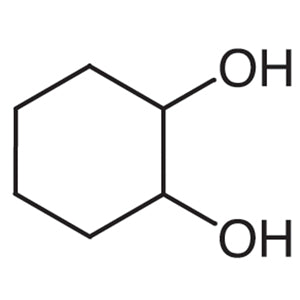
- TCI C0480 931-17-9 1,2-Cyclohexanediol (cis- and trans- mixture)
- TCI H0100 2935-44-6 2,5-Hexanediol
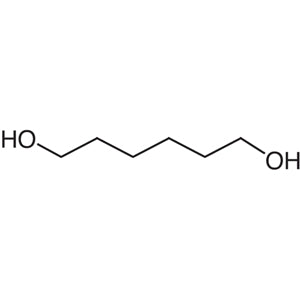
- TCI H0099 629-11-8 1,6-Hexanediol
- Synthesis of esters, ethers, and carbonates: the two equivalent hydroxyl groups react predictably, so researchers can prepare symmetrical difunctional derivatives built on a rigid cyclohexane core.
- Preparation of tosylates and mesylates: converting the hydroxyl groups into good leaving groups opens routes to substitution reactions and to further elaboration of the trans-cyclohexane framework.
- Polyester and polyurethane monomer research: the linear, symmetrical trans geometry helps polymer chemists study how a rigid alicyclic diol unit affects chain packing and material behaviour.
- Spacers for liquid crystal materials: its conformational stability, with both substituents able to sit equatorially, gives the predictable molecular shape that liquid crystal design requires.
- Bridging ligand design and stereochemistry studies: the defined trans configuration simplifies NMR interpretation and lets researchers relate molecular geometry directly to observed reaction or coordination outcomes.
| Brand | TCI (product code C2320) |
|---|---|
| CAS number | 6995-79-5 |
| Molecular formula | — |
| Purity | — |
| Category | Chemistry > Building Blocks > Non-Heterocyclic Building Blocks |
| Pack sizes | available in TCI standard pack sizes; please confirm the options when you enquire |
| Physical form | refer to the TCI specification sheet and Certificate of Analysis |
| Storage | keep tightly closed in a cool, dry place; follow the storage conditions on the TCI label and SDS |
Store trans-1,4-Cyclohexanediol in its original, tightly sealed container in a cool, dry, well-ventilated area, away from direct sunlight, heat sources, and incompatible materials such as strong oxidizing agents. Close the container promptly after each use to keep moisture and contaminants out. When decanting, use clean, dry glass or chemically compatible containers that are clearly labelled. Handle the material in a well-ventilated area or a fume hood, and wear standard laboratory personal protective equipment, including safety glasses, gloves, and a lab coat. Avoid creating dust, inhalation, and contact with skin or eyes. Always read the TCI Safety Data Sheet before use, and dispose of waste according to local laboratory and environmental regulations.
—
Produk Terkait
-
trans-1,3-Cyclohexanediol TCI C2323
Regular price Rp 10.281.600,00Regular priceRp 7.205.100,00Sale price Rp 10.281.600,00 -
1,4-Cyclohexanediol(cis-andtrans-mixture) TCI C0482
Regular price From Rp 582.750,00Regular priceRp 423.150,00Sale price From Rp 582.750,00 -
1,3-Cyclohexanediol(cis-andtrans-mixture) TCI C0481
Regular price From Rp 2.677.500,00Regular priceRp 1.887.900,00Sale price From Rp 2.677.500,00 -
1,2-Cyclohexanediol(cis-andtrans-mixture) TCI C0480
Regular price From Rp 2.252.250,00Regular priceRp 1.590.750,00Sale price From Rp 2.252.250,00 -
2,5-Hexanediol TCI H0100
Regular price From Rp 1.351.350,00Regular priceRp 960.750,00Sale price From Rp 1.351.350,00 -
1,6-Hexanediol TCI H0099
Regular price From Rp 530.250,00Regular priceRp 386.400,00Sale price From Rp 530.250,00 -
2,5-Dimethyl-2,5-hexanediol TCI D1167
Regular price From Rp 557.550,00Regular priceRp 405.300,00Sale price From Rp 557.550,00 -
cis-1,3-Cyclohexanediol TCI C2322
Regular price From Rp 6.465.900,00Regular priceRp 4.537.050,00Sale price From Rp 6.465.900,00