


TCI C2551 Chlorotripyrrolidinophosphonium Hexafluorophosphate is a phosphonium-based coupling reagent used in peptide chemistry and amide synthesis. It works by activating a carboxylic acid group so that it becomes ready to react with an amino group, forming the amide bond that serves as the backbone of every peptide chain. Its cationic structure consists of a phosphorus atom bound to three pyrrolidine rings and one chlorine atom, with hexafluorophosphate acting as the counter-anion. This anion is inert and does not interfere with the progress of the coupling reaction, whether the work is carried out in a flask or on solid-phase synthesis.
This reagent is chosen primarily when the coupling to be performed is classified as difficult. Such conditions arise with sterically hindered amino acids, with residues whose nitrogen is methylated, or in the joining of long peptide fragments, where ordinary coupling reagents frequently give low yields. The distinctive activation pathway of this chlorophosphonium class of reagent makes it effective on those problematic substrates. Because it does not carry a tertiary amino group capable of terminating the chain, the reagent is also safe to use in the presence of an excess of free amine. The hexafluorophosphate anion contributes to this well-behaved reaction profile.
In Indonesian laboratories, this reagent is typically found in research groups and institutional facilities engaged in peptide synthesis and organic synthesis work. It is generally reached for in the specific situations described above, rather than as the default reagent for routine, unhindered couplings. Analysts and synthetic chemists working on fragment condensation, N-methylated sequences, or hindered residues keep a reagent of this class on hand precisely because the standard options tend to underperform on those steps.
TCI brochures (PDF)
- Condensing Agents 2025-11-18 · p. 7
- Amino Acids and Peptide Synthesis Reagents 2025-08-14 · p. 39
Related TCI products
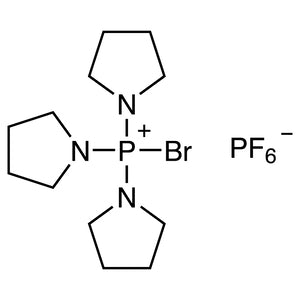
- TCI B2680 132705-51-2 Bromotripyrrolidinophosphonium Hexafluorophosphate
- TCI B1774 128625-52-5 1H-Benzotriazol-1-yloxytripyrrolidinophosphonium Hexafluorophosphate [Coupling Reagent for Peptide]
- TCI T2929 265651-18-1 N,N,N',N'-Tetramethyl-O-(N-succinimidyl)uronium Hexafluorophosphate
- TCI B4805 105379-24-6 O-(Benzotriazol-1-yl)-N,N,N',N'-bis(tetramethylene)uronium Hexafluorophosphate
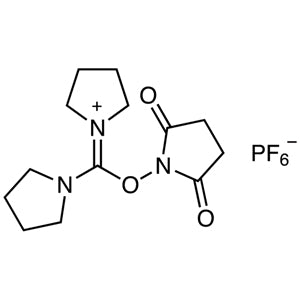
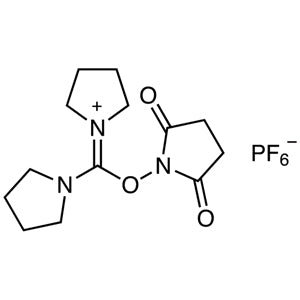
- TCI B3817 207683-26-9 N,N,N',N'-Bis(tetramethylene)-O-(N-succinimidyl)uronium Hexafluorophosphate
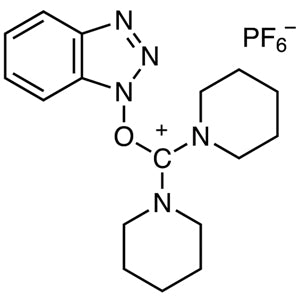
- TCI B3816 206752-41-2 O-(Benzotriazol-1-yl)-N,N,N',N'-bis(pentamethylene)uronium Hexafluorophosphate
- Solid-phase peptide synthesis: the reagent activates the carboxylic acid component for amide bond formation on resin, and the inert hexafluorophosphate anion does not interfere with the coupling step.
- Coupling of sterically hindered amino acids: its distinctive activation pathway makes this chlorophosphonium class effective on bulky residues where ordinary coupling reagents frequently return low yields.
- N-methylated residue coupling: residues whose nitrogen is methylated are a classic difficult case for standard reagents, and this phosphonium reagent is selected specifically for such demanding substrates.
- Peptide fragment condensation: the joining of long peptide fragments is one of the difficult coupling situations for which this reagent is chosen over conventional alternatives.
- General amide synthesis in solution: the reagent activates carboxylic acids toward amino groups in flask chemistry, and carries no chain-terminating tertiary amino group when free amine is present in excess.
| Brand | TCI |
|---|---|
| CAS number | 133894-48-1 |
| Molecular formula | — |
| Purity | — |
| Category | Chemistry > Chemical Biology > Peptide Chemistry |
| Pack sizes | available in the catalogue pack sizes offered for this product code |
| Physical form | — |
| Storage | store according to the manufacturer's stated conditions on the product label |
- Product code: C2551
Store the container in a cool, dry place, tightly closed and protected from moisture, following the storage conditions stated by the manufacturer on the product label. Keep the material in its original supplier container with an intact closure; transfer only into clean, dry, chemically compatible vessels that are clearly labelled. Handle in a well-ventilated area or a fume hood, wearing a laboratory coat, safety glasses, and suitable gloves. Avoid contact with skin and eyes and avoid breathing any dust. Weigh out and reseal promptly to limit exposure to atmospheric moisture. Consult the manufacturer's safety data sheet before use, and dispose of residues and contaminated materials in accordance with applicable laboratory waste procedures.
—
Product Categories
Produk Terkait
-
BromotripyrrolidinophosphoniumHexafluorophosphate TCI B2680
Regular price From Rp 1.458.450,00Regular price -
1H-Benzotriazol-1-yloxytripyrrolidinophosphoniumHexafluorophosphate[CouplingReagentforPeptide] TCI B1774
Regular price From Rp 980.700,00Regular price -
N,N,N',N'-Tetramethyl-O-(N-succinimidyl)uroniumHexafluorophosphate TCI T2929
Regular price From Rp 1.193.850,00Regular price -
O-(Benzotriazol-1-yl)-N,N,N',N'-bis(tetramethylene)uroniumHexafluorophosphate TCI B4805
Regular price From Rp 1.167.600,00Regular price -
N,N,N',N'-Bis(tetramethylene)-O-(N-succinimidyl)uroniumHexafluorophosphate TCI B3817
Regular price From Rp 1.298.850,00Regular price -
O-(Benzotriazol-1-yl)-N,N,N',N'-bis(pentamethylene)uroniumHexafluorophosphate TCI B3816
Regular price From Rp 823.200,00Regular price -
1H-Benzotriazol-1-yloxytris(dimethylamino)phosphoniumHexafluorophosphate[CouplingReagentforPeptide] TCI B1651
Regular price From Rp 795.900,00Regular price -
Fluoro-N,N,N',N'-tetramethylformamidiniumHexafluorophosphate TCI F0726
Regular price From Rp 1.565.550,00Regular price

![128625-52-5 1H-Benzotriazol-1-yloxytripyrrolidinophosphonium Hexafluorophosphate [Coupling Reagent for Peptide] - AMI Scientific](http://amiscientific.com/cdn/shop/files/TCI2510B1774.jpg?v=1768204096&width=533)


![56602-33-6 1H-Benzotriazol-1-yloxytris(dimethylamino)phosphonium Hexafluorophosphate [Coupling Reagent for Peptide] - AMI Scientific](http://amiscientific.com/cdn/shop/files/TCI2510B1651.jpg?v=1768204084&width=533)
