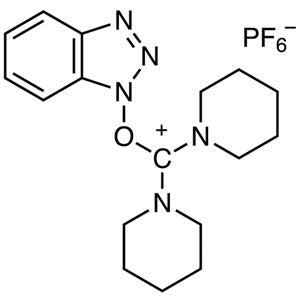
TCI B1774, also known as 1H-Benzotriazol-1-yloxytripyrrolidinophosphonium Hexafluorophosphate, is a coupling reagent widely used in peptide synthesis. It plays a crucial role in the chemical biology field by facilitating the efficient reaction between amino acids and other molecules during the formation of peptides. This reagent is essential in laboratories where precision and efficiency in chemical reactions are required. Its unique chemical structure enables it to act as a highly effective catalyst, promoting the formation of peptide bonds under specific reaction conditions.
One of the key properties that make TCI B1774 a preferred choice is its high reactivity towards various substrates. It is stable under certain conditions and maintains its effectiveness even in complex reaction environments. This makes it particularly suitable for applications where high specificity and reliability are necessary. Additionally, its ability to enhance reaction efficiency and reduce synthesis time makes it a valuable tool for researchers working in peptide chemistry. The reagent's stability and reactivity contribute to its widespread use in both academic and industrial research settings.
In Indonesian laboratories, TCI B1774 is commonly used in biochemical and chemical biology research. It is particularly favored for its role in peptide synthesis, where it helps in the creation of bioactive molecules with precise structures. Its application extends to studies involving proteins, enzymes, and other biomolecules, making it an essential component in the toolkit of many researchers. The reagent's reliability and performance under controlled conditions make it a trusted choice for both basic and applied research.
TCI brochures (PDF)
- Condensing Agents 2025-11-18 · p. 6
- Amino Acids and Peptide Synthesis Reagents 2025-08-14 · p. 37
- Reagents for Biological Research 2025-03-11 · p. 59
Related TCI products
- TCI B4805 105379-24-6 O-(Benzotriazol-1-yl)-N,N,N',N'-bis(tetramethylene)uronium Hexafluorophosphate
- TCI B3816 206752-41-2 O-(Benzotriazol-1-yl)-N,N,N',N'-bis(pentamethylene)uronium Hexafluorophosphate
- TCI B1658 125700-67-6 TBTU [Coupling Reagent for Peptide]
- TCI B1657 94790-37-1 HBTU [Coupling Reagent for Peptide]
- TCI B1651 56602-33-6 1H-Benzotriazol-1-yloxytris(dimethylamino)phosphonium Hexafluorophosphate [Coupling Reagent for Peptide]
- TCI N0634 125700-73-4 2-(5-Norbornene-2,3-dicarboximido)-1,1,3,3-tetramethyluronium Tetrafluoroborate [Coupling Reagent for Peptide]
- Peptide Synthesis: TCI B1774 is ideal for peptide synthesis due to its ability to efficiently catalyze the formation of peptide bonds between amino acids, enhancing reaction speed and yield.
- Protein Engineering: This reagent supports the development of custom proteins by enabling precise and controlled coupling reactions, crucial for structural and functional studies.
- Enzyme Modification: It facilitates the modification of enzymes by allowing the attachment of functional groups or other molecules, aiding in the study of enzyme activity and specificity.
- Bioconjugation Research: TCI B1774 is used in bioconjugation experiments to link biomolecules with various chemical moieties, enabling the creation of targeted therapeutics and diagnostic tools.
- Molecular Biology Studies: Its role in coupling reactions makes it valuable for molecular biology applications, including the synthesis of peptides for drug development and biomarker research.
From the TCI brochure
- Condensing agent in Fmoc solid phase peptide synthesis (Figure 1)
| Brand | TCI |
|---|---|
| CAS number | 128625-52-5 |
| Molecular formula | — |
| Purity | — |
| Category | Chemistry > Chemical Biology > Peptide Chemistry |
| Pack sizes | Available in various quantities as per standard laboratory supply |
| Physical form | Solid powder |
| Storage | Store in a cool, dry place away from moisture and direct sunlight |
TCI B1774 should be stored in a cool, dry environment to maintain its stability and effectiveness. It is recommended to keep the reagent in a tightly sealed container to prevent exposure to moisture and air. Due to its chemical nature, it should be handled in a well-ventilated area, preferably with appropriate personal protective equipment such as gloves and safety goggles. Avoid direct contact with skin and eyes, and ensure that spillage is contained and cleaned up promptly. The reagent is not flammable, but it is important to store it away from incompatible substances to ensure safety in the laboratory setting. Proper storage and handling practices will help preserve the reagent's integrity and ensure safe usage in research applications.
—
Product Categories
Produk Terkait
-
O-(Benzotriazol-1-yl)-N,N,N',N'-bis(tetramethylene)uroniumHexafluorophosphate TCI B4805
Regular price From Rp 1.220.100,00Regular priceRp 868.350,00Sale price From Rp 1.220.100,00 -
O-(Benzotriazol-1-yl)-N,N,N',N'-bis(pentamethylene)uroniumHexafluorophosphate TCI B3816
Regular price From Rp 875.700,00Regular priceRp 627.900,00Sale price From Rp 875.700,00 -
TBTU[CouplingReagentforPeptide] TCI B1658
Regular price From Rp 1.563.450,00Regular priceRp 1.108.800,00Sale price From Rp 1.563.450,00 -
HBTU[CouplingReagentforPeptide] TCI B1657
Regular price From Rp 637.350,00Regular priceRp 460.950,00Sale price From Rp 637.350,00 -
1H-Benzotriazol-1-yloxytris(dimethylamino)phosphoniumHexafluorophosphate[CouplingReagentforPeptide] TCI B1651
Regular price From Rp 848.400,00Regular priceRp 609.000,00Sale price From Rp 848.400,00 -
2-(5-Norbornene-2,3-dicarboximido)-1,1,3,3-tetramethyluroniumTetrafluoroborate[CouplingReagentforPeptide] TCI N0634
Regular price From Rp 1.670.550,00Regular priceRp 1.183.350,00Sale price From Rp 1.670.550,00 -
BromotripyrrolidinophosphoniumHexafluorophosphate TCI B2680
Regular price From Rp 1.510.950,00Regular priceRp 1.072.050,00Sale price From Rp 1.510.950,00 -
N-Hydroxysuccinimide[CouplingReagentforPeptide] TCI B0249
Regular price From Rp 1.988.700,00Regular priceRp 1.405.950,00Sale price From Rp 1.988.700,00