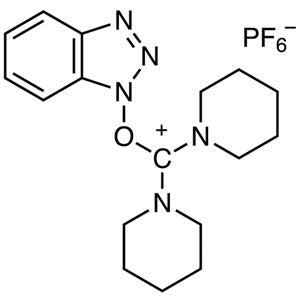
N,N,N',N'-Bis(tetramethylene)-O-(N-succinimidyl)uronium Hexafluorophosphate is a chemical compound widely used in chemical biology, particularly in peptide chemistry. This reagent plays a crucial role in laboratory settings by enabling the activation and coupling of peptide molecules through peptide bonds. Its application is essential in the synthesis of complex peptide structures, which are vital for biomedical research and pharmacological studies. The compound’s ability to form strong bonds with target molecules makes it a key component in various synthetic processes within the laboratory.
The compound’s high reactivity and strong bonding capabilities make it a preferred choice for peptide synthesis. It is known for its stability under certain conditions, which allows for ease of storage and use across different laboratory scales. These properties ensure consistent performance and reliability in experimental procedures. Additionally, its compatibility with a wide range of peptide sequences enhances its utility in diverse research applications. The compound’s effectiveness in creating stable peptide linkages contributes to its widespread adoption in both academic and industrial research environments.
In Indonesian laboratories, this compound is commonly used by researchers in biochemistry, pharmacy, and health sciences. It supports studies related to drug development, molecular diagnostics, and protein research. Its availability in the local market ensures that scientists have access to high-quality materials for their experiments. The compound’s role in complex peptide synthesis makes it an essential tool for advancing research in these fields.
TCI brochures (PDF)
- Condensing Agents 2025-11-18 · p. 7
Related TCI products
- TCI T2929 265651-18-1 N,N,N',N'-Tetramethyl-O-(N-succinimidyl)uronium Hexafluorophosphate
- TCI T2224 105832-38-0 N,N,N',N'-Tetramethyl-O-(N-succinimidyl)uronium Tetrafluoroborate
- TCI B4805 105379-24-6 O-(Benzotriazol-1-yl)-N,N,N',N'-bis(tetramethylene)uronium Hexafluorophosphate
- TCI B3816 206752-41-2 O-(Benzotriazol-1-yl)-N,N,N',N'-bis(pentamethylene)uronium Hexafluorophosphate
- TCI B2680 132705-51-2 Bromotripyrrolidinophosphonium Hexafluorophosphate
- TCI B1774 128625-52-5 1H-Benzotriazol-1-yloxytripyrrolidinophosphonium Hexafluorophosphate [Coupling Reagent for Peptide]
- Peptide Synthesis: This compound is ideal for synthesizing complex peptides due to its ability to activate and link peptide molecules efficiently.
- Biomedical Research: It supports the development of therapeutic peptides and biomolecules, aiding in drug discovery and development.
- Molecular Diagnostics: The compound facilitates the creation of diagnostic probes and assays, enhancing the accuracy of molecular testing.
- Protein Engineering: It enables the modification and assembly of protein structures, contributing to advancements in structural biology.
- Pharmaceutical Development: It is used in the design and testing of new pharmaceutical compounds, supporting innovation in drug formulation.
| Brand | TCI |
|---|---|
| CAS number | 207683-26-9 |
| Molecular formula | — |
| Purity | — |
| Category | Chemistry > Chemical Biology > Peptide Chemistry |
| Pack sizes | Available in various quantities as per standard laboratory requirements |
| Physical form | Solid powder |
| Storage | Store in a cool, dry place away from moisture and direct sunlight |
This compound should be stored in a cool, dry environment, away from moisture and direct sunlight to maintain its stability and effectiveness. It is recommended to use airtight containers to prevent exposure to air and humidity, which could affect its reactivity. Due to its chemical nature, it should be handled with appropriate personal protective equipment, such as gloves and safety goggles, to ensure laboratory safety. Proper ventilation is also essential when working with this material to minimize inhalation risks. The compound is not classified as hazardous under standard laboratory conditions, but general safety protocols should be followed to prevent accidental contamination or exposure. Its stability under controlled storage conditions ensures reliable performance in experimental applications.
—
Product Categories
Produk Terkait
-
N,N,N',N'-Tetramethyl-O-(N-succinimidyl)uroniumHexafluorophosphate TCI T2929
Regular price From Rp 1.246.350,00Regular priceRp 887.250,00Sale price From Rp 1.246.350,00 -
N,N,N',N'-Tetramethyl-O-(N-succinimidyl)uroniumTetrafluoroborate TCI T2224
Regular price From Rp 848.400,00Regular priceRp 609.000,00Sale price From Rp 848.400,00 -
O-(Benzotriazol-1-yl)-N,N,N',N'-bis(tetramethylene)uroniumHexafluorophosphate TCI B4805
Regular price From Rp 1.220.100,00Regular priceRp 868.350,00Sale price From Rp 1.220.100,00 -
O-(Benzotriazol-1-yl)-N,N,N',N'-bis(pentamethylene)uroniumHexafluorophosphate TCI B3816
Regular price From Rp 875.700,00Regular priceRp 627.900,00Sale price From Rp 875.700,00 -
BromotripyrrolidinophosphoniumHexafluorophosphate TCI B2680
Regular price From Rp 1.510.950,00Regular priceRp 1.072.050,00Sale price From Rp 1.510.950,00 -
1H-Benzotriazol-1-yloxytripyrrolidinophosphoniumHexafluorophosphate[CouplingReagentforPeptide] TCI B1774
Regular price From Rp 1.033.200,00Regular priceRp 738.150,00Sale price From Rp 1.033.200,00 -
1H-Benzotriazol-1-yloxytris(dimethylamino)phosphoniumHexafluorophosphate[CouplingReagentforPeptide] TCI B1651
Regular price From Rp 848.400,00Regular priceRp 609.000,00Sale price From Rp 848.400,00 -
Fluoro-N,N,N',N'-tetramethylformamidiniumHexafluorophosphate TCI F0726
Regular price From Rp 1.618.050,00Regular priceRp 1.146.600,00Sale price From Rp 1.618.050,00