

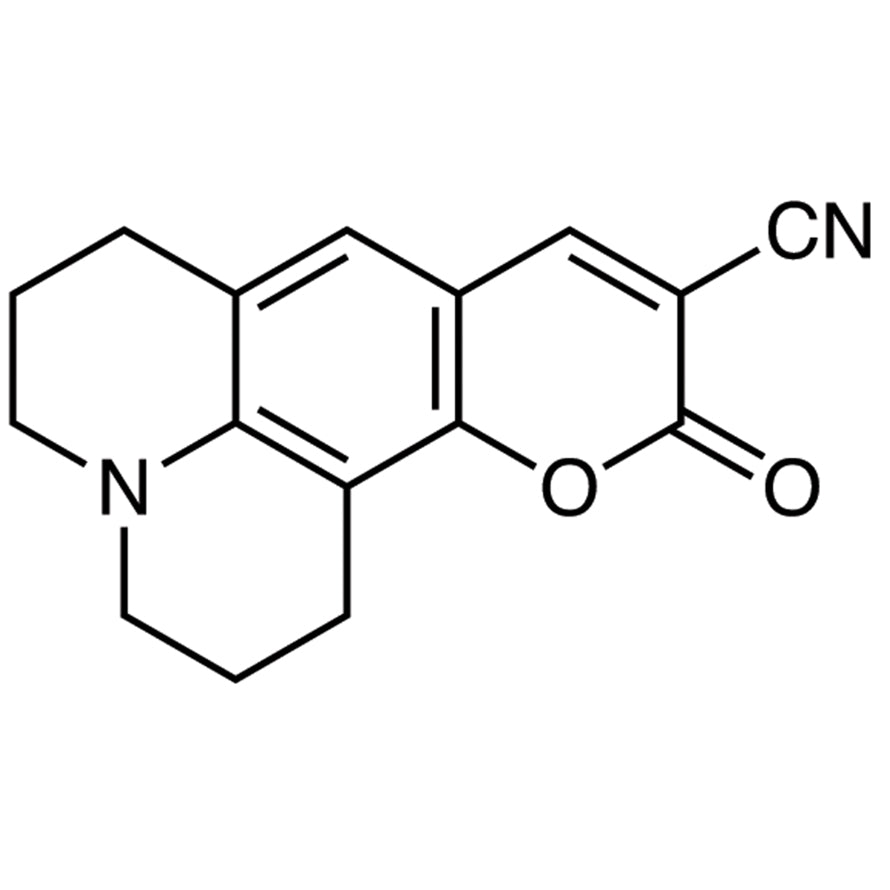
Coumarin 337 is a fluorescent dye from the coumarin family, a class of compounds widely known as laser dyes and fluorescent labels. Its structure combines a coumarin core with a rigid, cyclized amine system and a nitrile group that withdraws electrons. This design produces strong intramolecular charge transfer when the molecule is excited. In the laboratory, Coumarin 337 is classed as a photonic and optical material. It is used in dye laser experiments, fluorescence spectroscopy, and research on light-emitting materials, where a well-defined fluorophore is needed.
Coumarin dyes are valued for their high fluorescence efficiency and for emitting in the visible region, especially from blue to green. In Coumarin 337, the amine is locked into a ring, which restricts free rotation. As a result, less excitation energy is lost through non-radiative pathways. The nitrile group shifts the dye's optical properties and makes it sensitive to the polarity of its surroundings, an effect known as solvatochromism. Researchers use this sensitivity to probe microenvironments in solutions, polymers, and organized systems such as micelles. Together, these traits make it a strong choice for optical and photophysical work.
In Indonesia, Coumarin 337 suits optics and photonics physics laboratories, as well as spectroscopy research groups in chemistry and physics departments. It also fits materials science teams that develop luminescent or optically active materials. AMI Scientific supplies this TCI product to universities, research institutes, and industrial R&D laboratories that need a dependable coumarin dye. Typical work includes teaching experiments, thesis projects, and advanced research on fluorescence behavior, laser media, and environment-sensitive probes.
Related TCI products
- TCI B4257 155306-71-1 Coumarin 545T
- TCI B2111 27425-55-4 3-(2-Benzimidazolyl)-7-(diethylamino)coumarin
- TCI B2088 38215-36-0 3-(2-Benzothiazolyl)-7-(diethylamino)coumarin
- TCI D5007 117850-52-9 7-(Diethylamino)-3-(2-thienyl)coumarin
- TCI C3640 53518-18-6 Coumarin 153 (purified by sublimation)
- TCI C3072 87349-92-6 Coumarin 510
- Dye laser experiments: Coumarin 337 belongs to the coumarin class of laser dyes, and its efficient fluorescence in the visible region makes it useful as an active medium in dye laser research and teaching.
- Fluorescence spectroscopy: Its high fluorescence efficiency and well-defined emission make it a practical reference fluorophore for studying absorption, emission, and excited-state behavior in spectroscopy laboratories.
- Solvatochromism and polarity studies: The nitrile group makes the dye sensitive to its surroundings, so its optical response can show how solvent polarity affects charge-transfer excited states.
- Microenvironment probing in polymers and micelles: Because it responds to local polarity, the dye can report on microenvironments inside polymer matrices, solutions, and organized assemblies such as micelles.
- Research on light-emitting materials: As a photonic and optical material that emits from blue to green, it supports the development and characterization of luminescent materials and optical devices.
| Brand | TCI (product code C3063) |
|---|---|
| CAS number | 55804-68-7 |
| Molecular formula | — |
| Purity | — |
| Category | Materials Science > Photonic Materials and Optical Materials > Coumarin Dyes |
| Pack sizes | as listed on the product page; contact AMI Scientific to confirm availability |
| Physical form | refer to the manufacturer's certificate of analysis and safety data sheet |
| Storage | keep tightly closed and protected from light, following the manufacturer's label recommendations |
Store Coumarin 337 in its original, tightly sealed container in a cool, dry place away from direct light, since fluorescent dyes can degrade under prolonged light exposure. Use amber glass or light-tight containers for prepared solutions, and label them with the solvent, concentration, and date. Handle the material in a well-ventilated area or fume hood. Wear gloves, safety glasses, and a lab coat, and avoid inhaling dust or letting it touch your skin. Keep it away from strong oxidizing agents. Always check the manufacturer's safety data sheet for specific storage temperature, hazard information, and disposal requirements before use.
—
Product Categories
Produk Terkait
-
Coumarin545T TCI B4257
Regular price Rp 4.982.250,00Regular priceRp 3.499.650,00Sale price Rp 4.982.250,00 -
3-(2-Benzimidazolyl)-7-(diethylamino)coumarin TCI B2111
Regular price From Rp 1.246.350,00Regular priceRp 887.250,00Sale price From Rp 1.246.350,00 -
3-(2-Benzothiazolyl)-7-(diethylamino)coumarin TCI B2088
Regular price From Rp 2.068.500,00Regular priceRp 1.461.600,00Sale price From Rp 2.068.500,00 -
7-(Diethylamino)-3-(2-thienyl)coumarin TCI D5007
Regular price From Rp 2.889.600,00Regular priceRp 2.035.950,00Sale price From Rp 2.889.600,00 -
Coumarin153(purifiedbysublimation) TCI C3640
Regular price Rp 5.141.850,00Regular priceRp 3.610.950,00Sale price Rp 5.141.850,00 -
Coumarin510 TCI C3072
Regular price From Rp 2.332.050,00Regular priceRp 1.630.650,00Sale price From Rp 2.332.050,00 -
Coumarin525 TCI C3047
Regular price Rp 4.611.600,00Regular priceRp 3.240.300,00Sale price Rp 4.611.600,00 -
Coumarin521T TCI C3046
Regular price Rp 3.074.400,00Regular priceRp 2.165.100,00Sale price Rp 3.074.400,00


