

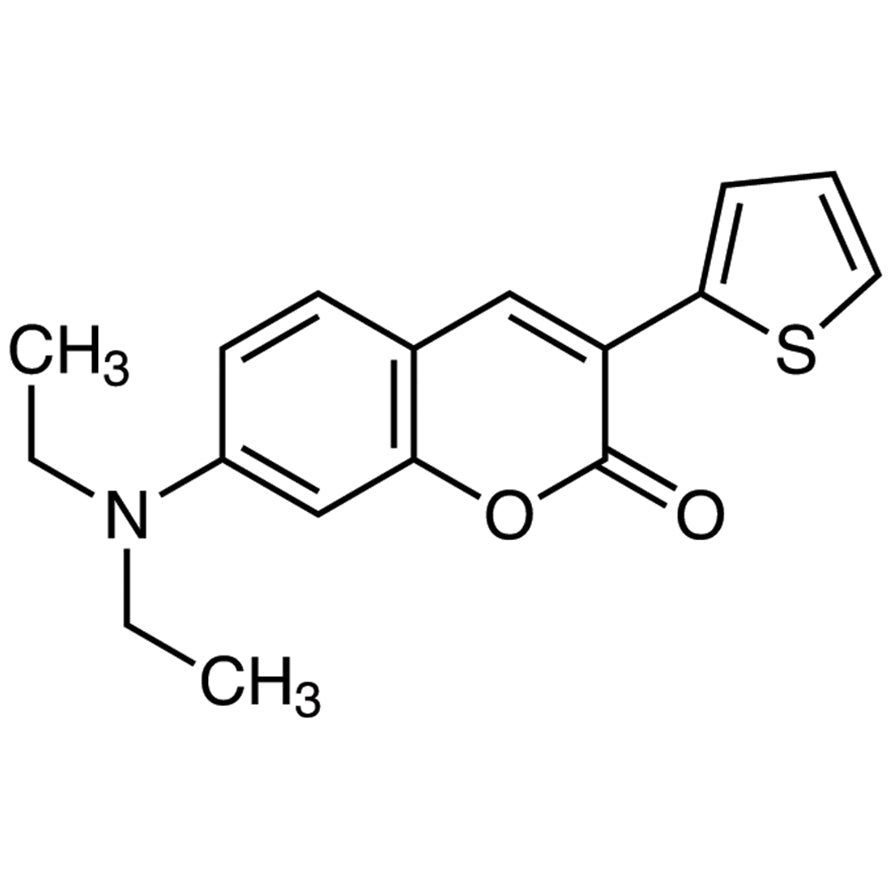
7-(Diethylamino)-3-(2-thienyl)coumarin is an organic compound widely used in scientific applications, particularly in the fields of materials science and optics. This compound belongs to the class of chromogens, which are known for their ability to absorb and emit light across various wavelengths. In the laboratory, it serves as a key component in the development of optical materials, including fluorescent coatings, optical sensors, and photonic materials. Its unique molecular structure enables it to exhibit strong fluorescence properties, making it a valuable tool for researchers working on advanced optical technologies.
The compound's excellent fluorescence characteristics, combined with its chemical stability under specific conditions, make it a preferred choice for a wide range of applications. Its ability to emit light efficiently in response to external stimuli is particularly useful in creating sensitive optical sensors and fluorescent markers. Additionally, its stability ensures that it remains effective over extended periods, reducing the need for frequent replacement. These properties make it an essential material for laboratories focused on innovation in photonics and optical engineering.
In Indonesian laboratories, this compound is commonly used in research related to optical technologies, light-sensitive sensors, and fluorescent materials. Its availability in various packaging options facilitates its use in both small-scale and larger research projects. Due to the growing demand for advanced optical materials, this compound is a sought-after resource for researchers and students in the field of materials science. Its role in supporting technological innovation makes it a critical component in modern scientific research.
Related TCI products
- TCI B2111 27425-55-4 3-(2-Benzimidazolyl)-7-(diethylamino)coumarin
- TCI B2088 38215-36-0 3-(2-Benzothiazolyl)-7-(diethylamino)coumarin
- TCI C2837 41044-12-6 7-(Diethylamino)-3-(1-methyl-2-benzimidazolyl)coumarin
- TCI D5799 139346-57-9 N-Succinimidyl 7-(Diethylamino)coumarin-3-carboxylate
- TCI B4257 155306-71-1 Coumarin 545T
- TCI C3640 53518-18-6 Coumarin 153 (purified by sublimation)
- Optical sensor development benefits from its strong fluorescence properties, enabling precise light detection and measurement in various environments.
- Fluorescent coating formulation utilizes its ability to emit light efficiently, making it ideal for creating high-performance optical materials.
- Photonic material research leverages its unique molecular structure to explore new applications in light manipulation and signal transmission.
- Light-sensitive material testing relies on its stable fluorescence response, allowing accurate analysis under controlled conditions.
- Fluorescence imaging applications take advantage of its emission characteristics for enhanced visibility and data collection in scientific studies.
| Brand | TCI |
|---|---|
| CAS number | 117850-52-9 |
| Molecular formula | — |
| Purity | — |
| Category | Materials Science > Photonic Materials and Optical Materials > Coumarin Dyes |
| Pack sizes | Available in various packaging options suitable for laboratory use |
| Physical form | Solid (exact form may vary depending on packaging) |
| Storage | Store in a cool, dry place away from direct sunlight |
This compound should be stored in a cool, dry environment to maintain its stability and optical properties. It is recommended to keep it in a sealed container to prevent exposure to moisture and air, which could affect its performance. While no specific container type is required, airtight glass or plastic containers are suitable for long-term storage. In laboratory settings, it is important to handle the compound with care, using appropriate personal protective equipment to ensure safety. Due to its fluorescent nature, it is advisable to store it away from sources of light to prevent premature degradation. Proper storage conditions help preserve its effectiveness and extend its usability in research applications.
—
Product Categories
Produk Terkait
-
3-(2-Benzimidazolyl)-7-(diethylamino)coumarin TCI B2111
Regular price From Rp 1.193.850,00Regular price -
3-(2-Benzothiazolyl)-7-(diethylamino)coumarin TCI B2088
Regular price From Rp 2.016.000,00Regular price -
7-(Diethylamino)-3-(1-methyl-2-benzimidazolyl)coumarin TCI C2837
Regular price From Rp 2.386.650,00Regular price -
N-Succinimidyl7-(Diethylamino)coumarin-3-carboxylate TCI D5799
Regular price From Rp 2.411.850,00Regular price -
Coumarin545T TCI B4257
Regular price Rp 4.929.750,00Regular price -
Coumarin153(purifiedbysublimation) TCI C3640
Regular price Rp 5.089.350,00Regular price -
Coumarin510 TCI C3072
Regular price From Rp 2.332.050,00Regular price -
Coumarin337 TCI C3063
Regular price Rp 2.094.750,00Regular price


