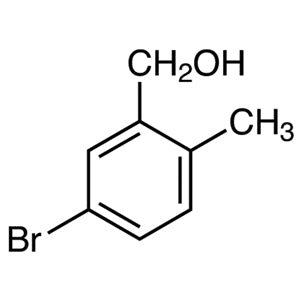
4-Chloro-2-methylbenzyl Alcohol from TCI (product code C3069) is a substituted aromatic compound from the benzyl alcohol family. Its benzene ring has a chlorine atom at position 4 and a methyl group at position 2. It is classed as a non-heterocyclic building block, a starting material that chemists use to assemble larger and more complex molecules. In organic synthesis laboratories, compounds like this one are the starting point for intermediates used in pharmaceutical, agrochemical, and materials research. The hydroxymethyl group can be converted into many other functional groups, depending on the planned synthetic route.
Chemists choose this compound because one molecule has three points of reactivity. The primary benzylic alcohol can be oxidized to an aldehyde or a carboxylic acid, converted to a benzyl halide, or turned into ethers and esters. The chlorine atom on the aromatic ring can serve as a handle for transition-metal-catalysed cross-coupling reactions under suitable conditions. The methyl group in the ortho position adds steric and electronic effects that influence the conformation and reactivity of derived molecules. Because the substitution pattern is well defined, researchers can plan regioselective transformations with more confidence and interpret their results more easily.
In Indonesian laboratories, this building block is mainly used in university organic chemistry research groups, pharmaceutical development laboratories, and research institutions working on new molecule synthesis. Postgraduate students and researchers use it to prepare series of derivatives for structure–activity relationship studies, to test new synthetic methods, or to build intermediates for multistep routes. Laboratories that work on agrochemical or functional materials development may also use it when they need a chlorinated, methylated aromatic fragment with a reactive benzylic position.
Related TCI products
- Oxidation to aldehydes and carboxylic acids: the primary benzylic alcohol is a straightforward substrate for oxidation, giving the corresponding substituted benzaldehyde or benzoic acid for further synthesis.
- Preparation of benzyl halides: the hydroxymethyl group can be converted to a benzyl halide, which then acts as an alkylating agent to introduce the 4-chloro-2-methylbenzyl fragment into other molecules.
- Ether and ester synthesis: the alcohol group reacts to form ethers and esters, so researchers can attach the substituted aromatic unit to other scaffolds or use protecting-group strategies.
- Transition-metal cross-coupling studies: the aryl chlorine atom can serve as a coupling handle under suitable catalytic conditions, which lets researchers extend the aromatic core in a controlled way.
- Pharmaceutical and agrochemical intermediate research: its defined substitution pattern makes it useful for building derivative series in structure–activity relationship studies, where small structural changes need to be tracked carefully.
| Brand | TCI (product code C3069) |
|---|---|
| CAS number | 129716-11-6 |
| Molecular formula | — |
| Purity | — |
| Category | Chemistry > Building Blocks > Non-Heterocyclic Building Blocks |
| Pack sizes | as offered by TCI for product C3069; please confirm available sizes when ordering |
| Physical form | refer to the TCI product documentation and Certificate of Analysis |
| Storage | follow the conditions stated on the TCI label and Safety Data Sheet |
Store 4-Chloro-2-methylbenzyl Alcohol in its original tightly closed container, in a cool, dry, well-ventilated area away from direct sunlight, heat sources, and strong oxidizing agents. Always follow the specific storage conditions printed on the TCI label and Safety Data Sheet. Handle the compound only in a fume hood or a well-ventilated workspace, and wear standard personal protective equipment, including a lab coat, safety glasses, and chemical-resistant gloves. Avoid inhaling dust or vapour, and avoid contact with skin and eyes. Close containers promptly after use, label any portions you transfer to other containers, and dispose of residues and waste according to your institution's chemical waste procedures.
—
Produk Terkait
-
4-Bromo-3-methylbenzylAlcohol TCI B5285
Regular price From Rp 2.359.350,00Regular priceRp 1.649.550,00Sale price From Rp 2.359.350,00 -
4-Bromo-2-methylbenzylAlcohol TCI B5231
Regular price From Rp 1.298.850,00Regular priceRp 908.250,00Sale price From Rp 1.298.850,00 -
5-Bromo-2-methylbenzylAlcohol TCI B5037
Regular price From Rp 4.240.950,00Regular priceRp 2.965.200,00Sale price From Rp 4.240.950,00 -
4-Bromo-alpha-methylbenzylAlcohol TCI B1955
Regular price From Rp 875.700,00Regular priceRp 612.150,00Sale price From Rp 875.700,00 -
3-MethylbenzylAlcohol TCI M1124
Regular price Rp 2.094.750,00Regular priceRp 1.464.750,00Sale price Rp 2.094.750,00 -
2-MethylbenzylAlcohol TCI M0887
Regular price Rp 1.378.650,00Regular priceRp 963.900,00Sale price Rp 1.378.650,00 -
4-MethylbenzylAlcohol TCI M0162
Regular price From Rp 955.500,00Regular priceRp 667.800,00Sale price From Rp 955.500,00 -
4-Hydroxy-3-methoxy-alpha-methylbenzylAlcohol TCI H1386
Regular price From Rp 2.518.950,00Regular priceRp 1.776.600,00Sale price From Rp 2.518.950,00