

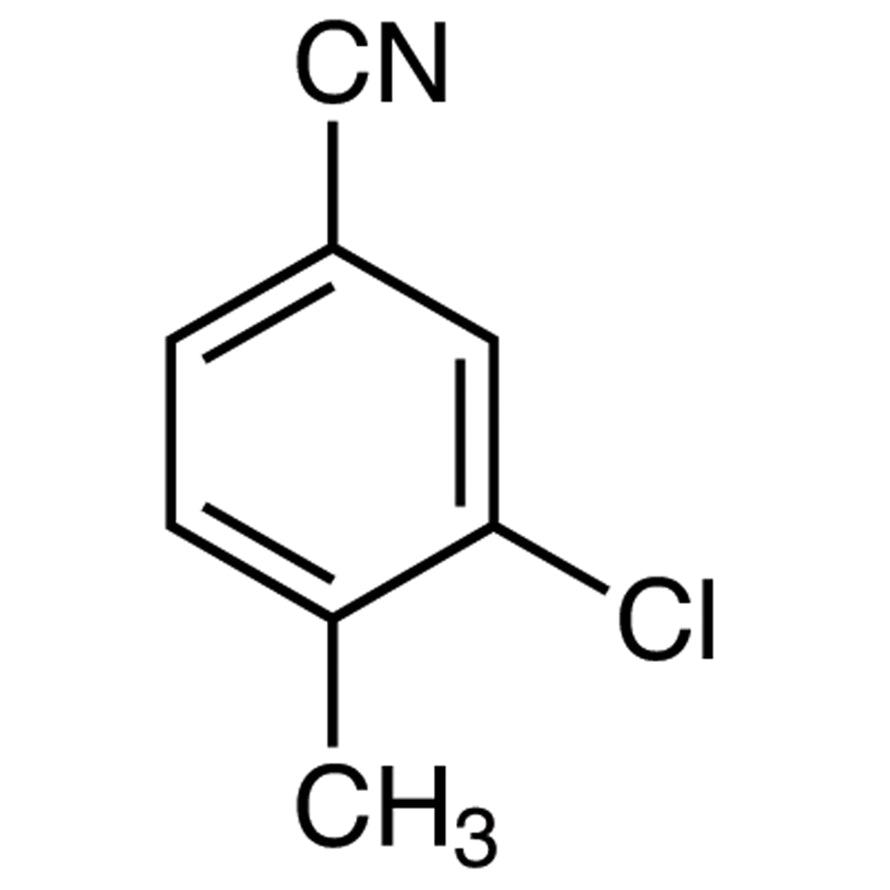
3-Chloro-4-methylbenzonitrile is a chemical compound widely used in organic reactions for the synthesis of complex molecules. It serves as a fundamental building block in chemical laboratories, offering a versatile structure that is essential in the development of aromatic and nitrile-based compounds. This compound is particularly valuable in fluorinated building blocks, where its unique properties enable it to participate in substitution and electrophilic reactions. Its role in synthetic chemistry makes it a key component for researchers aiming to create new compounds with specific functional groups.
The chemical properties of 3-Chloro-4-methylbenzonitrile, including its stability and reactivity, make it a preferred choice for various synthetic applications. The presence of both a nitrile group and a chlorine atom contributes to its reactivity and versatility in chemical reactions. These features allow it to be used in a wide range of organic transformations, making it an essential reagent in both academic and industrial research settings. Its ability to undergo multiple reaction pathways enhances its utility in the development of new materials and pharmaceutical compounds.
In Indonesian laboratories, 3-Chloro-4-methylbenzonitrile is commonly used in organic chemistry research, especially in the development of new compounds with potential applications in pharmaceuticals, materials science, and industrial chemistry. Its availability supports scientists in conducting experiments that require specific structural components, facilitating the advancement of chemical research in the region.
Related TCI products
- TCI F1123 198633-76-0 2-Fluoro-6-methylbenzonitrile
- TCI F1112 101048-76-4 2-Fluoro-4-formylbenzonitrile
- TCI F0962 147754-12-9 4-Fluoro-2-methylbenzonitrile
- TCI F0884 85070-67-3 2-Fluoro-4-methylbenzonitrile
- TCI F0747 77532-79-7 5-Fluoro-2-methylbenzonitrile
- TCI F0573 64113-84-4 2-Fluoro-5-methylbenzonitrile
- Organic synthesis applications benefit from this compound's ability to participate in substitution and electrophilic reactions, making it ideal for creating complex molecular structures.
- Pharmaceutical research utilizes its reactivity to develop new drug compounds with specific functional groups and biological activities.
- Material science applications leverage its structural versatility for the synthesis of advanced polymers and functional materials.
- Industrial chemistry projects rely on its stability and reactivity to produce specialized chemicals for various manufacturing processes.
- Academic research in chemical engineering uses it as a building block for teaching and experimental studies in synthetic chemistry.
| Brand | TCI |
|---|---|
| CAS number | 21423-81-4 |
| Molecular formula | — |
| Purity | — |
| Category | Chemistry > Building Blocks > Fluorinated Building Blocks |
| Pack sizes | Available in various quantities as per standard chemical supply practices |
| Physical form | Liquid or solid, depending on the specific product formulation |
| Storage | Store in a cool, dry place away from light and incompatible materials |
This compound should be stored in a cool, dry location, away from direct sunlight and sources of heat. It is recommended to use airtight containers made of materials compatible with its chemical properties, such as glass or high-density polyethylene. Due to its reactivity, it should be handled in a well-ventilated area, and appropriate personal protective equipment should be worn when working with it. Avoid contact with incompatible substances, and ensure that spill containment measures are in place to prevent accidental exposure. Proper storage and handling practices are essential to maintain its chemical integrity and ensure safe laboratory operations.
—
Produk Terkait
-
2-Fluoro-6-methylbenzonitrile TCI F1123
Regular price Rp 1.326.150,00Regular price -
2-Fluoro-4-formylbenzonitrile TCI F1112
Regular price Rp 2.411.850,00Regular price -
4-Fluoro-2-methylbenzonitrile TCI F0962
Regular price Rp 743.400,00Regular price -
2-Fluoro-4-methylbenzonitrile TCI F0884
Regular price From Rp 743.400,00Regular price -
5-Fluoro-2-methylbenzonitrile TCI F0747
Regular price Rp 2.942.100,00Regular price -
2-Fluoro-5-methylbenzonitrile TCI F0573
Regular price Rp 1.988.700,00Regular price -
2-Fluoro-5-formylbenzonitrile TCI C2692
Regular price From Rp 1.167.600,00Regular price -
5-Chloro-2-methylbenzonitrile TCI C3339
Regular price From Rp 610.050,00Regular price


