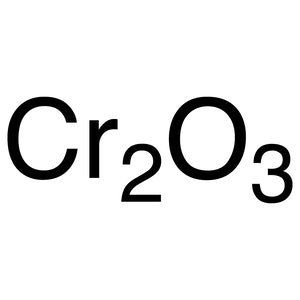
Chromium(III) Oxide (Cr₂O₃) is an inorganic compound widely utilized in laboratory settings, particularly in catalysis and inorganic chemistry. As a transition metal oxide, it plays a crucial role in various chemical reactions, especially those requiring metal-based catalysts. Its unique chemical properties make it a valuable component in synthetic processes and analytical procedures. Chromium(III) Oxide is known for its stability and versatility, making it a reliable choice for researchers in both academic and industrial environments. Its applications span across multiple disciplines, including materials science and environmental chemistry, where it contributes to the development of new compounds and the analysis of complex systems.
One of the key reasons Chromium(III) Oxide is preferred is its stable crystalline structure and moderate reactivity. It exhibits good thermal stability and high density, which are advantageous in high-temperature applications. The compound is not overly reactive under normal conditions, which enhances its safety in laboratory use. However, it can react with strong acids or bases, so careful handling is necessary. Its inertness in many environments makes it suitable for use in a wide range of chemical processes, ensuring consistent and predictable results. These properties contribute to its reliability and effectiveness in various experimental setups.
In Indonesian laboratories, Chromium(III) Oxide is commonly used in chemical research, especially in catalytic processes and analytical chemistry. It is a staple in both academic and industrial research settings, where its properties support the development of new materials and the refinement of analytical techniques. Its widespread use in Indonesia reflects its importance in advancing scientific understanding and practical applications in the field of chemistry.
TCI brochures (PDF)
- Metallic Salts 2025-11-06 · p. 6
- Transition Metal Catalysts 2026-04-10 · p. 5
- Catalytic reactions benefit from Chromium(III) Oxide due to its ability to act as a stable and efficient catalyst in redox processes.
- Inorganic synthesis often utilizes this compound for its role in stabilizing intermediates and promoting desired chemical transformations.
- Quantitative chemical analysis relies on Chromium(III) Oxide for its consistent properties and predictable behavior in analytical procedures.
- Material science research employs this compound to develop new compounds with specific physical and chemical properties.
- Environmental studies use Chromium(III) Oxide in the analysis of heavy metal compounds and their interactions in natural systems.
| Brand | TCI |
|---|---|
| CAS number | 1308-38-9 |
| Molecular formula | — |
| Purity | — |
| Category | Chemistry > Catalysis and Inorganic Chemistry > Transition Elements |
| Pack sizes | Available in various quantities as per standard laboratory supply |
| Physical form | Powder |
| Storage | Store in a cool, dry place away from moisture and strong oxidizing agents |
Chromium(III) Oxide should be stored in a cool, dry environment to maintain its stability and prevent degradation. It is recommended to use airtight containers to protect it from moisture and potential chemical interactions. Due to its moderate reactivity, it should be kept away from strong acids and bases to avoid unwanted reactions. Proper labeling and storage in a designated chemical storage area are essential for safety and accessibility. Laboratory personnel should handle the compound with care, using appropriate personal protective equipment when necessary. Regular monitoring of storage conditions ensures the compound remains in optimal condition for use in experiments.
—
Produk Terkait
-
Tris(2,4-pentanedionato)chromium(III) TCI C0336
Regular price From Rp 795.900,00Regular price -
Zirconium(IV)Oxide TCI Z0049
Regular price From Rp 848.400,00Regular price -
Yttrium(III)Oxide TCI Y0007
Regular price From Rp 955.500,00Regular price -
Vanadium(IV)Oxide TCI V0177
Regular price From Rp 1.803.900,00Regular price -
Vanadium(III)Oxide TCI V0170
Regular price From Rp 1.167.600,00Regular price -
Vanadium(V)Oxide TCI V0169
Regular price From Rp 477.750,00Regular price -
Titanium(IV)Oxide,AEROXIDE(regR)P25 TCI T4118
Regular price Rp 1.220.100,00Regular price -
Titanium(IV)Oxide,Rutile(999%,tracemetalsbasis) TCI T4019
Regular price From Rp 1.696.800,00Regular price