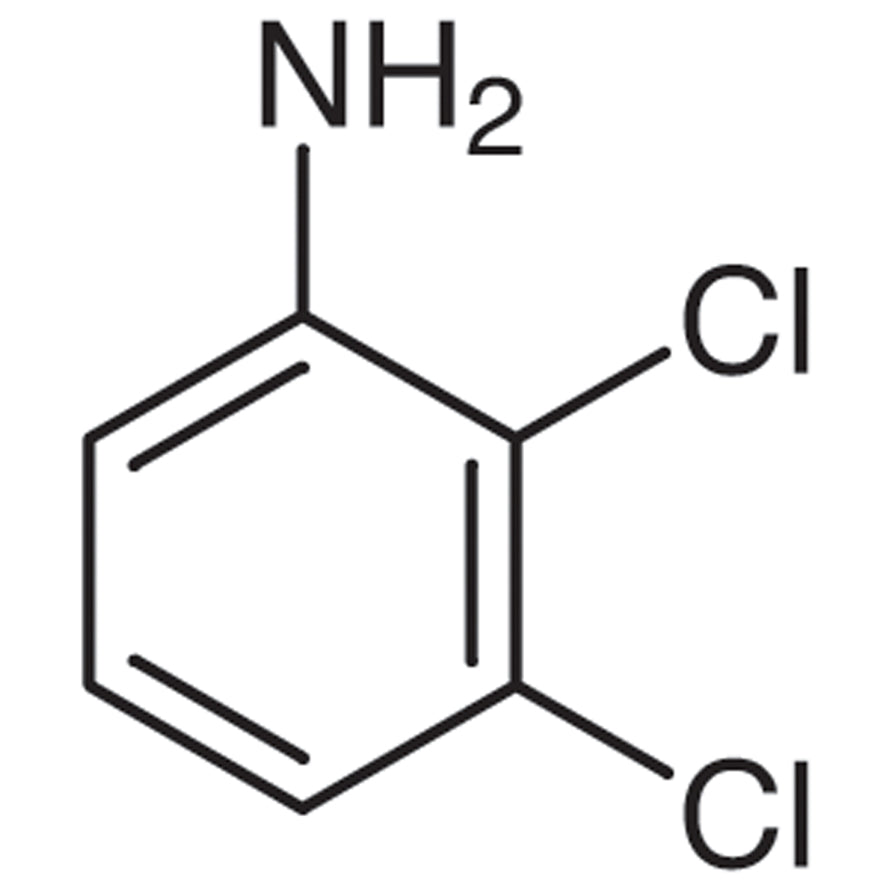
2,3-Dichloroaniline is a chemical compound widely used as a foundational building block in the synthesis of complex organic compounds. It plays a crucial role in various chemical reactions, particularly in the development of heterocyclic structures and amine derivatives. This compound is essential for researchers working in organic chemistry, pharmaceuticals, and material science, where it serves as a versatile reagent for substitution, reduction, and coupling reactions. Its unique chemical properties make it a valuable asset in the laboratory, enabling the creation of more intricate molecular structures with precise control over reactivity.
The compound's active amine group and the presence of chlorine atoms at positions 2 and 3 contribute to its distinctive chemical behavior. The chlorine substituents provide chemical stability while modifying the reactivity of the amine, allowing for more specific and controlled reactions. Additionally, its good solubility in organic solvents makes it an ideal choice for a wide range of laboratory applications. These properties ensure that 2,3-Dichloroaniline remains a preferred reagent for synthetic chemists seeking reliable and effective results.
In Indonesian laboratories, 2,3-Dichloroaniline is extensively used in chemical research, pharmaceutical development, and material science. Its availability and chemical properties make it a go-to compound for researchers aiming to explore new synthetic pathways and develop advanced materials. It supports both academic and industrial research, contributing to the growth of scientific innovation in the region.
- Organic synthesis is a key application where 2,3-Dichloroaniline is used to create complex molecules through substitution and coupling reactions.
- Pharmaceutical research benefits from its role in the development of drugs, particularly in the synthesis of heterocyclic compounds and amine derivatives.
- Material science applications rely on its chemical stability and reactivity for the production of advanced polymers and functional materials.
- Analytical chemistry uses it as a standard compound for calibration and as a reagent in various chemical assays.
- Environmental studies incorporate it in the analysis of pollutants and in the development of chemical sensors for environmental monitoring.
| Brand | TCI |
|---|---|
| CAS number | 608-27-5 |
| Molecular formula | — |
| Purity | — |
| Category | Chemistry > Building Blocks > Non-Heterocyclic Building Blocks |
| Pack sizes | Available in various quantities as per supplier specifications |
| Physical form | Solid, typically in crystalline form |
| Storage | Store in a cool, dry place away from light and incompatible substances |
2,3-Dichloroaniline should be stored in a cool, dry environment, away from direct sunlight and sources of heat. It is recommended to keep the compound in a tightly sealed container to prevent moisture absorption and contamination. Due to its chemical reactivity, it should be stored separately from strong oxidizing agents and acids to avoid potential hazardous reactions. In laboratory settings, it is important to handle the compound with appropriate personal protective equipment, such as gloves and safety goggles, to ensure safety. Proper ventilation should be maintained when working with this compound to minimize exposure to vapors. Regular inspection of storage conditions is advised to maintain its integrity and ensure safe handling in the laboratory.
—
Produk Terkait
-
2-Bromo-4,6-dichloroaniline TCI B2197
Regular price Rp 848.400,00Regular price -
3,5-Dichloroaniline TCI D0325
Regular price Rp 1.167.600,00Regular price -
3,4-Dichloroaniline TCI D0324
Regular price From Rp 664.650,00Regular price -
2,6-Dichloroaniline TCI D0323
Regular price From Rp 557.550,00Regular price -
2,5-Dichloroaniline TCI D0322
Regular price From Rp 557.550,00Regular price -
2,4-Dichloroaniline TCI D0321
Regular price From Rp 637.350,00Regular price -
3,4,5-Trichloroaniline TCI T3008
Regular price Rp 4.664.100,00Regular price -
3-Bromo-4-chloroaniline TCI B4160
Regular price Rp 1.538.250,00Regular price