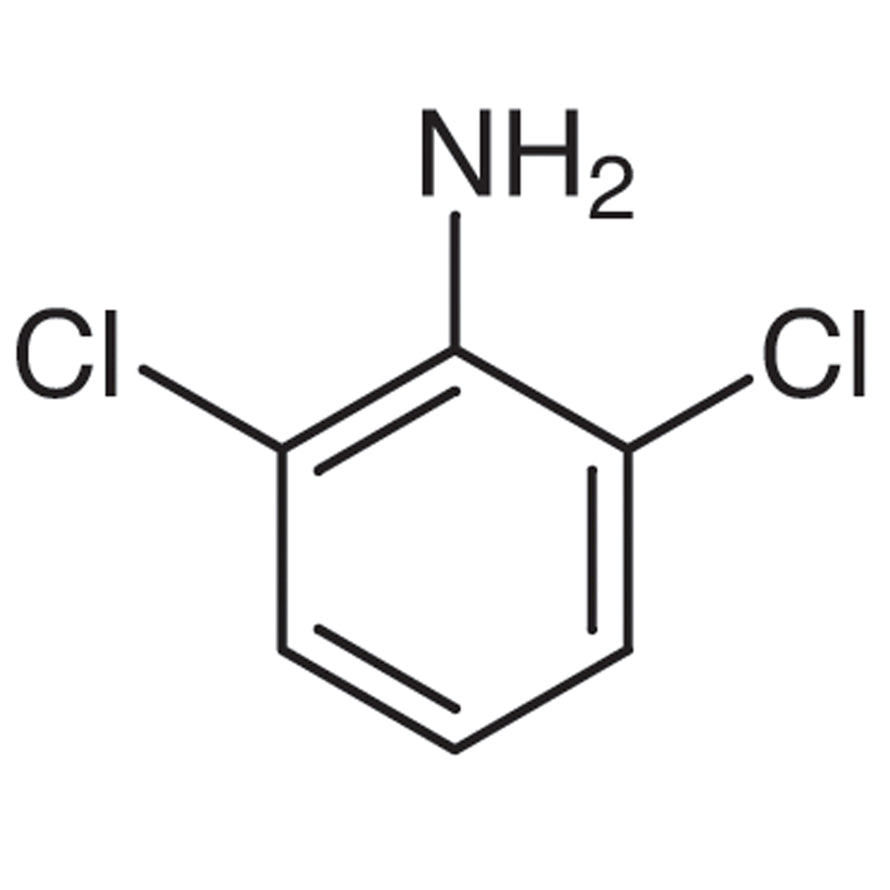
2,6-Dichloroaniline is a chemical compound widely used as a foundational building block in the synthesis of complex organic compounds. It plays a crucial role in laboratory settings, particularly in the development of new molecules with applications in pharmaceutical and organic chemistry. This compound is essential for researchers aiming to create compounds with specific functional groups, such as amines, which are vital in various chemical reactions. Its presence in synthetic pathways makes it a versatile reagent for a wide range of chemical transformations.
The compound is known for its stable molecular structure and high reactivity, which allows it to participate in substitution reactions and other chemical processes with various reagents. These properties make it a preferred choice in laboratory experiments where controlled chemical reactions are required. Its ability to interact with different reagents and its predictable behavior under various conditions contribute to its reliability in synthetic chemistry. This makes it a valuable tool for both academic and industrial research.
In Indonesian laboratories, 2,6-Dichloroaniline is commonly used in scientific research, especially in the fields of organic chemistry and pharmacology. Researchers rely on this compound to develop new substances with potential medical or industrial applications. Its role in the synthesis of bioactive compounds and its utility in chemical experimentation make it an important material for scientific advancement in the region.
- Organic synthesis applications benefit from 2,6-Dichloroaniline due to its reactivity and ability to form various derivatives, making it ideal for creating complex organic molecules.
- Pharmaceutical research utilizes this compound as a precursor in the development of new drugs, as its functional groups can be modified to produce bioactive compounds.
- Heterocyclic compound synthesis is enhanced by 2,6-Dichloroaniline, which serves as a key intermediate in the formation of ring structures essential in many pharmaceuticals.
- Analytical chemistry experiments often incorporate this compound to test reaction mechanisms and evaluate the behavior of different reagents under controlled conditions.
- Industrial chemical processes rely on 2,6-Dichloroaniline for the production of specialized chemicals, where its stability and reactivity support efficient synthesis pathways.
| Brand | TCI |
|---|---|
| CAS number | 608-31-1 |
| Molecular formula | — |
| Purity | — |
| Category | Chemistry > Building Blocks > Non-Heterocyclic Building Blocks |
| Pack sizes | Available in various quantities to meet different research needs |
| Physical form | Solid, typically in crystalline or powder form |
| Storage | Store in a cool, dry place away from direct sunlight and moisture |
2,6-Dichloroaniline should be stored in a cool, dry environment to maintain its stability and prevent degradation. It is recommended to use airtight containers to protect it from moisture and air exposure. Due to its chemical nature, it should be kept away from incompatible substances such as strong oxidizers. Proper labeling of storage containers is essential for safety and identification. Laboratory personnel should wear appropriate personal protective equipment, including gloves and safety goggles, when handling this compound. Regular inspection of storage conditions ensures the compound remains in optimal condition for use in research applications.
—
Produk Terkait
-
2-Bromo-4,6-dichloroaniline TCI B2197
Regular price Rp 848.400,00Regular price -
3,5-Dichloroaniline TCI D0325
Regular price Rp 1.167.600,00Regular price -
3,4-Dichloroaniline TCI D0324
Regular price From Rp 664.650,00Regular price -
2,5-Dichloroaniline TCI D0322
Regular price From Rp 557.550,00Regular price -
2,4-Dichloroaniline TCI D0321
Regular price From Rp 637.350,00Regular price -
2,3-Dichloroaniline TCI D0320
Regular price From Rp 584.850,00Regular price -
3,4,5-Trichloroaniline TCI T3008
Regular price Rp 4.664.100,00Regular price -
3-Bromo-4-chloroaniline TCI B4160
Regular price Rp 1.538.250,00Regular price