

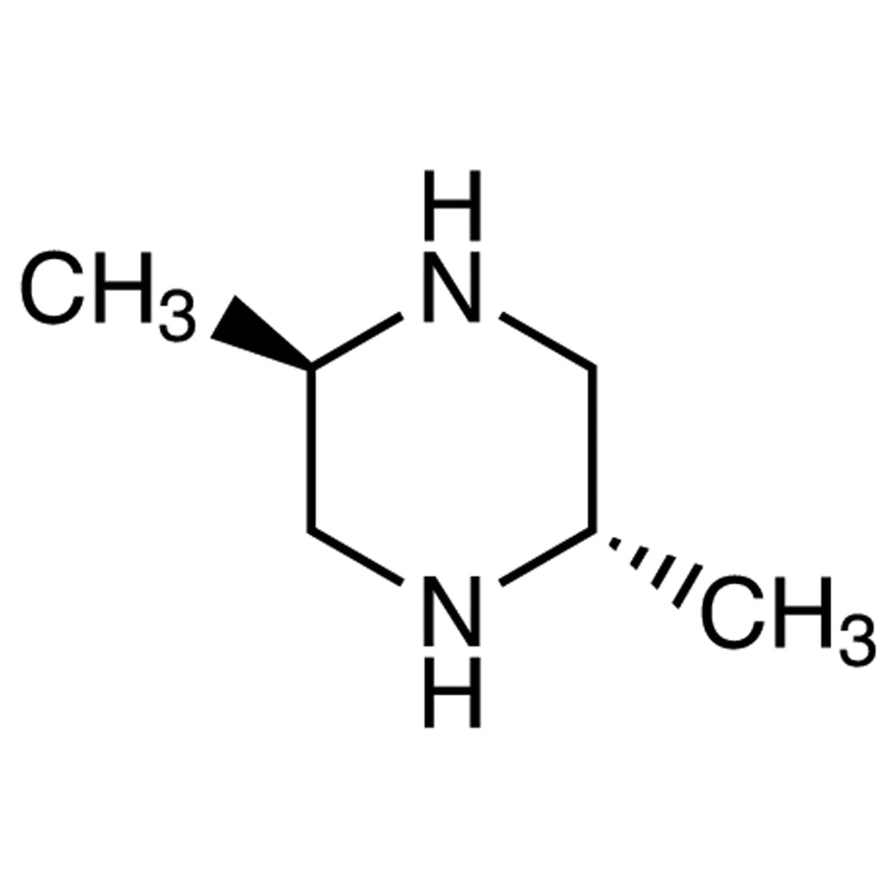
Trans-2,5-Dimethylpiperazine is a chemical compound widely used as a building block in the synthesis of heterocyclic compounds. This versatile reagent plays a crucial role in organic chemistry by enabling the formation of complex molecular structures through various reaction mechanisms. Its unique reactivity and structural stability make it an essential component in the development of pharmaceuticals, specialty chemicals, and advanced materials. In laboratory settings, it is frequently employed to facilitate substitution and cyclization reactions, contributing to the creation of compounds with diverse functional applications.
The compound’s chemical structure, featuring a piperazine ring with two methyl groups at positions 2 and 5, provides it with enhanced reactivity and compatibility in a wide range of synthetic pathways. Its solubility in organic solvents such as ethyl acetate and acetone further simplifies handling and purification processes in the lab. These properties, combined with its chemical stability, make it a preferred choice for researchers aiming to produce high-quality, functional molecules. The compound’s ability to participate in multiple reaction types also enhances its utility across different experimental designs.
In Indonesian laboratories, trans-2,5-Dimethylpiperazine is extensively used in both academic and industrial research. It supports the development of new compounds with potential applications in medicine, agriculture, and materials science. Its availability in various packaging formats allows for flexible use in both small-scale and medium-scale experiments. As a result, it remains a key reagent in the chemical research landscape of Indonesia, supporting innovation and discovery in multiple scientific fields.
Related TCI products
- TCI D6456 639068-43-2 tert-Butyl 3,5-Dimethylpiperazine-1-carboxylate (cis- and trans- mixture)
- TCI D6463 259808-67-8 tert-Butyl 3,3-Dimethylpiperazine-1-carboxylate
- TCI D2360 21655-48-1 cis-2,6-Dimethylpiperazine
- TCI D0787 106-58-1 N,N'-Dimethylpiperazine
- TCI A3772 4572-03-6 3-(4-Methylpiperazin-1-yl)propan-1-amine
- TCI A1192 6928-85-4 1-Amino-4-methylpiperazine
- Pharmaceutical research utilizes trans-2,5-Dimethylpiperazine for the synthesis of bioactive compounds due to its reactivity and structural versatility.
- Organic chemistry experiments benefit from its role in substitution and cyclization reactions, enabling the formation of complex heterocyclic structures.
- Material science applications leverage its chemical stability to develop advanced polymers and functional materials with tailored properties.
- Academic research in Indonesian universities relies on this compound to support the development of new chemical entities for medicinal and industrial use.
- Industrial chemical synthesis processes incorporate it as a building block to produce specialty chemicals with specific functional groups and molecular architectures.
| Brand | TCI |
|---|---|
| CAS number | 2815-34-1 |
| Molecular formula | — |
| Purity | — |
| Category | Chemistry > Building Blocks > Heterocyclic Building Blocks |
| Pack sizes | Available in various sizes to suit different experimental needs |
| Physical form | Liquid |
| Storage | Store in a cool, dry place away from direct sunlight and incompatible substances |
Trans-2,5-Dimethylpiperazine should be stored in a cool, dry environment to maintain its chemical stability and prevent degradation. It is recommended to keep the compound in tightly sealed containers made of glass or high-density polyethylene to minimize exposure to air and moisture. Due to its solubility in organic solvents, it should be stored away from incompatible materials such as strong oxidizing agents or reactive metals. In laboratory settings, proper ventilation should be ensured when handling the compound to avoid inhalation of vapors. Always use appropriate personal protective equipment, including gloves and safety goggles, to ensure safe handling. Regular inspection of storage conditions is advised to maintain optimal chemical integrity and safety.
—
Produk Terkait
-
tert-Butyl3,5-Dimethylpiperazine-1-carboxylate(cis-andtrans-mixture) TCI D6456
Regular price From Rp 1.458.450,00Regular price -
tert-Butyl3,3-Dimethylpiperazine-1-carboxylate TCI D6463
Regular price From Rp 1.431.150,00Regular price -
cis-2,6-Dimethylpiperazine TCI D2360
Regular price From Rp 1.060.500,00Regular price -
N,N'-Dimethylpiperazine TCI D0787
Regular price From Rp 848.400,00Regular price -
3-(4-Methylpiperazin-1-yl)propan-1-amine TCI A3772
Regular price From Rp 2.359.350,00Regular price -
1-Amino-4-methylpiperazine TCI A1192
Regular price From Rp 1.908.900,00Regular price -
4-Methylpiperazine-1-carbaldehyde TCI M3738
Regular price From Rp 1.644.300,00Regular price -
1-Methylpiperazin-2-one TCI M3684
Regular price From Rp 1.485.750,00Regular price


