

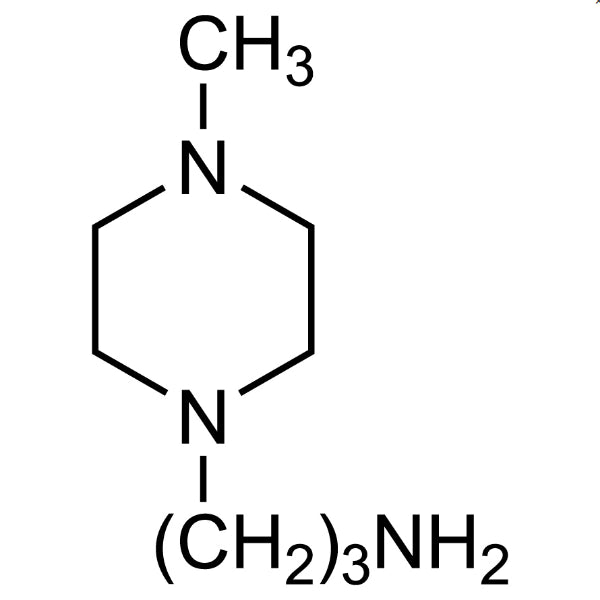
3-(4-Methylpiperazin-1-yl)propan-1-amine is a versatile organic compound widely used in laboratory settings for its role in the synthesis of complex molecules. As a heterocyclic building block, it plays a crucial part in the development of compounds with specific biological activities. This compound is particularly valuable in organic chemistry research, where its reactivity and structural adaptability make it a preferred choice for creating new chemical entities. Its application spans multiple scientific disciplines, including pharmaceutical and biochemical research.
The compound's unique structure, combining a piperazine ring with a propan-1-amine chain, provides both stability and flexibility in chemical reactions. This allows it to participate in various synthetic pathways, enabling the formation of new bonds and the creation of diverse molecular architectures. Its reactivity makes it suitable for a wide range of chemical transformations, which is why it is frequently used in both academic and industrial research environments. The ability to form new chemical bonds is a key factor in its popularity among chemists working on complex molecule synthesis.
In Indonesian laboratories, this compound is a staple in chemical research, particularly in the fields of pharmacology and biochemistry. It is commonly used in the development of new drugs and in the synthesis of compounds with specific pharmacological properties. Many research institutions and universities rely on this compound for their experimental work, contributing to advancements in both scientific understanding and practical applications in medicine and chemistry.
Related TCI products
- TCI M3597 934-98-5 2-(4-Methylpiperazin-1-yl)ethan-1-amine
- TCI M3176 571189-49-6 5-(4-Methylpiperazin-1-yl)pyridin-2-amine
- TCI M3684 59702-07-7 1-Methylpiperazin-2-one
- TCI A1192 6928-85-4 1-Amino-4-methylpiperazine
- TCI M3738 7556-55-0 4-Methylpiperazine-1-carbaldehyde
- TCI M2499 5464-12-0 4-Methylpiperazine-1-ethanol
- Synthesis of heterocyclic compounds for the development of new pharmaceuticals due to its structural versatility and reactivity.
- Organic chemistry research where the compound serves as a key building block for creating complex molecular structures.
- Pharmacological studies involving the design of compounds with specific biological activities and therapeutic potential.
- Biochemical experiments requiring the formation of new chemical bonds and the synthesis of bioactive molecules.
- Drug discovery programs focused on the creation of compounds with targeted pharmacological effects and improved therapeutic profiles.
| Brand | TCI |
|---|---|
| CAS number | 4572-03-6 |
| Molecular formula | — |
| Purity | — |
| Category | Chemistry > Building Blocks > Heterocyclic Building Blocks |
| Pack sizes | Available in various quantities as per standard laboratory supply formats |
| Physical form | Solid or liquid, depending on the specific formulation |
| Storage | Store in a cool, dry place away from direct sunlight and moisture |
This compound should be stored in a cool, dry environment to maintain its chemical integrity. It is recommended to keep it in a sealed container to prevent exposure to moisture and air. Proper ventilation is essential when handling the material to minimize inhalation risks. The container should be made of a material compatible with the compound’s chemical properties, such as glass or high-density polyethylene. Avoid contact with incompatible substances to prevent unwanted reactions. Always follow standard laboratory safety protocols when working with this compound to ensure a safe and controlled environment.
—
Produk Terkait
-
2-(4-Methylpiperazin-1-yl)ethan-1-amine TCI M3597
Regular price Rp 1.538.250,00Regular priceRp 1.090.950,00Sale price Rp 1.538.250,00 -
5-(4-Methylpiperazin-1-yl)pyridin-2-amine TCI M3176
Regular price From Rp 2.464.350,00Regular priceRp 1.738.800,00Sale price From Rp 2.464.350,00 -
1-Methylpiperazin-2-one TCI M3684
Regular price From Rp 1.538.250,00Regular priceRp 1.090.950,00Sale price From Rp 1.538.250,00 -
1-Amino-4-methylpiperazine TCI A1192
Regular price From Rp 1.961.400,00Regular priceRp 1.387.050,00Sale price From Rp 1.961.400,00 -
4-Methylpiperazine-1-carbaldehyde TCI M3738
Regular price From Rp 1.696.800,00Regular priceRp 1.202.250,00Sale price From Rp 1.696.800,00 -
4-Methylpiperazine-1-ethanol TCI M2499
Regular price From Rp 1.298.850,00Regular priceRp 924.000,00Sale price From Rp 1.298.850,00 -
4-(4-Methylpiperazinyl)benzoicAcid TCI M2267
Regular price From Rp 1.220.100,00Regular priceRp 868.350,00Sale price From Rp 1.220.100,00 -
4-(4-Methylpiperazinyl)benzaldehyde TCI M1624
Regular price From Rp 2.571.450,00Regular priceRp 1.813.350,00Sale price From Rp 2.571.450,00


