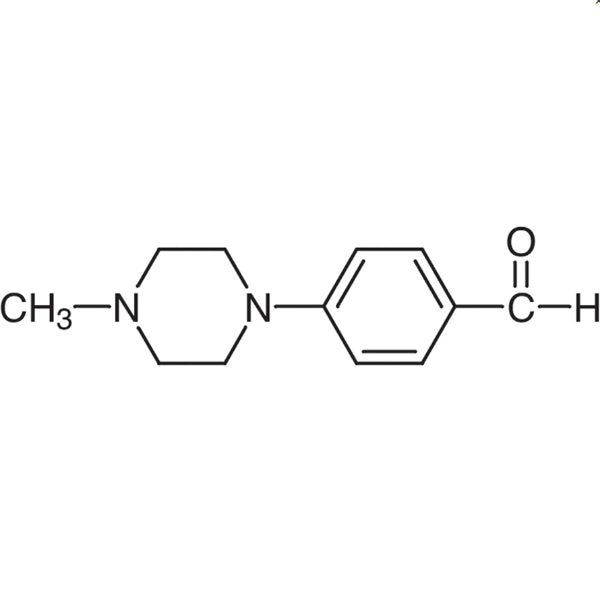
4-(4-Methylpiperazinyl)benzaldehyde is a chemical compound widely used as a building block in the synthesis of heterocyclic compounds. This versatile reagent plays a crucial role in organic chemistry laboratories, where it serves as a foundational element for constructing complex molecular structures. Its unique molecular structure combines an aldehyde group with a modified piperazine ring, making it an essential tool for researchers aiming to develop new chemical entities. Due to its reactivity and functional group versatility, it is frequently employed in the creation of bioactive compounds, including pharmaceuticals and industrial chemicals.
The compound’s high reactivity and ability to participate in various chemical reactions make it a preferred choice for synthetic chemists. It can readily undergo substitution, condensation, and chain reactions, allowing for the formation of a wide range of derivatives. Additionally, its stability under controlled laboratory conditions ensures reliable performance during synthesis processes. These properties make it a valuable asset in both academic and industrial research settings, where precision and reproducibility are paramount.
In Indonesian laboratories, 4-(4-Methylpiperazinyl)benzaldehyde is commonly used in chemical, pharmaceutical, and industrial research. Its application spans across multiple disciplines, including drug discovery, material science, and chemical engineering. Researchers in Indonesia rely on this compound to advance their work in developing new compounds with potential therapeutic or industrial applications. Its availability and chemical properties make it a key component in the toolkit of many Indonesian scientists.
- Organic synthesis of heterocyclic compounds due to its reactive aldehyde and piperazine functionalities.
- Development of pharmaceuticals and bioactive molecules through functional group modification and substitution reactions.
- Creation of industrial chemicals by extending molecular structures with diverse functional groups.
- Research in chemical engineering for the production of advanced materials and polymers.
- Support for academic studies in medicinal chemistry and drug design through compound derivatization.
| Brand | TCI |
|---|---|
| CAS number | 27913-99-1 |
| Molecular formula | — |
| Purity | — |
| Category | Chemistry > Building Blocks > Heterocyclic Building Blocks |
| Pack sizes | Available in various quantities as per supplier specifications |
| Physical form | Solid or liquid depending on formulation |
| Storage | Store in a cool, dry place away from light and moisture |
This compound should be stored in a cool, dry environment, away from direct light and moisture to maintain its chemical stability. It is recommended to use airtight containers made of glass or high-density polyethylene to prevent contamination and degradation. Due to its reactivity, it should be handled in a well-ventilated laboratory setting, with appropriate personal protective equipment such as gloves and goggles. Avoid exposure to incompatible substances like strong oxidizing agents. Proper labeling and storage conditions are essential to ensure safety and maintain the compound’s integrity during experimental use.
—
Produk Terkait
-
4-(4-Methylpiperazinyl)benzoicAcid TCI M2267
Regular price From Rp 1.167.600,00Regular price -
3-(4-Methylpiperazin-1-yl)propan-1-amine TCI A3772
Regular price From Rp 2.359.350,00Regular price -
3-(4-Methyl-1-piperazinyl)aniline TCI A2714
Regular price From Rp 1.008.000,00Regular price -
1-Amino-4-methylpiperazine TCI A1192
Regular price From Rp 1.908.900,00Regular price -
4-(1-Piperazinyl)benzonitrile TCI P2449
Regular price From Rp 2.597.700,00Regular price -
2-(1-Piperazinyl)benzonitrile TCI P2448
Regular price Rp 2.068.500,00Regular price -
1-Methylpiperazin-2-one TCI M3684
Regular price From Rp 1.485.750,00Regular price -
2-(4-Methylpiperazin-1-yl)ethan-1-amine TCI M3597
Regular price Rp 1.485.750,00Regular price