

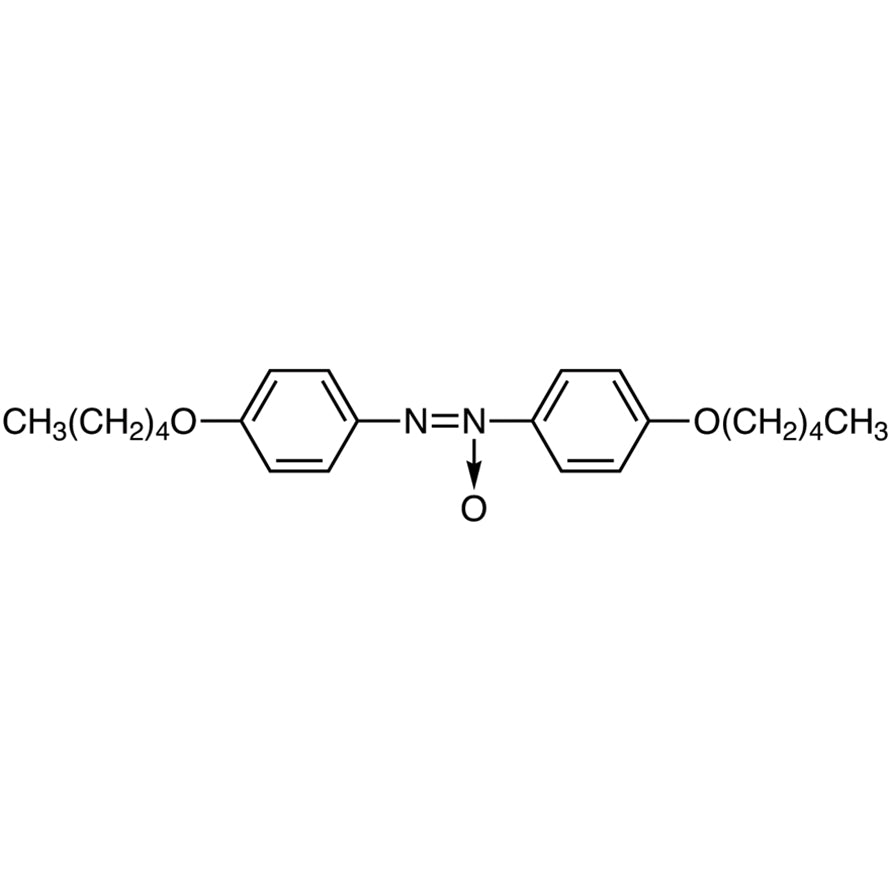
4,4'-Diamyloxyazoxybenzene is a chemical compound widely used in electronic materials research, particularly in the field of liquid crystal (LC) materials. This compound plays a crucial role in laboratory settings where the development of advanced optical and electronic materials is required. It is commonly employed in the formulation of liquid crystal materials, which are essential in the creation of high-performance displays and optical devices. Its unique molecular structure enables it to function as an active component in liquid crystal systems, contributing to their responsiveness to environmental changes such as temperature and electric fields.
The compound is valued for its stable optical properties and complex molecular structure, which make it ideal for applications requiring precision and consistency. These characteristics allow it to maintain performance under various experimental conditions, making it a reliable choice for researchers working on sensitive material systems. Its optical stability ensures that it remains effective in long-term studies, supporting the development of advanced technologies in both academic and industrial research environments.
In Indonesian laboratories, 4,4'-Diamyloxyazoxybenzene is utilized by researchers in higher education institutions and research organizations. Its application is critical in the pursuit of technological innovation, especially in the development of new materials for display technologies and optical sensors. The compound supports ongoing efforts to enhance the capabilities of electronic materials, aligning with Indonesia’s growing demand for advanced scientific research and technological advancement.
TCI brochures (PDF)
- Liquid Crystal Materials 2026-04-01 · p. 9
Related TCI products
- TCI A1065 6421-04-1 Diethyl Azoxybenzene-4,4'-dicarboxylate
- TCI D1094 23315-55-1 4,4'-Dipropoxyazoxybenzene
- TCI A0554 1562-94-3 4,4'-Azoxydianisole
- TCI T3756 132123-45-6 3,4,5-Trifluorophenyl trans,trans-4'-Propylbicyclohexyl-4-carboxylate
- TCI B5364 208709-55-1 1-Butoxy-2,3-difluoro-4-(trans-4-propylcyclohexyl)benzene
- TCI B5356 174063-87-7 1,4-Bis[4-(3-acryloyloxypropoxy)benzoyloxy]-2-methylbenzene
- Liquid Crystal Display Development: This compound is essential for formulating LC materials used in advanced display technologies, providing the necessary optical and electronic properties required for high-performance screens.
- Optical Sensor Fabrication: Its stable optical characteristics make it suitable for use in optical sensors, where precise light interaction is critical for accurate measurements and detection.
- Material Science Research: It is widely used in material science studies to investigate the behavior of liquid crystal materials under different environmental conditions, aiding in the development of new materials.
- Electronic Device Prototyping: Researchers use this compound to create prototypes of electronic devices that rely on liquid crystal properties for functionality, such as tunable optical components.
- Academic Research Projects: It supports a wide range of academic research initiatives focused on exploring the potential of liquid crystal materials in various technological applications.
| Brand | TCI |
|---|---|
| CAS number | 19482-05-4 |
| Molecular formula | — |
| Purity | — |
| Category | Materials Science > Electronic Materials > Liquid Crystal (LC) Materials |
| Pack sizes | As per supplier specifications |
| Physical form | Solid (as per standard product description) |
| Storage | Store in a cool, dry place away from light and moisture |
This compound should be stored in a cool, dry environment, away from direct sunlight and moisture to maintain its stability and effectiveness. It is recommended to use airtight containers made of materials such as glass or high-density polyethylene to prevent contamination and degradation. In laboratory settings, it should be handled with care using appropriate personal protective equipment, including gloves and safety goggles, to ensure safety. Due to its chemical nature, it should be kept in a well-ventilated area and stored separately from incompatible substances. Proper labeling and storage practices are essential to prevent accidental exposure and ensure safe handling during experiments.
—
Produk Terkait
-
DiethylAzoxybenzene-4,4'-dicarboxylate TCI A1065
Regular price Rp 4.531.800,00Regular price -
4,4'-Dipropoxyazoxybenzene TCI D1094
Regular price Rp 6.545.700,00Regular priceRp 4.576.950,00Sale price Rp 6.545.700,00 -
4,4'-Azoxydianisole TCI A0554
Regular price From Rp 1.458.450,00Regular price -
3,4,5-Trifluorophenyltrans,trans-4'-Propylbicyclohexyl-4-carboxylate TCI T3756
Regular price Rp 1.483.650,00Regular priceRp 1.053.150,00Sale price Rp 1.483.650,00 -
1-Butoxy-2,3-difluoro-4-(trans-4-propylcyclohexyl)benzene TCI B5364
Regular price Rp 1.696.800,00Regular priceRp 1.186.500,00Sale price Rp 1.696.800,00 -
1,4-Bis[4-(3-acryloyloxypropoxy)benzoyloxy]-2-methylbenzene TCI B5356
Regular price Rp 1.538.250,00Regular priceRp 1.090.950,00Sale price Rp 1.538.250,00 -
4-(trans-4-Butylcyclohexyl)benzonitrile TCI B4924
Regular price Rp 848.400,00Regular priceRp 609.000,00Sale price Rp 848.400,00 -
4-Butyl-4'-cyanobiphenyl TCI B4923
Regular price Rp 1.326.150,00Regular priceRp 942.900,00Sale price Rp 1.326.150,00


![174063-87-7 1,4-Bis[4-(3-acryloyloxypropoxy)benzoyloxy]-2-methylbenzene - AMI Scientific](http://amiscientific.com/cdn/shop/files/TCI2510B5356.jpg?v=1768815782&width=533)

