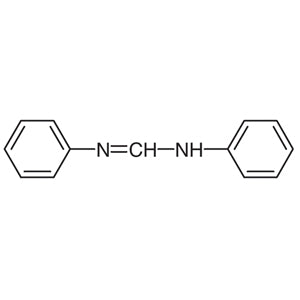
N,N’-Diphenylformamidine is a chemical compound widely used in organic synthesis reactions within laboratory settings. It serves as a key building block for the development of complex organic molecules, including pharmaceuticals, industrial chemicals, and specialty compounds. Its molecular structure consists of two phenyl groups attached to a formamidine core, making it a versatile intermediate in various synthetic pathways. This compound is particularly valued for its ability to participate in substitution, coupling, and condensation reactions, which are fundamental in the synthesis of a wide range of chemical products.
The chemical properties of N,N’-Diphenylformamidine make it a preferred choice in laboratory applications. It exhibits good chemical stability and is non-corrosive, ensuring safe handling under normal laboratory conditions. Its relatively high melting point allows it to remain in solid form, which enhances its usability in reactions requiring elevated temperatures. Additionally, its inert nature contributes to its reliability as a reagent, minimizing unwanted side reactions during synthesis processes.
In Indonesian laboratories, N,N’-Diphenylformamidine is commonly used in organic chemistry research, particularly in academic and research institutions. It plays a crucial role in the development of new chemical compounds and is often incorporated into experimental protocols for teaching and advanced research. Its availability through suppliers like AMI Scientific ensures that it remains accessible to both educational and industrial research sectors in Indonesia.
- Organic synthesis reactions where N,N’-Diphenylformamidine acts as a versatile building block for creating complex molecular structures.
- Coupling reactions that require a stable and reactive intermediate for the formation of new chemical bonds.
- Condensation reactions where the compound’s molecular structure facilitates the formation of larger organic molecules.
- Research in pharmaceutical development, where it is used to synthesize potential drug candidates and active pharmaceutical ingredients.
- Educational experiments in chemistry laboratories, where it serves as a key reagent for teaching synthetic methods and reaction mechanisms.
| Brand | TCI |
|---|---|
| CAS number | 622-15-1 |
| Molecular formula | — |
| Purity | — |
| Category | Chemistry > Building Blocks > Non-Heterocyclic Building Blocks |
| Pack sizes | Available in various quantities as per supplier specifications |
| Physical form | Solid |
| Storage | Store in a cool, dry place away from direct sunlight and moisture |
N,N’-Diphenylformamidine should be stored in a cool, dry environment to maintain its chemical stability. It is recommended to keep it in a sealed container to prevent exposure to moisture and air, which could potentially affect its integrity. While it is non-corrosive, it should be handled with standard laboratory precautions to avoid direct contact with skin or inhalation of vapors. Proper ventilation is advised during handling to ensure a safe working environment. The compound is stable under normal storage conditions and does not require refrigeration unless specified otherwise. Always follow standard safety protocols when working with chemical reagents in a laboratory setting.
—
Produk Terkait
-
2,3-Bis(2,6-diisopropylphenylimino)butane TCI B5606
Regular price From Rp 2.942.100,00Regular price -
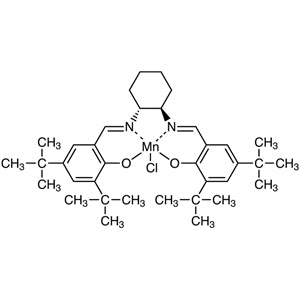
(R,R)-(-)-N,N'-Bis(3,5-di-tert-butylsalicylidene)-1,2-cyclohexanediaminomanganese(III)Chloride TCI B5613
Regular price Rp 3.127.950,00Regular price -
(R,R)-N,N'-Bis(3,5-di-tert-butylsalicylidene)-1,2-cyclohexanediaminocobalt(II) TCI B5732
Regular price From Rp 1.670.550,00Regular price -
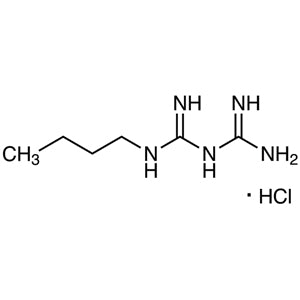
BuforminHydrochloride TCI B6007
Regular price From Rp 1.961.400,00Regular price -
2-tert-Butyl-1,1,3,3-tetramethylguanidine TCI B6052
Regular price From Rp 1.565.550,00Regular price -
Boc-Arg-OH TCI B6362
Regular price From Rp 903.000,00Regular price -
6,6'-[[Ethane-1,2-diylbis(azaneylylidene)]bis(methaneylylidene)]bis(2,4-di-tert-butylphenol) TCI B6501
Regular price Rp 3.287.550,00Regular price -
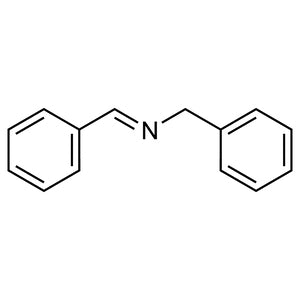
(E)-N-Benzyl-1-phenylmethanimine TCI B6850
Regular price From Rp 2.862.300,00Regular price





![6,6'-[[Ethane-1,2-diylbis(azaneylylidene)]bis(methaneylylidene)]bis(2,4-di-tert-butylphenol) (CAS 103595-81-9) - TCI B6501 - AMI Scientific](http://amiscientific.com/cdn/shop/files/TCI2510B6501.jpg?v=1767093755&width=533)